Sign In Start Free Trial
Account

Add to playlist

Create a Playlist

Modal Close icon
You need to login to use this feature.
  • Book Overview & Buying jQuery 2.0 Development Cookbook
  • Table Of Contents Toc
  • Feedback & Rating feedback
jQuery 2.0 Development Cookbook

jQuery 2.0 Development Cookbook

By : Leon Revill
4.2 (12)
close
close
jQuery 2.0 Development Cookbook

jQuery 2.0 Development Cookbook

4.2 (12)
By: Leon Revill

Overview of this book

Taking a recipe-based approach, this book presents numerous practical examples that you can use directly in your applications. The book covers the essential issues you will face while developing your web applications and gives you solutions to them. The recipes in this book are written in a manner that rapidly takes you from beginner to expert level. This book is for web developers of all skill levels. Although some knowledge of JavaScript, HTML, and CSS is required, this Cookbook will teach jQuery newcomers all the basics required to move on to the more complex examples of this book, which will benefit the more seasoned jQuery developer. If you want to learn how to create modern website features quickly, using best practice techniques, then this book is for you.
Table of Contents (12 chapters)
close
close
11
Index

Populating list elements

List elements are commonly used around the Web; they can be used to display search results, menus, and navigational items to name a few. Thanks to CSS, they no longer need to be boring, and it is possible to style list elements to make your data beautiful.

With jQuery, it is possible to populate a list element dynamically. This can be done directly from a JavaScript array via an AJAX response, with data from a web server or some other source.

Getting ready

Create a blank HTML document named recipe-9.html, and ensure that it is saved to a location where the latest version of jQuery can be included.

How to do it…

Learn how to dynamically populate a list with jQuery by performing each of the following recipes:

  1. In order to demonstrate how you can use jQuery to populate a list element, we will create a JavaScript array of objects. Add the following HTML and JavaScript code to recipe-9.html, which you have just created:
    <!DOCTYPE html>
    <html>
    <head>
       <title>Populating list elements</title>
       <script src="jquery.min.js"></script>
       <script type="text/javascript">
          var names = [
             {
                id: 1,
                firstname: 'Leon',
                lastname: 'Revill'
             },
             {
                id: 2,
                firstname: 'Allyce',
                lastname: 'Wolverson'
             },
             {
                id: 3,
                firstname: 'Harry',
                lastname: 'Round'
             },
                {
                   id: 4,
                   firstname: 'Chris',
                   lastname: 'Wilshaw'
                }
             ];
             $(function(){
    
          });
       </script>
    </head>
    <body>
        <ul id="namelist"></ul>
    </body>
    </html>

    Note

    At the top of our JavaScript code, we have created an array of objects which includes a set of names. We are going to use this array to populate the list element #namelist within the HTML code.

  2. Add the following JavaScript within $(function(){});, just under the JavaScript array. This JavaScript will use the objects within the JavaScript array we created in the Getting ready section to populate the list element on our page.
    $.each(names, function(index, obj){
    $('#namelist').append("<li>#" + obj.id + " " + obj.firstname + " " + obj.lastname + "</li>");
    });

How it works…

We use jQuery's $.each() function to loop through each of the JavaScript objects within the names array. Then, for each of these objects, we can create a <li> element and insert the values of the id, firstname, and lastname variables. Finally, we can use the jQuery append() function to append the list element to the end of the unordered list.

Within the $.each() function, the first parameter is the array we wish to iterate through and the second parameter is the function we wish to execute for each of the objects within the names array. The specified function also has two arguments: index and obj. The index argument will contain the current array index of the JavaScript object, and the obj variable will contain the actual JavaScript object. Both these variables are available within the specified callback function.

We are then able to reference obj.propertyName (replace propertyName with a property of the object) in order to access specific parts of the object we wish to use. By doing this, we construct a string and pass it to the append() function, which then appends it to the specified #nameslist unordered list.

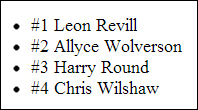
Open the HTML page within the browser, and you should see the list populated with the names from the JavaScript array, illustrated as follows:

How it works…

See also

  • Creating DOM elements
  • Re-using DOM elements
Visually different images
CONTINUE READING
83
Tech Concepts
36
Programming languages
73
Tech Tools
Icon Unlimited access to the largest independent learning library in tech of over 8,000 expert-authored tech books and videos.
Icon Innovative learning tools, including AI book assistants, code context explainers, and text-to-speech.
Icon 50+ new titles added per month and exclusive early access to books as they are being written.
jQuery 2.0 Development Cookbook
notes
bookmark Notes and Bookmarks search Search in title playlist Add to playlist font-size Font size

Change the font size

margin-width Margin width

Change margin width

day-mode Day/Sepia/Night Modes

Change background colour

Close icon Search
Country selected

Close icon Your notes and bookmarks

Confirmation

Modal Close icon
claim successful

Buy this book with your credits?

Modal Close icon
Are you sure you want to buy this book with one of your credits?
Close
YES, BUY

Submit Your Feedback

Modal Close icon
Modal Close icon
Modal Close icon