Sign In Start Free Trial
Account

Add to playlist

Create a Playlist

Modal Close icon
You need to login to use this feature.
  • Book Overview & Buying MEAN Blueprints
  • Table Of Contents Toc
  • Feedback & Rating feedback
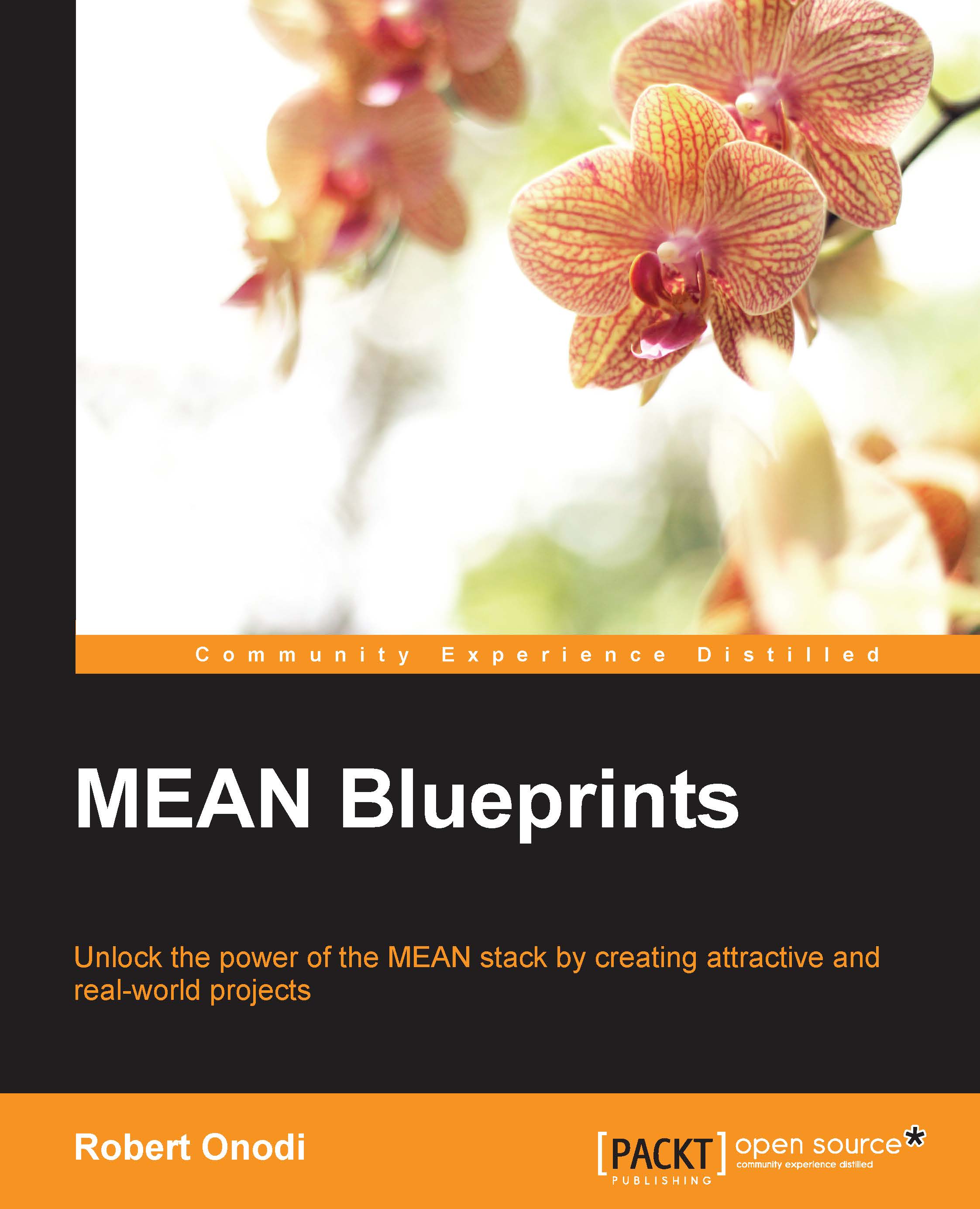
MEAN Blueprints

MEAN Blueprints

By : Onodi
3 (1)
close
close
MEAN Blueprints

MEAN Blueprints

3 (1)
By: Onodi

Overview of this book

The MEAN stack is a combination of the most popular web development frameworks available—MongoDB, Angular, Express, and Node.js used together to offer a powerful and comprehensive full stack web development solution. It is the modern day web dev alternative to the old LAMP stack. It works by allowing AngularJS to handle the front end, and selecting Mongo, Express, and Node to handle the back-end development, which makes increasing sense to forward-thinking web developers. The MEAN stack is great if you want to prototype complex web applications. This book will enable you to build a better foundation for your AngularJS apps. Each chapter covers a complete, single, advanced end-to-end project. You’ll learn how to build complex real-life applications with the MEAN stack and few more advanced projects. You will become familiar with WebSockets and build real-time web applications, as well as create auto-destructing entities. Later, we will combine server-side rendering techniques with a single page application approach. You’ll build a fun project and see how to work with monetary data in Mongo. You will also find out how to a build real-time e-commerce application. By the end of this book, you will be a lot more confident in developing real-time, complex web applications using the MEAN stack.
Table of Contents (8 chapters)
close
close
7
Index

Authenticating users


In the previous chapter, we used session-based authentication. For this chapter, we are going to explore a different solution—using access tokens to authenticate our users.

Access tokens are widely used for RESTful APIs. Because we are building our application with the premise that it could be used not only by our Angular app but also by many other client applications, we need to rely on something that can be used to identify users with something that they have.

An access token is a string that identifies a user, or even an app, and it can be used to make API calls to our system. Tokens can be issued via a number of methods. For example, tokens can be issued easily using OAuth 2.0.

For this chapter, we are going to build a custom module that is responsible for creating tokens. This will give us the ability to easily switch to any other available solution.

We are going to implement two strategies to authenticate our users. One of them will be an HTTP Basic authentication...

Visually different images
CONTINUE READING
83
Tech Concepts
36
Programming languages
73
Tech Tools
Icon Unlimited access to the largest independent learning library in tech of over 8,000 expert-authored tech books and videos.
Icon Innovative learning tools, including AI book assistants, code context explainers, and text-to-speech.
Icon 50+ new titles added per month and exclusive early access to books as they are being written.
MEAN Blueprints
notes
bookmark Notes and Bookmarks search Search in title playlist Add to playlist download Download options font-size Font size

Change the font size

margin-width Margin width

Change margin width

day-mode Day/Sepia/Night Modes

Change background colour

Close icon Search
Country selected

Close icon Your notes and bookmarks

Confirmation

Modal Close icon
claim successful

Buy this book with your credits?

Modal Close icon
Are you sure you want to buy this book with one of your credits?
Close
YES, BUY

Submit Your Feedback

Modal Close icon
Modal Close icon
Modal Close icon