Sign In Start Free Trial
Account

Add to playlist

Create a Playlist

Modal Close icon
You need to login to use this feature.
  • Book Overview & Buying Node Cookbook
  • Table Of Contents Toc
  • Feedback & Rating feedback
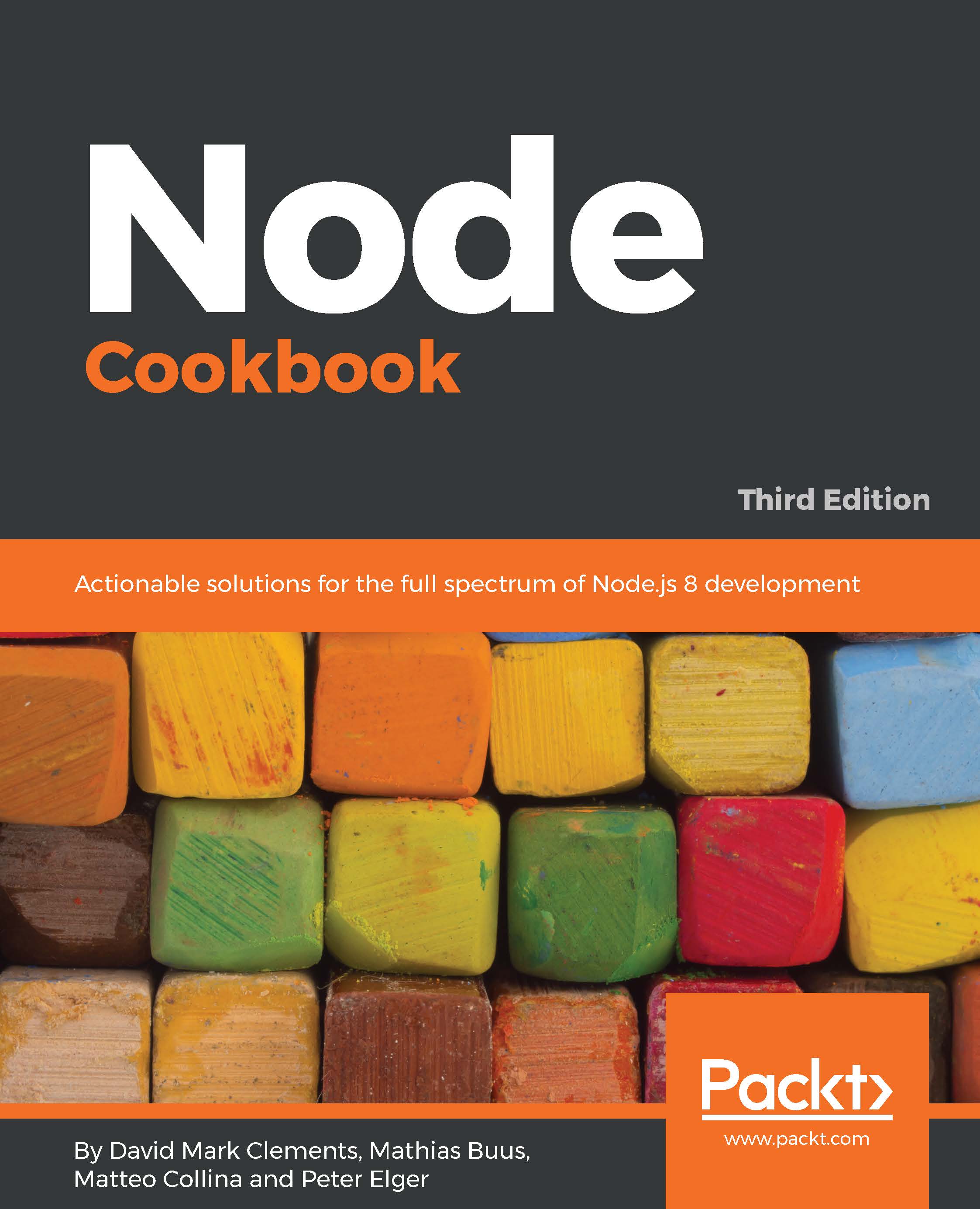
Node Cookbook

Node Cookbook - Third Edition

By : David Mark Clements, Matteo Collina, Peter Elger, Mathias Buus Madsen
4.7 (3)
close
close
Node Cookbook

Node Cookbook

4.7 (3)
By: David Mark Clements, Matteo Collina, Peter Elger, Mathias Buus Madsen

Overview of this book

Today's web demands efficient real-time applications and scalability. Asynchronous event-driven programming is ideal for this, and this is where Node.js comes in. Server-side JavaScript has been here since the 90s, but Node got it right. With Node for tooling and server-side logic, and a browser-based client-side UI, everything is JavaScript. This leads to rapid, fluid development cycles. The full-stack, single language experience means less context-switching between languages for developers, architects and whole teams. This book shows you how to build fast, efficient, and scalable client-server solutions using the latest versions of Node. The book begins with debugging tips and tricks of the trade, and how to write your own modules. Then you'll learn the fundamentals of streams in Node.js, discover I/O control, and how to implement the different web protocols. You'll find recipes for integrating databases such as MongoDB, MySQL/MariaDB, Postgres, Redis, and LevelDB. We also cover the options for building web application with Express, Hapi and Koa. You will then learn about security essentials in Node.js and advanced optimization tools and techniques. By the end of the book you will have acquired the level of expertise to build production-ready and scalable Node.js systems. The techniques and skills you will learn in this book are based on the best practices developed by nearForm, one of the leaders in Node implementations, who supported the work of the authors on this book.

Table of Contents (12 chapters)
close
close

Adding a Queue Based Service

In this recipe, we will create a simple asynchronous event recording service. In this context asynchronous means that we will expose the service over a queue rather than a direct point to point connection.

We will be using Redis as a our queue mechanism, specifically we're using a Redis list structure with the LPUSH and BRPOP commands to make a FIFO queue.

Redis and Node
We cover using Redis with Node in the Storing and Retrieving Data with Redis reciepe in Chapter 6, Persisting to Databases holds.

Getting ready

To prepare for this recipe we need to ensure that we have Redis available. The simplest way to do this is to use the official Docker Redis image, so, to get ready for this section...

Visually different images
CONTINUE READING
83
Tech Concepts
36
Programming languages
73
Tech Tools
Icon Unlimited access to the largest independent learning library in tech of over 8,000 expert-authored tech books and videos.
Icon Innovative learning tools, including AI book assistants, code context explainers, and text-to-speech.
Icon 50+ new titles added per month and exclusive early access to books as they are being written.
Node Cookbook
notes
bookmark Notes and Bookmarks search Search in title playlist Add to playlist download Download options font-size Font size

Change the font size

margin-width Margin width

Change margin width

day-mode Day/Sepia/Night Modes

Change background colour

Close icon Search
Country selected

Close icon Your notes and bookmarks

Confirmation

Modal Close icon
claim successful

Buy this book with your credits?

Modal Close icon
Are you sure you want to buy this book with one of your credits?
Close
YES, BUY

Submit Your Feedback

Modal Close icon
Modal Close icon
Modal Close icon