Sign In Start Free Trial
Account

Add to playlist

Create a Playlist

Modal Close icon
You need to login to use this feature.
  • Book Overview & Buying Getting Started with hapi.js
  • Table Of Contents Toc
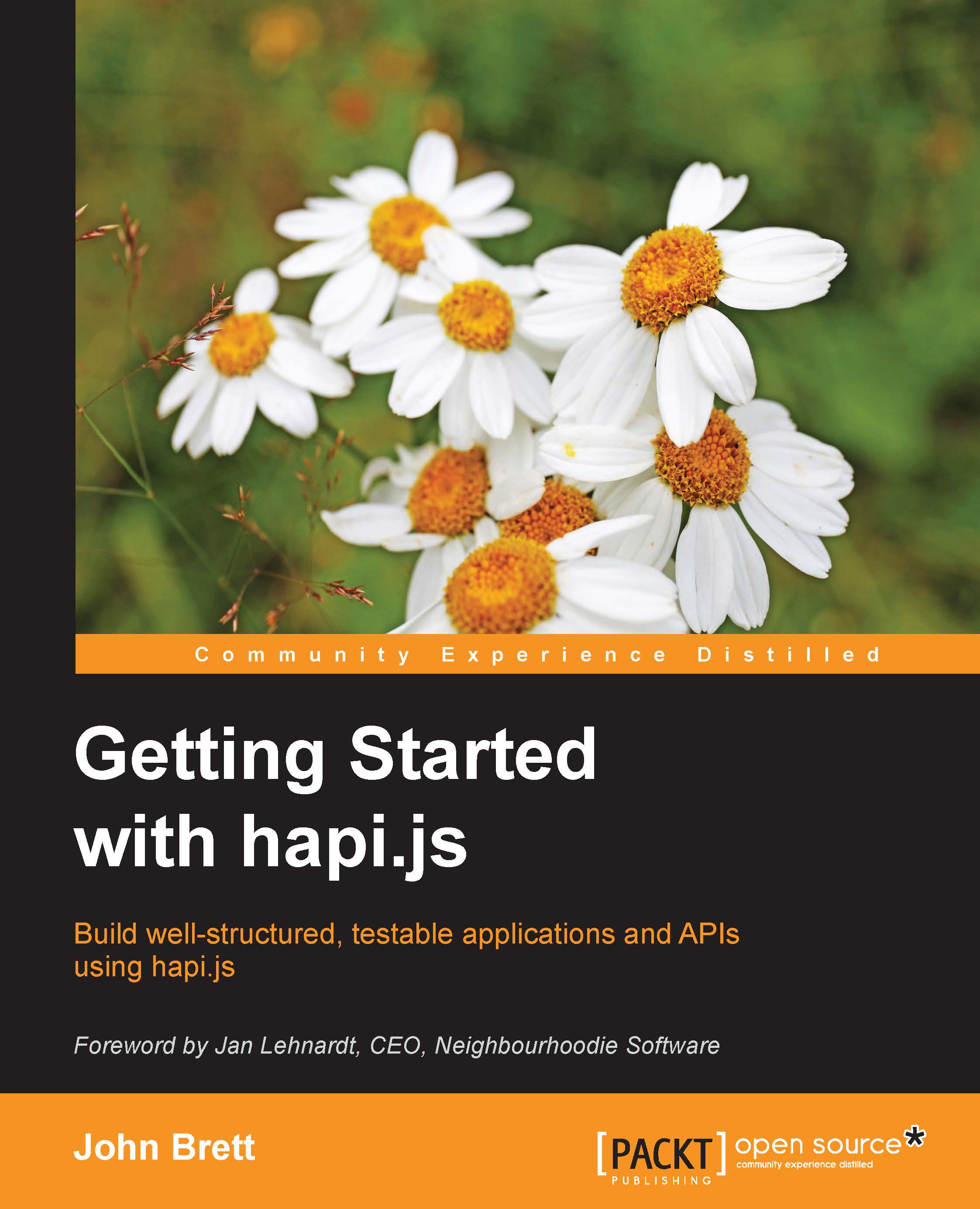
Getting Started with hapi.js

Getting Started with hapi.js

By : Brett
3.2 (6)
close
close
Getting Started with hapi.js

Getting Started with hapi.js

3.2 (6)
By: Brett

Overview of this book

This book will introduce hapi.js and walk you through the creation of your first working application using the out-of-the-box features hapi.js provides. Packed with real-world problems and examples, this book introduces some of the basic concepts of hapi.js and Node.js and takes you through the typical journey you'll face when developing an application. Starting with easier concepts such as routing requests, building APIs serving JSON, using templates to build websites and applications, and connecting databases, we then move on to more complex problems such as authentication, model validation, caching, and techniques for structuring your codebase to scale gracefully. You will also develop skills to ensure your application's reliability through testing, code coverage, and logging. By the end of this book, you'll be equipped with all the skills you need to build your first fully featured application. This book will be invaluable if you are investigating Node.js frameworks or planning on using hapi.js in your next project.
Table of Contents (9 chapters)
close
close
5
5. Securing Applications with Authentication and Authorization
8
Index

hapi plugins

We've seen briefly in the previous chapters how to register third-party plugins to a hapi server, and the power that they have in being able to add custom handlers, routes, or print our routing table on startup. hapi's plugin system is powerful, extensive, and at the level where not only is the plugin system useful for integrating third-party modules, but also a great abstraction for breaking up your application into smaller, reusable chunks of code. Let's take one of our examples from the previous chapters, and show how we can break up our business logic into more manageable chunks using plugins.

Encapsulating functionality within plugins

If you remember, in the first chapter, we looked at what a full server with a single route added to it looks like, and used the blipp module to print the routing table on server start. In the example, all the code is contained in one entry file. As long as you have one route, this is fine; however, as an application grows, this...

CONTINUE READING
83
Tech Concepts
36
Programming languages
73
Tech Tools
Icon Unlimited access to the largest independent learning library in tech of over 8,000 expert-authored tech books and videos.
Icon Innovative learning tools, including AI book assistants, code context explainers, and text-to-speech.
Icon 50+ new titles added per month and exclusive early access to books as they are being written.
Getting Started with hapi.js
notes
bookmark Notes and Bookmarks search Search in title playlist Add to playlist font-size Font size

Change the font size

margin-width Margin width

Change margin width

day-mode Day/Sepia/Night Modes

Change background colour

Close icon Search
Country selected

Close icon Your notes and bookmarks

Confirmation

Modal Close icon
claim successful

Buy this book with your credits?

Modal Close icon
Are you sure you want to buy this book with one of your credits?
Close
YES, BUY

Submit Your Feedback

Modal Close icon
Modal Close icon
Modal Close icon