
Sign In Start Free Trial
Account

Add to playlist

Create a Playlist

Modal Close icon
You need to login to use this feature.
  • Book Overview & Buying Learning Spring Boot 2.0
  • Table Of Contents Toc
  • Feedback & Rating feedback
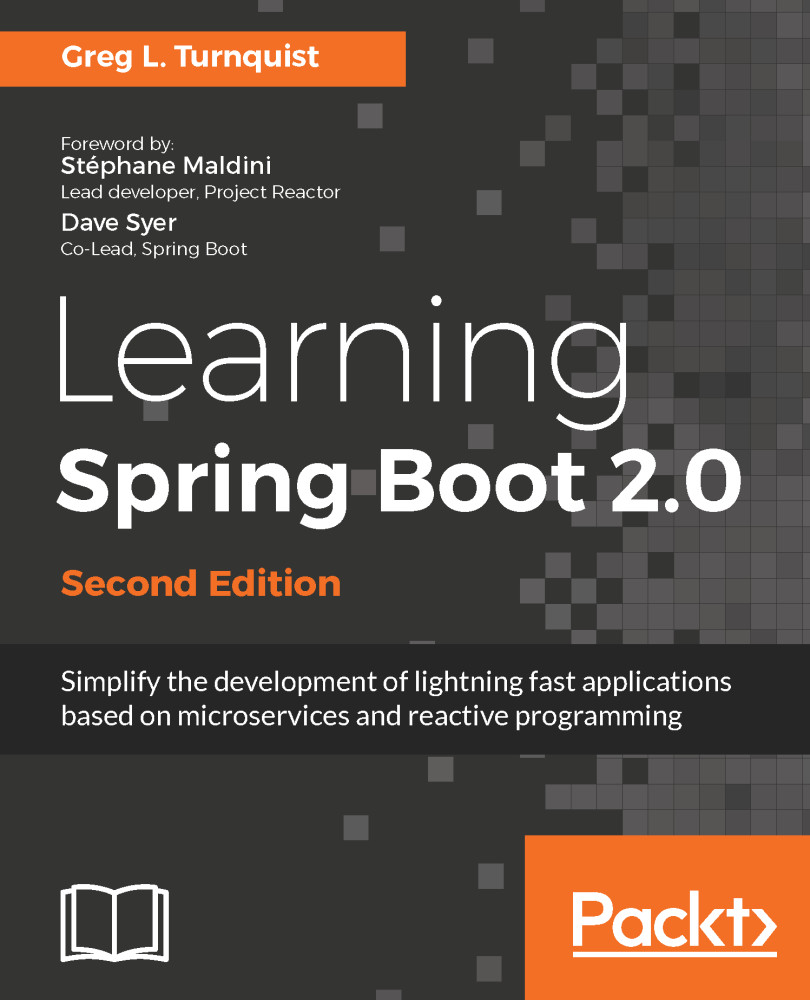
Learning Spring Boot 2.0

Learning Spring Boot 2.0 - Second Edition

By : Greg L. Turnquist
4 (22)
close
close
Learning Spring Boot 2.0

Learning Spring Boot 2.0

4 (22)
By: Greg L. Turnquist

Overview of this book

Spring Boot provides a variety of features that address today's business needs along with today's scalable requirements. In this book, you will learn how to leverage powerful databases and Spring Boot's state-of-the-art WebFlux framework. This practical guide will help you get up and running with all the latest features of Spring Boot, especially the new Reactor-based toolkit. The book starts off by helping you build a simple app, then shows you how to bundle and deploy it to the cloud. From here, we take you through reactive programming, showing you how to interact with controllers and templates and handle data access. Once you're done, you can start writing unit tests, slice tests, embedded container tests, and even autoconfiguration tests. We go into detail about developer tools, AMQP messaging, WebSockets, security, and deployment. You will learn how to secure your application using both routes and method-based rules. By the end of the book, you'll have built a social media platform from which to apply the lessons you have learned to any problem. If you want a good understanding of building scalable applications using the core functionality of Spring Boot, this is the book for you.
Table of Contents (11 chapters)
close
close

Why use reactive programming?

At this stage, you've gotten a good taste of how to whip up a file-handling controller, and hitch it to a service that reads and writes files to disk. But the question that often arises is why do I need to do this reactively?

With imperative programming, the process of taking inputs, building intermediate collections and other steps often leaves us with lots of intermediate states--some of it potentially blocking in bad places.

Using the functional style as we've explored so far moves away from the risk of inefficiently building up this state, and switches to building a stream of data instead. And Reactor's operations let us have one stream feed another in lots of different ways. We can merge streams, filter streams, and transform streams.

When we engage in reactive programming, the level of abstraction moves up a level. We find ourselves...

Visually different images
CONTINUE READING
83
Tech Concepts
36
Programming languages
73
Tech Tools
Icon Unlimited access to the largest independent learning library in tech of over 8,000 expert-authored tech books and videos.
Icon Innovative learning tools, including AI book assistants, code context explainers, and text-to-speech.
Icon 50+ new titles added per month and exclusive early access to books as they are being written.
Learning Spring Boot 2.0
notes
bookmark Notes and Bookmarks search Search in title playlist Add to playlist download Download options font-size Font size

Change the font size

margin-width Margin width

Change margin width

day-mode Day/Sepia/Night Modes

Change background colour

Close icon Search
Country selected

Close icon Your notes and bookmarks

Confirmation

Modal Close icon
claim successful

Buy this book with your credits?

Modal Close icon
Are you sure you want to buy this book with one of your credits?
Close
YES, BUY

Submit Your Feedback

Modal Close icon
Modal Close icon
Modal Close icon