Sign In Start Free Trial
Account

Add to playlist

Create a Playlist

Modal Close icon
You need to login to use this feature.
  • Book Overview & Buying Scala Test-Driven Development
  • Table Of Contents Toc
  • Feedback & Rating feedback
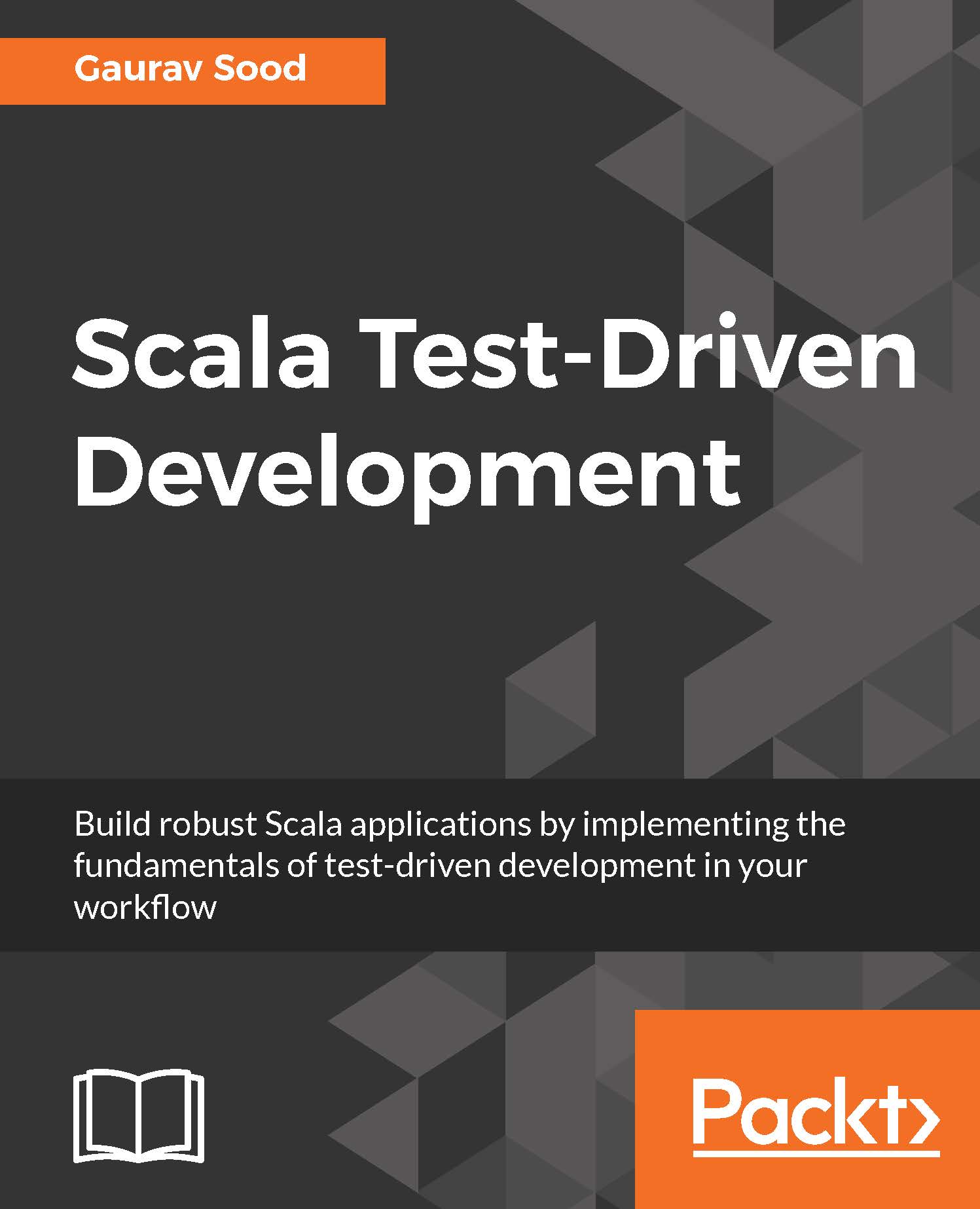
Scala Test-Driven Development

Scala Test-Driven Development

By : Sood
3.3 (3)
close
close
Scala Test-Driven Development

Scala Test-Driven Development

3.3 (3)
By: Sood

Overview of this book

Test-driven development (TDD) produces high-quality applications in less time than is possible with traditional methods. Due to the systematic nature of TDD, the application is tested in individual units as well as cumulatively, right from the design stage, to ensure optimum performance and reduced debugging costs. This step-by-step guide shows you how to use the principles of TDD and built-in Scala testing modules to write clean and fully tested Scala code and give your workflow the change it needs to let you create better applications than ever before. After an introduction to TDD, you will learn the basics of ScalaTest, one of the most flexible and most popular testing tools around for Scala, by building your first fully test-driven application. Building on from that you will learn about the ScalaTest API and how to refactor code to produce high-quality applications. We’ll teach you the concepts of BDD (Behavior-driven development) and you’ll see how to add functional tests to the existing suite of tests. You’ll be introduced to the concepts of Mocks and Stubs and will learn to increase test coverage using properties. With a concluding chapter on miscellaneous tools, this book will enable you to write better quality code that is easily maintainable and watch your apps change for the better.
Table of Contents (10 chapters)
close
close

Integration testing

Individual components of the software module are tested together during integration testing. This phase sits in between unit testing and acceptance testing. In unit testing, we are testing a single unit of the code, whether it be a class or a method. Once we are sure that the individual bits are working according to the specification, we can start with integration testing to check if the modules/components behave as expected with other components, both internal and external.

The process of integration testing can be broken down into these steps:

  1. Identify the interfaces between the units that are used for interaction.
  2. Specify a collection of units with interfaces that form a complete end-to-end integration.
  3. Create integration test cases along with the inputs and expected outputs.
  4. Evaluate the test to determine if the results are matched and record the results.

Functional testing

We can think of functional testing as a verification activity. It is a type of black-box testing...

Visually different images
CONTINUE READING
83
Tech Concepts
36
Programming languages
73
Tech Tools
Icon Unlimited access to the largest independent learning library in tech of over 8,000 expert-authored tech books and videos.
Icon Innovative learning tools, including AI book assistants, code context explainers, and text-to-speech.
Icon 50+ new titles added per month and exclusive early access to books as they are being written.
Scala Test-Driven Development
notes
bookmark Notes and Bookmarks search Search in title playlist Add to playlist download Download options font-size Font size

Change the font size

margin-width Margin width

Change margin width

day-mode Day/Sepia/Night Modes

Change background colour

Close icon Search
Country selected

Close icon Your notes and bookmarks

Confirmation

Modal Close icon
claim successful

Buy this book with your credits?

Modal Close icon
Are you sure you want to buy this book with one of your credits?
Close
YES, BUY

Submit Your Feedback

Modal Close icon
Modal Close icon
Modal Close icon