
Sign In Start Free Trial
Account

Add to playlist

Create a Playlist

Modal Close icon
You need to login to use this feature.
  • Book Overview & Buying AMP: Building Accelerated Mobile Pages
  • Table Of Contents Toc
  • Feedback & Rating feedback
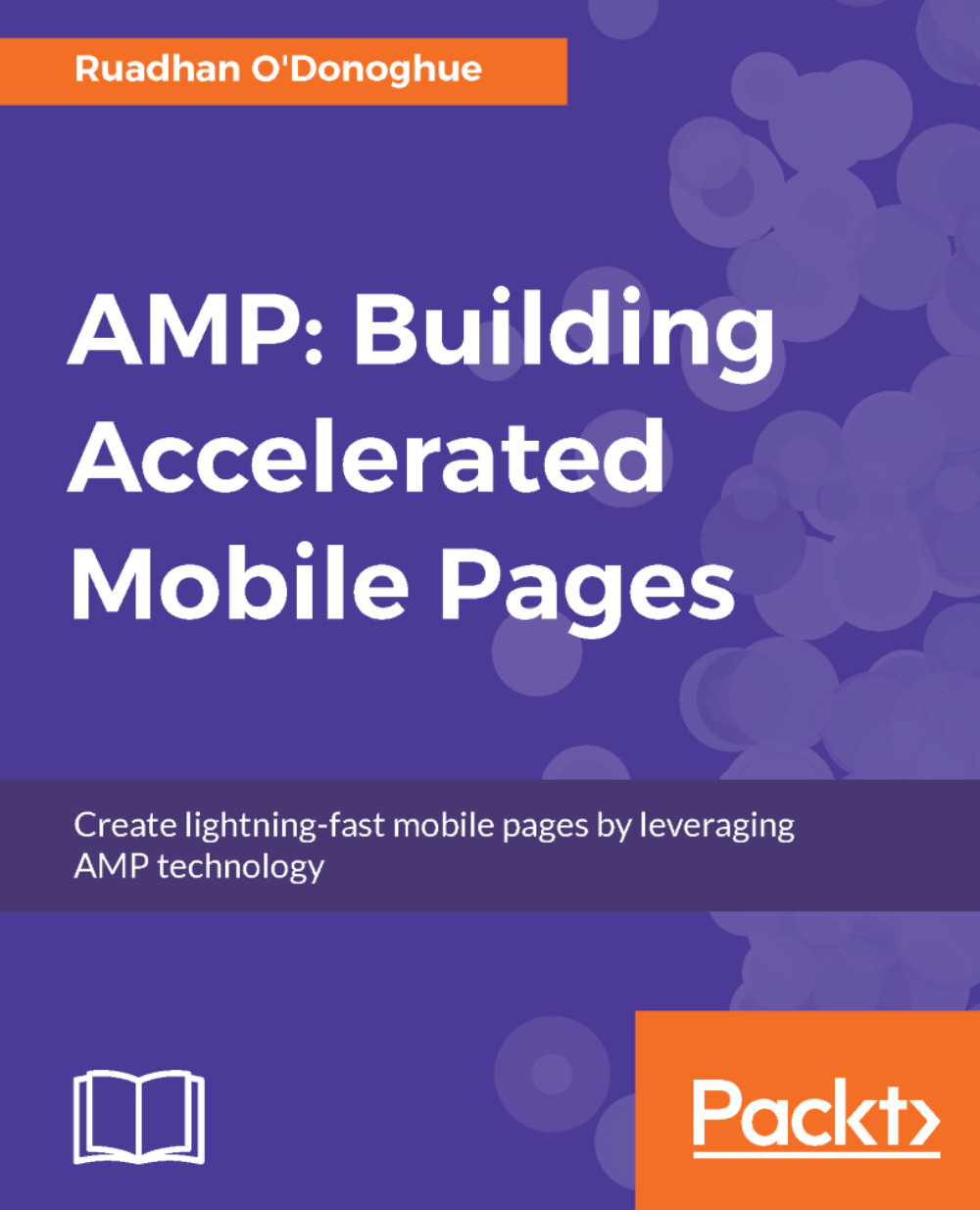
AMP: Building Accelerated Mobile Pages

AMP: Building Accelerated Mobile Pages

By : O'Donoghue
5 (4)
close
close
AMP: Building Accelerated Mobile Pages

AMP: Building Accelerated Mobile Pages

5 (4)
By: O'Donoghue

Overview of this book

Google introduced the Accelerated Mobile Pages (AMP) project to give mobile users lightning-fast response times when accessing web pages on mobile devices. AMP delivers great user experiences by providing a framework for optimizing web pages that otherwise would take much longer to load on a mobile platform. This book shows how to solve page performance issues using the mobile web technologies available today. You will learn how to build instant-loading web pages, and have them featured more prominently on Google searches. If you want your website to succeed on mobile, if you care about SEO, and if you want to stay competitive, then this book is for you! You will go on a mobile web development journey that demonstrates with concrete examples how to build lightning-fast pages that will keep your visitors on-site and happy. This journey begins by showing how to build a simple blog article-style web page using AMP. As new concepts are introduced this page is gradually refined until you will have the skills and confidence to build a variety of rich and interactive mobile web pages. These will include e-commerce product pages, interactive forms and menus, maps and commenting systems, and even Progressive Web Apps.
Table of Contents (17 chapters)
close
close
14
Actions and Events
16
amp-bind Permitted Attribute Bindings

Preface

Why did I write this book? Back in 2006, I was working with a company called dotMobi. I had the wonderful opportunity of working with some super-smart people--Ronan Cremin, Jo Rabin, and James Pearce--who were trying to make the mobile web happen (every year, according to James, was going to be the year of the mobile web, until 2008, when it eventually was).

One of the things that the team at dotMobi was doing was working with the W3C to help draft the Mobile Web Best Practices (MWBPs). We had already built the mobiReady mobile web checker, and the W3C was building its own Mobile Web Best Practices checker that, with my experiences with mobiReady under my belt, I was able to help out with. It was around this time, too, that we launched mobiForge; this was an educational site for web developers getting into mobile web development.

The point of all these initiatives? To give web developers and site owners the tools and knowledge they needed to build sites that performed acceptably under the constraints of the devices and cell networks of the day. This was 10 years ago, pre-iPhone, and the challenges for mobile web developers were considerable. Slow devices, slow networks, and small screens were the order of the day.

When the AMP project was launched, the similarities with the W3C MWBPs struck a chord with me. For one thing, the general goal was the same: follow good development practices, make the mobile web faster, and deliver a better user experience. However, even more than this, the AMP restrictions echoed very much the MWBPs, and the rules we'd built into mobiReady, even if some of the exact details had changed during the intervening 10 years. These were things like not using JavaScript, limiting the number of external resources and HTTP requests, and keeping the page size down. I could be talking about AMP, or the MWBPs.

So, AMP was a project I could identify with, even if some parts of it (such as the AMP cache URLs) are controversial, and I embraced what--as Alex Russell described it at the first AMP conference--has become "the most successful component library in the world." I understand the criticisms of the project, but coming from a background where web performance and user experience goals are important, I believe that, right now, the benefits outweigh the drawbacks.

Even without the cache, AMP is a fast, easy-to-use, and versatile component library. I hope that this book will help you see it the way I do.

Visually different images
CONTINUE READING
83
Tech Concepts
36
Programming languages
73
Tech Tools
Icon Unlimited access to the largest independent learning library in tech of over 8,000 expert-authored tech books and videos.
Icon Innovative learning tools, including AI book assistants, code context explainers, and text-to-speech.
Icon 50+ new titles added per month and exclusive early access to books as they are being written.
AMP: Building Accelerated Mobile Pages
notes
bookmark Notes and Bookmarks search Search in title playlist Add to playlist download Download options font-size Font size

Change the font size

margin-width Margin width

Change margin width

day-mode Day/Sepia/Night Modes

Change background colour

Close icon Search
Country selected

Close icon Your notes and bookmarks

Confirmation

Modal Close icon
claim successful

Buy this book with your credits?

Modal Close icon
Are you sure you want to buy this book with one of your credits?
Close
YES, BUY

Submit Your Feedback

Modal Close icon
Modal Close icon
Modal Close icon