Sign In Start Free Trial
Account

Add to playlist

Create a Playlist

Modal Close icon
You need to login to use this feature.
  • Book Overview & Buying Building RESTful Web Services with PHP 7
  • Table Of Contents Toc
  • Feedback & Rating feedback
Building RESTful Web Services with PHP 7

Building RESTful Web Services with PHP 7

By : Waheed ud din
2.4 (5)
close
close
Building RESTful Web Services with PHP 7

Building RESTful Web Services with PHP 7

2.4 (5)
By: Waheed ud din

Overview of this book

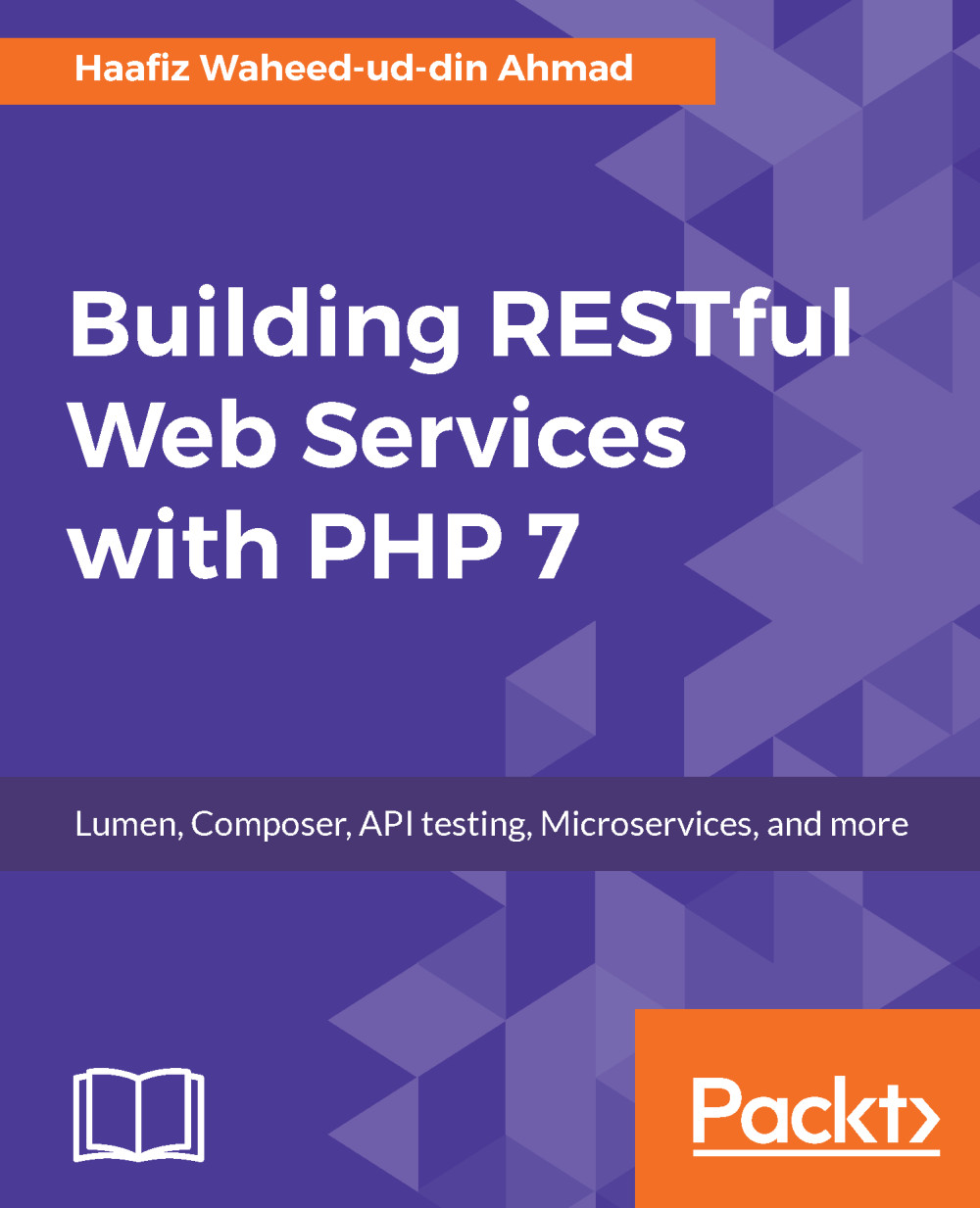
REST is the most wide spread and effective standard to develop APIs for internet services. With the way PHP and its eco-system has modernized the way code is written by simplifying various operations, it is useful to develop RESTful APIs with PHP 7 and modern tools. This book explains in detail how to create your own RESTful API in PHP 7 that can be consumed by other users in your organization. Starting with a brief introduction to the fundamentals of REST architecture and the new features in PHP 7, you will learn to implement basic RESTful API endpoints using vanilla PHP. The book explains how to identify flaws in security and design and teach you how to tackle them. You will learn about composer, Lumen framework and how to make your RESTful API cleaner, secure and efficient. The book emphasizes on automated tests, teaches about different testing types and give a brief introduction to microservices which is the natural way forward. After reading this book, you will have a clear understanding of the REST architecture and you can build a web service from scratch.
Table of Contents (10 chapters)
close
close

Group use declarations


Classes, functions, and constants, which are in the same namespace, can now imported in a single use statement. Previously, multiple use statements were required for that. Here is an example to understand it better:

<?php
// use statement in Pre-PHP7 code
use abc\namespace\ClassA;
use abc\namespace\ClassB;
use abc\namespace\ClassC as C;

use function abc\namespace\funcA;
use function abc\namespace\funcB;
use function abc\namespace\funcC;

use const abc\namespace\ConstA;
use const abc\namespace\ConstB;
use const abc\namespace\ConstC;

// PHP 7+ code
use abc\namespace\{ClassA, ClassB, ClassC as C};
use function abc\namespace\{funcA, funcB, funcC};
use const abc\namespace\{ConstA, ConstB, ConstC};

As you can see from this example, how convenient the group use statement is, it is clearly visible. Curly braces with comma separated values are used to group values such as {classA, classB, classC as C}, resulting in the grouped use statement, instead of separately using...

Visually different images
CONTINUE READING
83
Tech Concepts
36
Programming languages
73
Tech Tools
Icon Unlimited access to the largest independent learning library in tech of over 8,000 expert-authored tech books and videos.
Icon Innovative learning tools, including AI book assistants, code context explainers, and text-to-speech.
Icon 50+ new titles added per month and exclusive early access to books as they are being written.
Building RESTful Web Services with PHP 7
notes
bookmark Notes and Bookmarks search Search in title playlist Add to playlist download Download options font-size Font size

Change the font size

margin-width Margin width

Change margin width

day-mode Day/Sepia/Night Modes

Change background colour

Close icon Search
Country selected

Close icon Your notes and bookmarks

Confirmation

Modal Close icon
claim successful

Buy this book with your credits?

Modal Close icon
Are you sure you want to buy this book with one of your credits?
Close
YES, BUY

Submit Your Feedback

Modal Close icon
Modal Close icon
Modal Close icon