
Sign In Start Free Trial
Account

Add to playlist

Create a Playlist

Modal Close icon
You need to login to use this feature.
  • Book Overview & Buying Java EE 8 and Angular
  • Table Of Contents Toc
Java EE 8 and Angular

Java EE 8 and Angular

By : Prashant Padmanabhan
3.2 (6)
close
close
Java EE 8 and Angular

Java EE 8 and Angular

3.2 (6)
By: Prashant Padmanabhan

Overview of this book

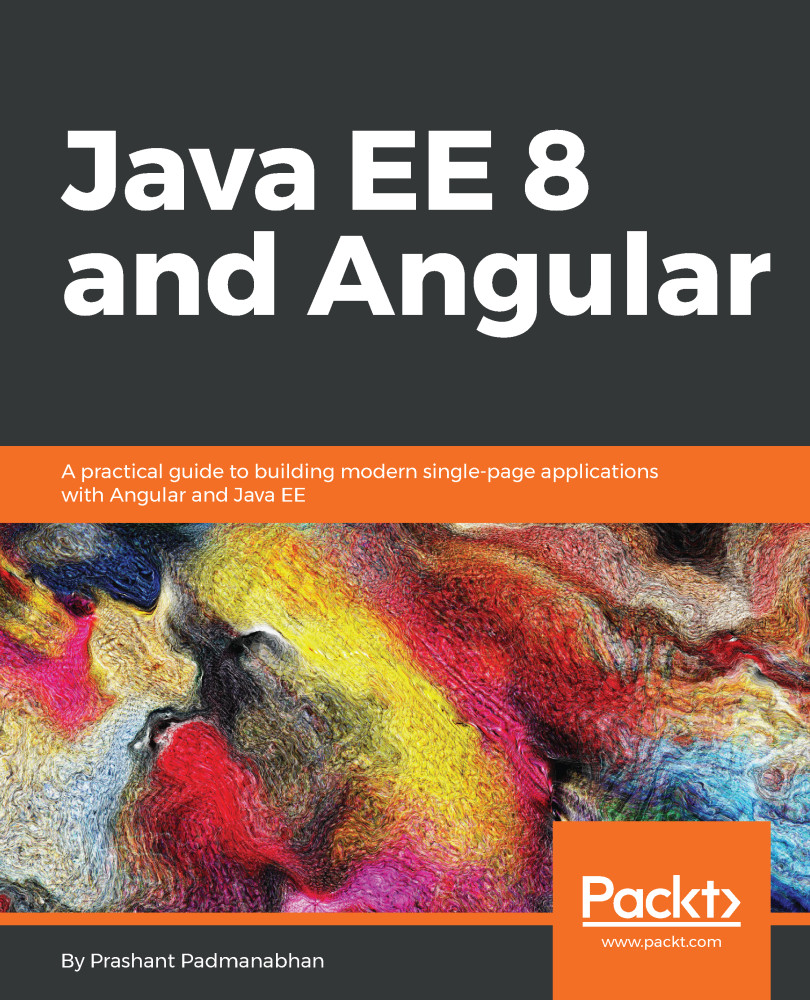
The demand for modern and high performing web enterprise applications is growing rapidly. No more is a basic HTML frontend enough to meet customer demands. This book will be your one-stop guide to build outstanding enterprise web applications with Java EE and Angular. It will teach you how to harness the power of Java EE to build sturdy backends while applying Angular on the frontend. Your journey to building modern web enterprise applications starts here! The book starts with a brief introduction to the fundamentals of Java EE and all the new APIs offered in the latest release. Armed with the knowledge of Java EE 8, you will go over what it's like to build an end-to-end application, configure database connection for JPA, and build scalable microservices using RESTful APIs running in Docker containers. Taking advantage of the Payara Micro capabilities, you will build an Issue Management System, which will have various features exposed as services using the Java EE backend. With a detailed coverage of Angular fundamentals, the book will expand the Issue Management System by building a modern single page application frontend. Moving forward, you will learn to fit both the pieces together, that is, the frontend Angular application with the backend Java EE microservices. As each unit in a microservice promotes high cohesion, you will learn different ways in which independent units can be tested efficiently. Finishing off with concepts on securing your enterprise applications, this book is a handson guide for building modern web applications.
Table of Contents (16 chapters)
close
close

Validation

JAXRS 2.1 now enables declarative validation support by leveraging its integration with the Bean Validation API. This is done by using the constraint annotations for validating Beans, method parameters, and return values. These annotations can be placed on resource classes, fields and properties. For example, the following is a sample showing a User entity having a field level constraint of @NotNull. The same User class is then used as an argument to the resource method add which uses the @Valid annotation. A POST request would trigger the validation of the User entity field name to meet the @NotNull criteria:

class User {
@NotNull
private String name;
...
}

@Path("/")
class ResourceClass {
@POST public void add(@Valid User newUser) { ... }
}

Similar to the method parameter, the response can also be validated by applying constraints on the return type...

CONTINUE READING
83
Tech Concepts
36
Programming languages
73
Tech Tools
Icon Unlimited access to the largest independent learning library in tech of over 8,000 expert-authored tech books and videos.
Icon Innovative learning tools, including AI book assistants, code context explainers, and text-to-speech.
Icon 50+ new titles added per month and exclusive early access to books as they are being written.
Java EE 8 and Angular
notes
bookmark Notes and Bookmarks search Search in title playlist Add to playlist download Download options font-size Font size

Change the font size

margin-width Margin width

Change margin width

day-mode Day/Sepia/Night Modes

Change background colour

Close icon Search
Country selected

Close icon Your notes and bookmarks

Confirmation

Modal Close icon
claim successful

Buy this book with your credits?

Modal Close icon
Are you sure you want to buy this book with one of your credits?
Close
YES, BUY

Submit Your Feedback

Modal Close icon
Modal Close icon
Modal Close icon