
Sign In Start Free Trial
Account

Add to playlist

Create a Playlist

Modal Close icon
You need to login to use this feature.
  • Book Overview & Buying Building RESTful Web Services with .NET Core
  • Table Of Contents Toc
  • Feedback & Rating feedback
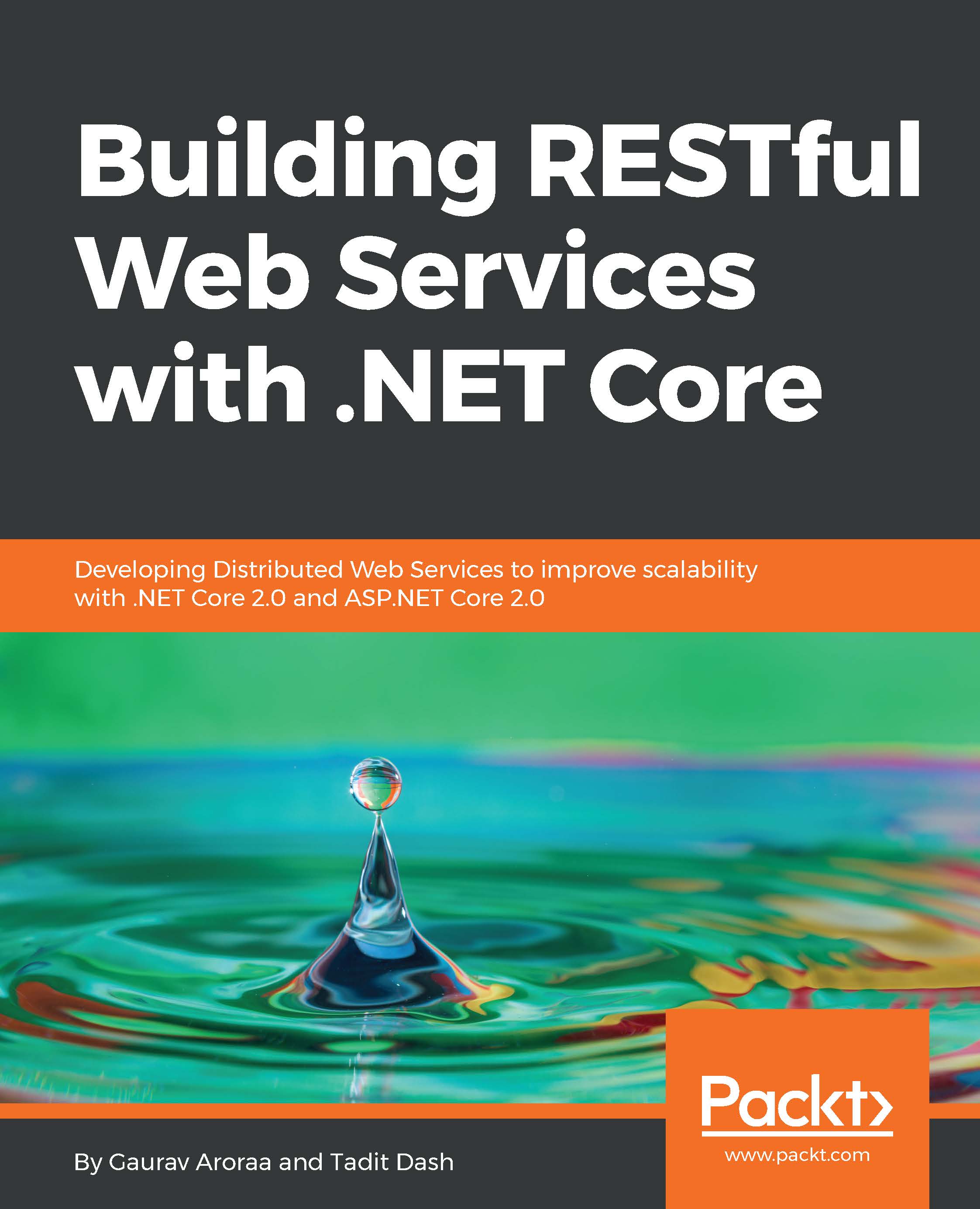
Building RESTful Web Services with .NET Core

Building RESTful Web Services with .NET Core

By : Bhattacharya, Gaurav Aroraa, Tadit Dash
2.7 (6)
close
close
Building RESTful Web Services with .NET Core

Building RESTful Web Services with .NET Core

2.7 (6)
By: Bhattacharya, Gaurav Aroraa, Tadit Dash

Overview of this book

REST is an architectural style that tackles the challenges of building scalable web services. In today's connected world, APIs have taken a central role on the web. APIs provide the fabric through which systems interact, and REST has become synonymous with APIs. The depth, breadth, and ease of use of ASP.NET Core makes it a breeze for developers to work with for building robust web APIs. This book takes you through the design of RESTful web services and leverages the ASP.NET Core framework to implement these services. This book begins by introducing you to the basics of the philosophy behind REST. You'll go through the steps of designing and implementing an enterprise-grade RESTful web service. This book takes a practical approach, that you can apply to your own circumstances. This book brings forth the power of the latest .NET Core release, working with MVC. Later, you will learn about the use of the framework to explore approaches to tackle resilience, security, and scalability concerns. You will explore the steps to improve the performance of your applications. You'll also learn techniques to deal with security in web APIs and discover how to implement unit and integration test strategies. By the end of the book, you will have a complete understanding of Building a client for RESTful web services, along with some scaling techniques.
Table of Contents (13 chapters)
close
close

Adding basic authentication to our REST API

Now that we registered the customer, we can move towards the authentication process. Authentication is to verify whether a customer is a valid user of our site or not. We already have their credentials with us since they registered using our registration form. When they try to access any resource from our site using those credentials, we will verify first and then allow.

Registration will be allowed for everyone and won't be authenticated. However, when a customer wants to read their profile details or delete their account, and so on, then we need authentication in place so that the data is returned to users who are actual trusted users of the application.

For basic authentication:

  • We will get the username, which will be the email ID and password from the client while they request a resource. This will be sent with HTTP headers...
Visually different images
CONTINUE READING
83
Tech Concepts
36
Programming languages
73
Tech Tools
Icon Unlimited access to the largest independent learning library in tech of over 8,000 expert-authored tech books and videos.
Icon Innovative learning tools, including AI book assistants, code context explainers, and text-to-speech.
Icon 50+ new titles added per month and exclusive early access to books as they are being written.
Building RESTful Web Services with .NET Core
notes
bookmark Notes and Bookmarks search Search in title playlist Add to playlist download Download options font-size Font size

Change the font size

margin-width Margin width

Change margin width

day-mode Day/Sepia/Night Modes

Change background colour

Close icon Search
Country selected

Close icon Your notes and bookmarks

Confirmation

Modal Close icon
claim successful

Buy this book with your credits?

Modal Close icon
Are you sure you want to buy this book with one of your credits?
Close
YES, BUY

Submit Your Feedback

Modal Close icon
Modal Close icon
Modal Close icon