Sign In Start Free Trial
Account

Add to playlist

Create a Playlist

Modal Close icon
You need to login to use this feature.
  • Book Overview & Buying Building a RESTful Web Service with Spring
  • Table Of Contents Toc
  • Feedback & Rating feedback
Building a RESTful Web Service with Spring

Building a RESTful Web Service with Spring

By : Dewailly
2.6 (8)
close
close
Building a RESTful Web Service with Spring

Building a RESTful Web Service with Spring

2.6 (8)
By: Dewailly

Overview of this book

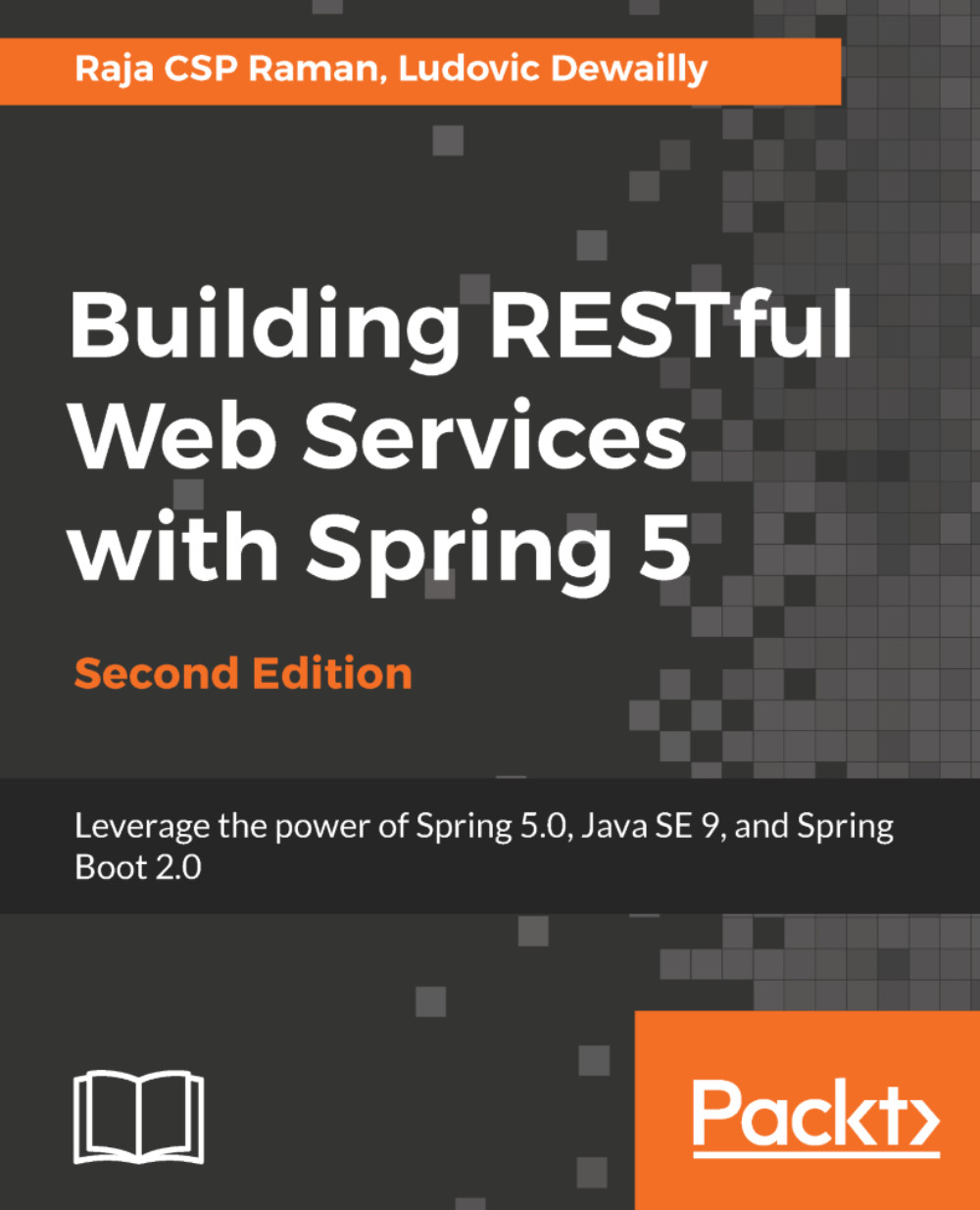
REST is an architectural style that tackles the challenges of building scalable web services. In today’s connected world, APIs have taken a central role on the web. APIs provide the fabric through which systems interact, and REST has become synonymous with APIs. The depth, breadth, and ease of use of Spring makes it one of the most attractive frameworks in the Java ecosystem. Marrying the two technologies is therefore a very natural choice. This book takes you through the design of RESTful web services and leverages the Spring Framework to implement these services. Starting from the basics of the philosophy behind REST, you’ll go through the steps of designing and implementing an enterprise-grade RESTful web service. Taking a practical approach, each chapter provides code samples that you can apply to your own circumstances. This book goes beyond the use of Spring and explores approaches to tackle resilience, security, and scalability concerns. You’ll learn techniques to deal with security in Spring and discover how to implement unit and integration test strategies. Finally, the book ends by walking you through building a Java client for your RESTful web service, along with some scaling techniques for it.
Table of Contents (15 chapters)
close
close
6
Spring Security and JWT (JSON Web Token)

REST principles

REST is a software architecture approach for creating scalable web services. The term REST was coined by Roy Fielding in his PhD dissertation, and revolves around a number of principles. These principles underpin the architecture of RESTful web services and are described in the following sections.

Uniform interface

At the core of REST are resources, and resources are identified using Uniform Resource Identifiers (URIs). Conceptually, resources are separate from their representation (that is, the format in which they are provided to clients). REST does not mandate any specific format, but typically includes XML and JSON (which will be discussed in Chapter 4, Data Representation).

In addition, resource representations are self-descriptive. In more concrete terms, this means that sufficient information must be returned for the successful processing of responses.

Another distinctive property of REST is that clients interact entirely through hypermedia, which is dynamically provided by the application servers. Apart from endpoints, clients need no prior knowledge of how to interact with a RESTful service. This constraint is referred to as Hypermedia as the Engine of Application State (HATEOAS).

Client-Server

The client-server model that REST embraces enables the separation of client concerns, such as user interaction or user state management, from that of server concerns such as data storage and scalability.

This decoupling ensures that, provided an interface that is agreed upon, the development of client and server can be done independently. It also helps reduce complexity and improve the effectiveness of performance tuning.

Stateless

REST advocates statelessness. No client state is stored on the server. All the information needed to perform operations is contained in the requests (as part of the URL, request body, or as HTTP headers).

Cacheable

RESTful web services must provide caching capabilities. Servers can indicate how and for how long to cache responses. Clients can use cached responses instead of contacting the server.

Tip

This principle has significant advantages for scalability. Caching techniques will be discussed in Chapter 6, Performance.

Since REST typically leverages HTTP, it inherits all the caching properties that HTTP offers.

Layered system

Given the style of communication between clients and servers, clients are not aware of which specific server they are interacting with. This property allows the introduction of intermediate servers that can, for example, handle security or offer load-balancing capabilities. These architectural concepts are discussed in more detail in Chapter 10, Scaling a RESTful Web Service.

Code on demand

Even though it's part of the REST architecture, this principal is optional. Servers can temporarily extend the functionality of clients by transferring executable code. For example, JavaScript can be provided to web-based clients to customize functionality.

For a service to be considered RESTful, it should abide by the preceding principles.

Visually different images
CONTINUE READING
83
Tech Concepts
36
Programming languages
73
Tech Tools
Icon Unlimited access to the largest independent learning library in tech of over 8,000 expert-authored tech books and videos.
Icon Innovative learning tools, including AI book assistants, code context explainers, and text-to-speech.
Icon 50+ new titles added per month and exclusive early access to books as they are being written.
Building a RESTful Web Service with Spring
notes
bookmark Notes and Bookmarks search Search in title playlist Add to playlist font-size Font size

Change the font size

margin-width Margin width

Change margin width

day-mode Day/Sepia/Night Modes

Change background colour

Close icon Search
Country selected

Close icon Your notes and bookmarks

Confirmation

Modal Close icon
claim successful

Buy this book with your credits?

Modal Close icon
Are you sure you want to buy this book with one of your credits?
Close
YES, BUY

Submit Your Feedback

Modal Close icon
Modal Close icon
Modal Close icon