


-
Book Overview & Buying
-
Table Of Contents

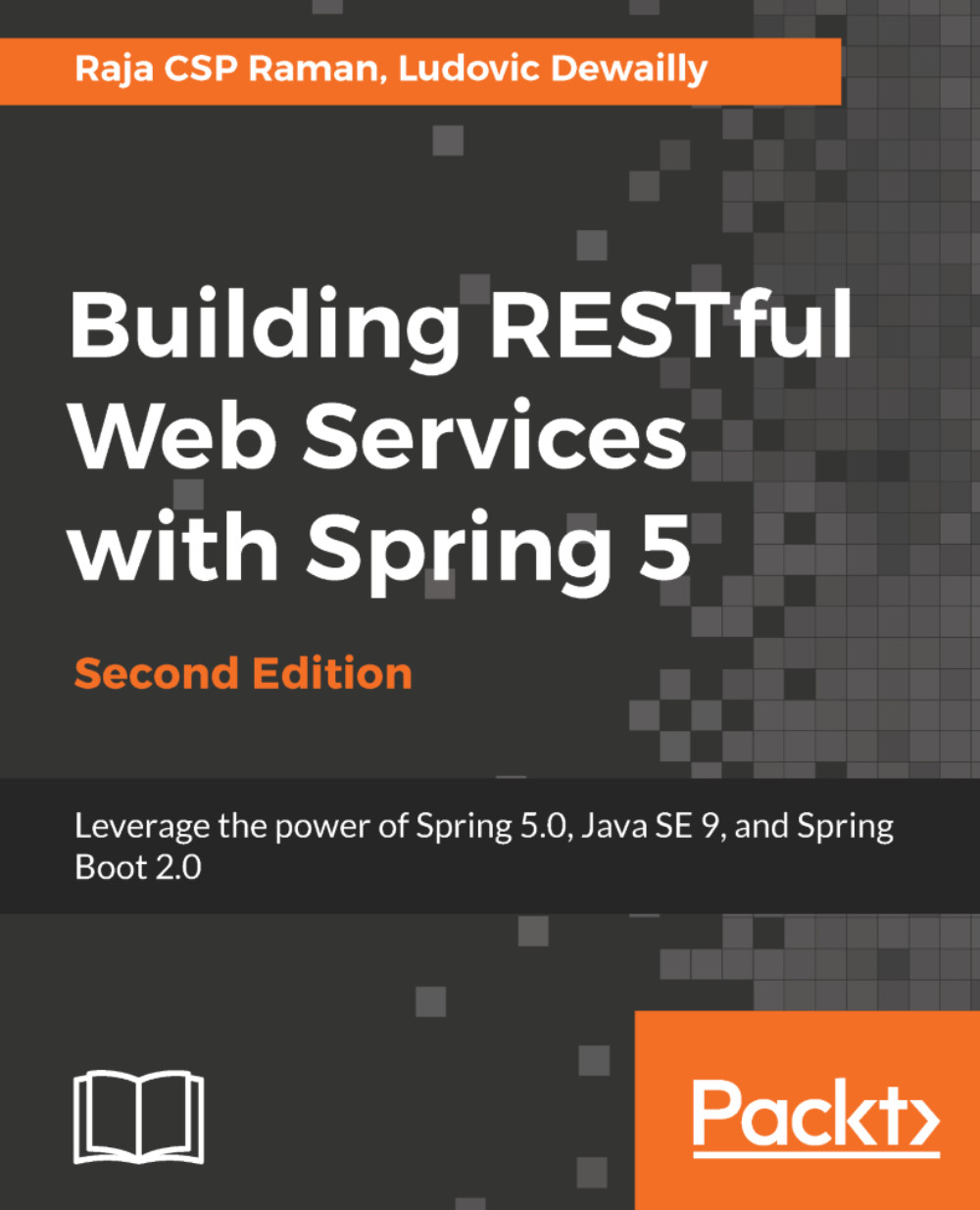
Building RESTful Web Services with Spring 5 - Second Edition
By :


Building RESTful Web Services with Spring 5
By:
Overview of this book
REST is an architectural style that tackles the challenges of building scalable web services. In today's connected world, APIs have taken a central role on the web. APIs provide the fabric through which systems interact, and REST has become synonymous with APIs.The depth, breadth, and ease of use of Spring makes it one of the most attractive frameworks in the Java ecosystem. Marrying the two technologies is therefore a very natural choice.This book takes you through the design of RESTful web services and leverages the Spring Framework to implement these services. Starting from the basics of the philosophy behind REST, you'll go through the steps of designing and implementing an enterprise-grade RESTful web service. Taking a practical approach, each chapter provides code samples that you can apply to your own circumstances.This second edition brings forth the power of the latest Spring 5.0 release, working with MVC built-in as well as the front end framework. It then goes beyond the use of Spring to explores approaches to tackle resilience, security, and scalability concerns. Improve performance of your applications with the new HTTP 2.0 standards. You'll learn techniques to deal with security in Spring and discover how to implement unit and integration test strategies.Finally, the book ends by walking you through building a Java client for your RESTful web service, along with some scaling techniques using the new Spring Reactive libraries.
Table of Contents (15 chapters)
Preface


 Free Chapter
A Few Basics
Building RESTful Web Services in Spring 5 with Maven
Flux and Mono (Reactor Support) in Spring
CRUD Operations in Spring REST
CRUD Operations in Plain REST (Without Reactive) and File Upload
Spring Security and JWT (JSON Web Token)
Testing RESTful Web Services
AOP and Logger Controls
Building a REST Client and Error Handling

Microservice Basics
Ticket Management – Advanced CRUD
Other Books You May Enjoy


