
Sign In Start Free Trial
Account

Add to playlist

Create a Playlist

Modal Close icon
You need to login to use this feature.
  • Book Overview & Buying RESTful Web API Design with Node.js 10
  • Table Of Contents Toc
RESTful Web API Design with Node.js 10

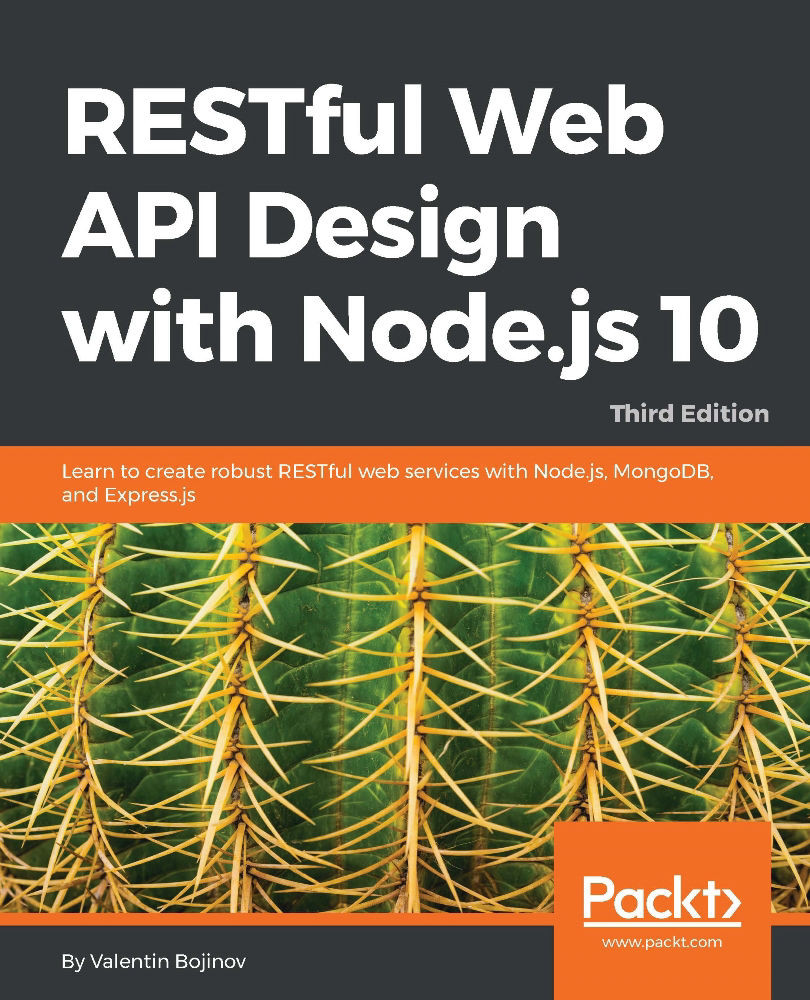
RESTful Web API Design with Node.js 10 - Third Edition

By : Valentin Bojinov
3.5 (4)
close
close
RESTful Web API Design with Node.js 10

RESTful Web API Design with Node.js 10

3.5 (4)
By: Valentin Bojinov

Overview of this book

When building RESTful services, it is really important to choose the right framework. Node.js, with its asynchronous, event-driven architecture, is exactly the right choice for building RESTful APIs. This third edition of RESTful Web API Design with Node.js 10 will teach you to create scalable and rich RESTful applications based on the Node.js platform. You will be introduced to the latest NPM package handler and understand how to use it to customize your RESTful development process. You will begin by understanding the key principle that makes an HTTP application a RESTful-enabled application. After writing a simple HTTP request handler, you will create and test Node.js modules using automated tests and mock objects; explore using the NoSQL database, MongoDB, to store data; and get to grips with using self-descriptive URLs. You’ll learn to set accurate HTTP status codes along with understanding how to keep your applications backward-compatible. Also, while implementing a full-fledged RESTful service, you will use Swagger to document the API and implement automation tests for a REST-enabled endpoint with Mocha. Lastly, you will explore some authentication techniques to secure your application.
Table of Contents (11 chapters)
close
close

API versioning

It is an inevitable fact that all application APIs evolve. However, the evolution of public APIs with an unknown number of consumers, such as RESTful services, is a sensitive topic. As consumers may not be able to handle the modified data appropriately and there is no way of notifying all of them, we need to keep our APIs as backward-compatible as possible. One way to do so is to use different URIs for different versions of our application. Currently, our catalog API is available at /catalog.

When the time is right for a new version, for example, Version 2, we may need to keep the previous version available at another URI for backward-compatibility. Best practice is to encode the version number in the URI, such as /v1/catalog, and keep /catalog mapped to the latest version. Thus, requesting /catalog will cause a redirect to /v2/catalog and will make use of...

CONTINUE READING
83
Tech Concepts
36
Programming languages
73
Tech Tools
Icon Unlimited access to the largest independent learning library in tech of over 8,000 expert-authored tech books and videos.
Icon Innovative learning tools, including AI book assistants, code context explainers, and text-to-speech.
Icon 50+ new titles added per month and exclusive early access to books as they are being written.
RESTful Web API Design with Node.js 10
notes
bookmark Notes and Bookmarks search Search in title playlist Add to playlist download Download options font-size Font size

Change the font size

margin-width Margin width

Change margin width

day-mode Day/Sepia/Night Modes

Change background colour

Close icon Search
Country selected

Close icon Your notes and bookmarks

Confirmation

Modal Close icon
claim successful

Buy this book with your credits?

Modal Close icon
Are you sure you want to buy this book with one of your credits?
Close
YES, BUY

Submit Your Feedback

Modal Close icon
Modal Close icon
Modal Close icon