
Sign In Start Free Trial
Account

Add to playlist

Create a Playlist

Modal Close icon
You need to login to use this feature.
  • Book Overview & Buying Django RESTful Web Services
  • Table Of Contents Toc
  • Feedback & Rating feedback
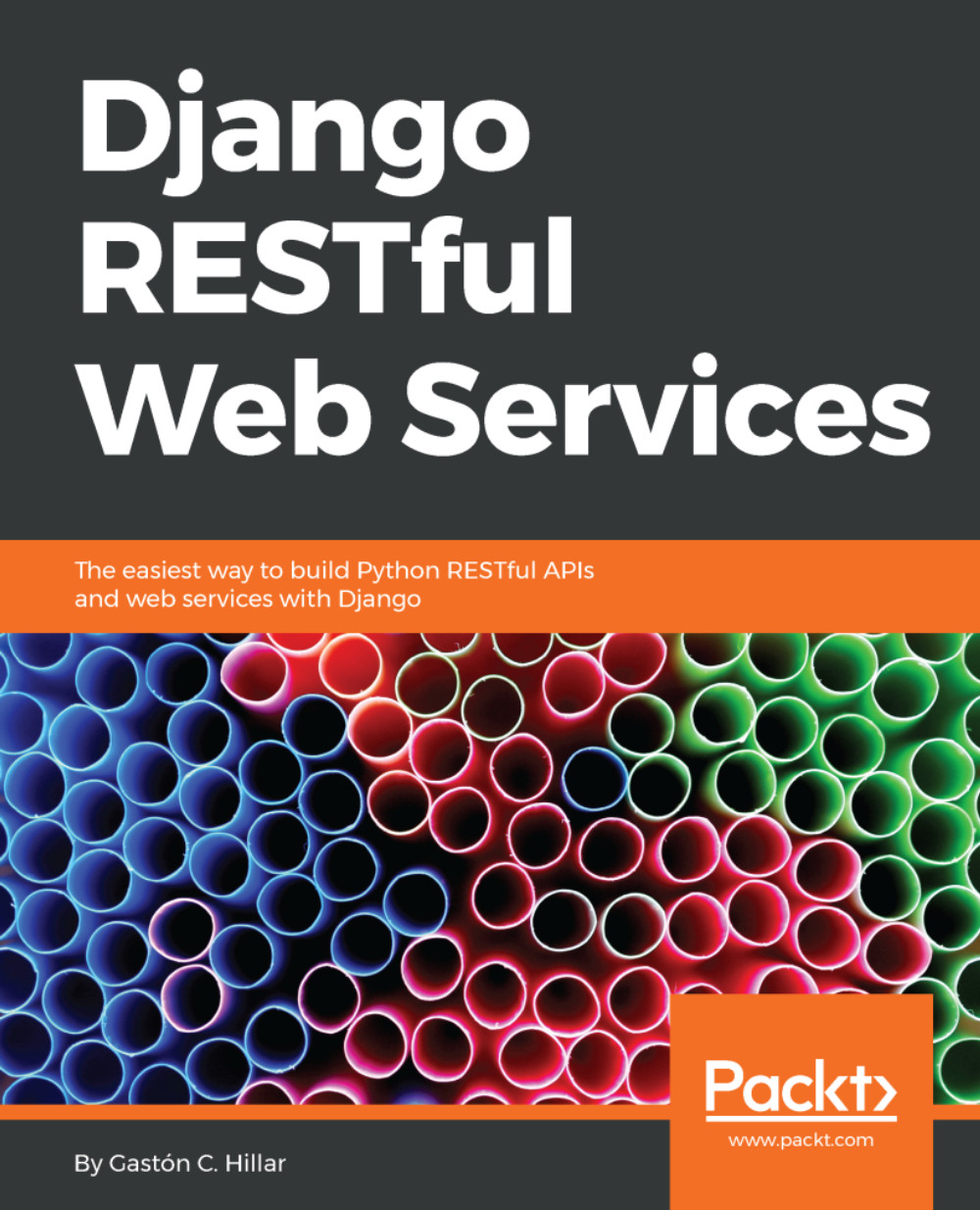
Django RESTful Web Services

Django RESTful Web Services

By : Gaston C. Hillar
3.1 (8)
close
close
Django RESTful Web Services

Django RESTful Web Services

3.1 (8)
By: Gaston C. Hillar

Overview of this book

Django is a Python web framework that makes the web development process very easy. It reduces the amount of trivial code, which simplifies the creation of web applications and results in faster development. It is very powerful and a great choice for creating RESTful web services. If you are a Python developer and want to efficiently create RESTful web services with Django for your apps, then this is the right book for you. The book starts off by showing you how to install and configure the environment, required software, and tools to create RESTful web services with Django and the Django REST framework. We then move on to working with advanced serialization and migrations to interact with SQLite and non-SQL data sources. We will use the features included in the Django REST framework to improve our simple web service. Further, we will create API views to process diverse HTTP requests on objects, go through relationships and hyperlinked API management, and then discover the necessary steps to include security and permissions related to data models and APIs. We will also apply throttling rules and run tests to check that versioning works as expected. Next we will run automated tests to improve code coverage. By the end of the book, you will be able to build RESTful web services with Django.
Table of Contents (13 chapters)
close
close

Running our initial migration

Now, it is necessary to create the initial migration for the new Toy model we recently coded. We will also synchronize the SQLite database for the first time. By default, Django uses the popular self-contained and embedded SQLite database, and therefore we don't need to make changes in the initial ORM configuration. In this example, we will be working with this default configuration. Of course, we will upgrade to another database after we have a sample web service built with Django. We will only use SQLite for this example.

We just need to run the following Python script in the virtual environment that we activated in the previous chapter. Make sure you are in the restful01 folder within the main folder for the virtual environment when you run the following command:

    python manage.py makemigrations toys  

The following lines show the output...

Visually different images
CONTINUE READING
83
Tech Concepts
36
Programming languages
73
Tech Tools
Icon Unlimited access to the largest independent learning library in tech of over 8,000 expert-authored tech books and videos.
Icon Innovative learning tools, including AI book assistants, code context explainers, and text-to-speech.
Icon 50+ new titles added per month and exclusive early access to books as they are being written.
Django RESTful Web Services
notes
bookmark Notes and Bookmarks search Search in title playlist Add to playlist download Download options font-size Font size

Change the font size

margin-width Margin width

Change margin width

day-mode Day/Sepia/Night Modes

Change background colour

Close icon Search
Country selected

Close icon Your notes and bookmarks

Confirmation

Modal Close icon
claim successful

Buy this book with your credits?

Modal Close icon
Are you sure you want to buy this book with one of your credits?
Close
YES, BUY

Submit Your Feedback

Modal Close icon
Modal Close icon
Modal Close icon