
Sign In Start Free Trial
Account

Add to playlist

Create a Playlist

Modal Close icon
You need to login to use this feature.
  • Book Overview & Buying Mastering Bootstrap 4
  • Table Of Contents Toc
  • Feedback & Rating feedback
Mastering Bootstrap 4

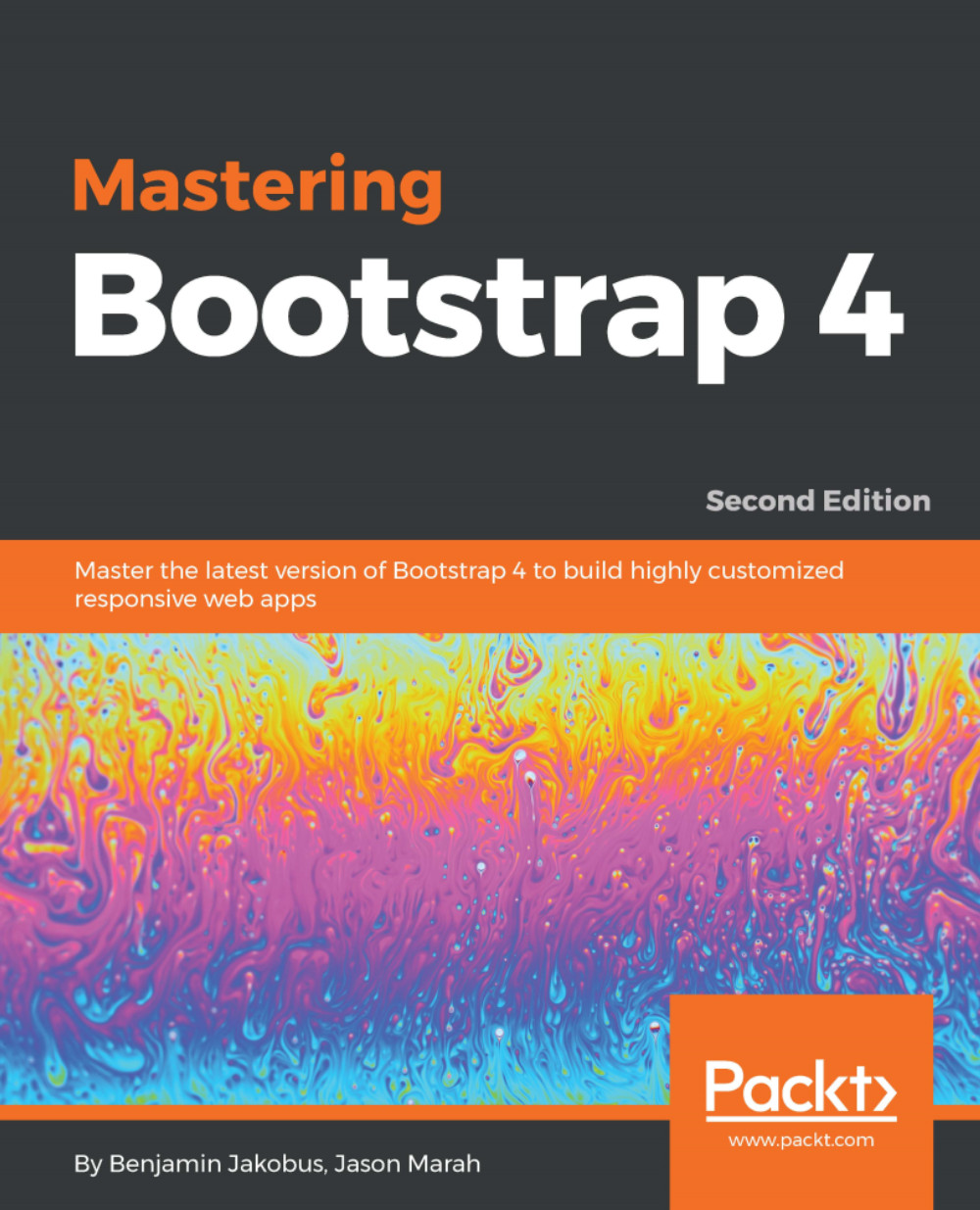
Mastering Bootstrap 4 - Second Edition

3 (6)
close
close
Mastering Bootstrap 4

Mastering Bootstrap 4

3 (6)

Overview of this book

Bootstrap 4 is a free CSS and JavaScript framework that allows developers to rapidly build responsive web interfaces. This book will help you use and adapt Bootstrap to produce enticing websites that fit your needs. You will build a customized Bootstrap website from scratch, using various approaches to customize the framework with increasing levels of skill. You will get to grips with Bootstrap's key features and quickly discover various ways in which Bootstrap can help you develop web interfaces. Then take a walk through the fundamental features, such as its grid system, global styles, helper classes, and responsive utilities. When you have mastered these, you will discover how to structure page layouts, utilize Bootstrap's various navigation components, use forms, and style different types of content. Among other things, you will also tour the anatomy of a Bootstrap plugin, create your own custom components, and extend Bootstrap using jQuery. You will also understand what utility classes Bootstrap 4 has to offer, and how you can use them effectively to speed up the development of your website. Finally, you will discover how to optimize your website and integrate it with third-party frameworks. By the end of this book, you will have a thorough knowledge of the framework's ins and outs, and will be able to build highly customizable and optimized web interfaces.
Table of Contents (13 chapters)
close
close

Creating sections

The MyPhoto web page will consist of five separate sections: Welcome, Services, Gallery, About, and Contact Us. Each of these sections will form one distinct container. This will allow us to treat each section as a standalone component on the page.

As we want each container to take up 100% of the available horizontal space, we will begin by applying the container-fluid class. As noted in Chapter 2, Making a Style Statement, container-fluid allows its contents to be responsive across all resolutions. It achieves this by relying on the percentage width of the page, unlike the standard container class, which uses predefined horizontal breakpoints. To provide a visual cue that these are separate parts of the page, we will apply Bootstrap's contextual background classes to each section. We will also include a footer element in the page. The footer will contain...

Visually different images
CONTINUE READING
83
Tech Concepts
36
Programming languages
73
Tech Tools
Icon Unlimited access to the largest independent learning library in tech of over 8,000 expert-authored tech books and videos.
Icon Innovative learning tools, including AI book assistants, code context explainers, and text-to-speech.
Icon 50+ new titles added per month and exclusive early access to books as they are being written.
Mastering Bootstrap 4
notes
bookmark Notes and Bookmarks search Search in title playlist Add to playlist download Download options font-size Font size

Change the font size

margin-width Margin width

Change margin width

day-mode Day/Sepia/Night Modes

Change background colour

Close icon Search
Country selected

Close icon Your notes and bookmarks

Confirmation

Modal Close icon
claim successful

Buy this book with your credits?

Modal Close icon
Are you sure you want to buy this book with one of your credits?
Close
YES, BUY

Submit Your Feedback

Modal Close icon
Modal Close icon
Modal Close icon