
Sign In Start Free Trial
Account

Add to playlist

Create a Playlist

Modal Close icon
You need to login to use this feature.
  • Book Overview & Buying React 17 Design Patterns and Best Practices
  • Table Of Contents Toc
React 17 Design Patterns and Best Practices

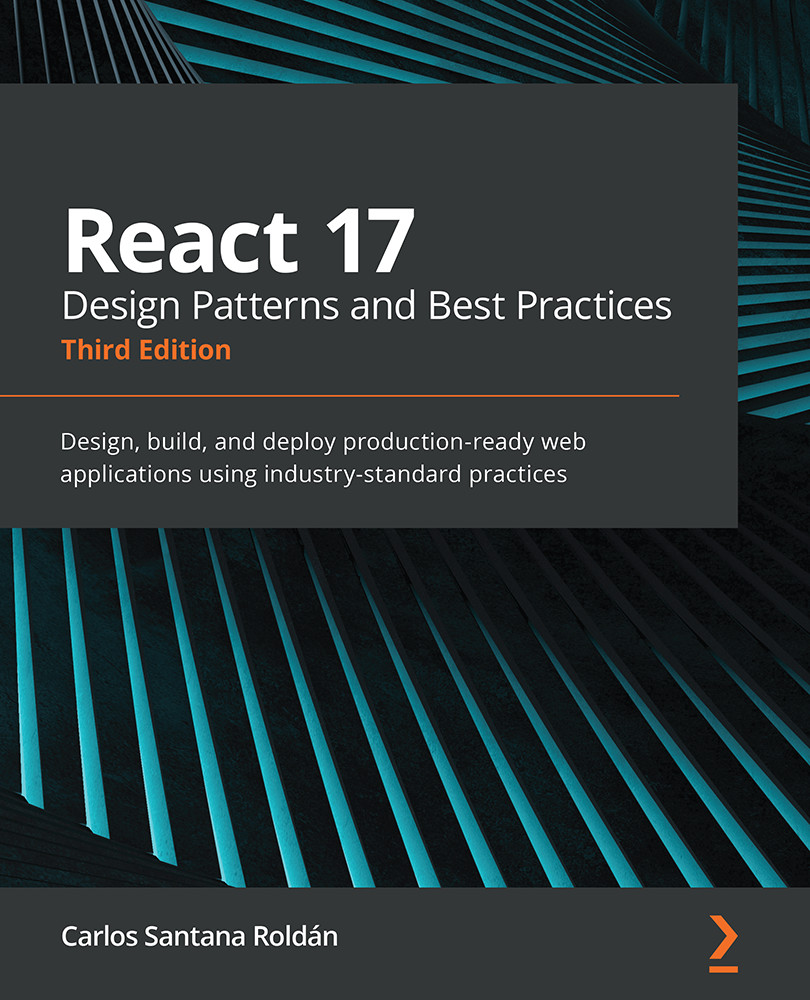
React 17 Design Patterns and Best Practices - Third Edition

By : Carlos Santana Roldán
3.5 (10)
close
close
React 17 Design Patterns and Best Practices

React 17 Design Patterns and Best Practices

3.5 (10)
By: Carlos Santana Roldán

Overview of this book

Filled with useful React patterns that you can use in your projects straight away, this book will help you save time and build better web applications with ease. React 17 Design Patterns and Best Practices is a hands-on guide for those who want to take their coding skills to a new level. You’ll spend most of your time working your way through the principles of writing maintainable and clean code, but you’ll also gain a deeper insight into the inner workings of React. As you progress through the chapters, you’ll learn how to build components that are reusable across the application, how to structure applications, and create forms that actually work. Then you’ll build on your knowledge by exploring how to style React components and optimize them to make applications faster and more responsive. Once you’ve mastered the rest, you’ll learn how to write tests effectively and how to contribute to React and its ecosystem. By the end of this book, you'll be able to avoid the process of trial and error and developmental headaches. Instead, you’ll be able to use your new skills to efficiently build and deploy real-world React web applications you can be proud of.
Table of Contents (21 chapters)
close
close
1
Hello React!
4
How React Works
10
Performance, Improvements, and Production!
19
About Packt

Introducing the React Context API

The React Context API has been officially added since version 16.3.0; before it was just experimental. The new Context API is a game-changer. A lot of people are moving away from Redux in order to use the new Context API. Context provides a way to share data between components without passing a prop to all the child components.

Let's see a basic example where we can use the new Context API. We will do the same example we did in Chapter 3, React Hooks, where we fetched some GitHub issues, but now using the Context API.

Creating our first context

The first thing you need to do is to create the issue context. For this, you can create a folder called contexts inside your src folder and then inside that, add the Issue.tsx file.

Then, you need to import some functions from React and axios:

import { FC, createContext, useState, useEffect, ReactElement, useCallback } from 'react'
import axios from 'axios'

At this point, it is clear that...

CONTINUE READING
83
Tech Concepts
36
Programming languages
73
Tech Tools
Icon Unlimited access to the largest independent learning library in tech of over 8,000 expert-authored tech books and videos.
Icon Innovative learning tools, including AI book assistants, code context explainers, and text-to-speech.
Icon 50+ new titles added per month and exclusive early access to books as they are being written.
React 17 Design Patterns and Best Practices
notes
bookmark Notes and Bookmarks search Search in title playlist Add to playlist download Download options font-size Font size

Change the font size

margin-width Margin width

Change margin width

day-mode Day/Sepia/Night Modes

Change background colour

Close icon Search
Country selected

Close icon Your notes and bookmarks

Confirmation

Modal Close icon
claim successful

Buy this book with your credits?

Modal Close icon
Are you sure you want to buy this book with one of your credits?
Close
YES, BUY

Submit Your Feedback

Modal Close icon
Modal Close icon
Modal Close icon