


-
Book Overview & Buying
-
Table Of Contents

Modern API Development with Spring and Spring Boot
By :


Modern API Development with Spring and Spring Boot
By:
Overview of this book
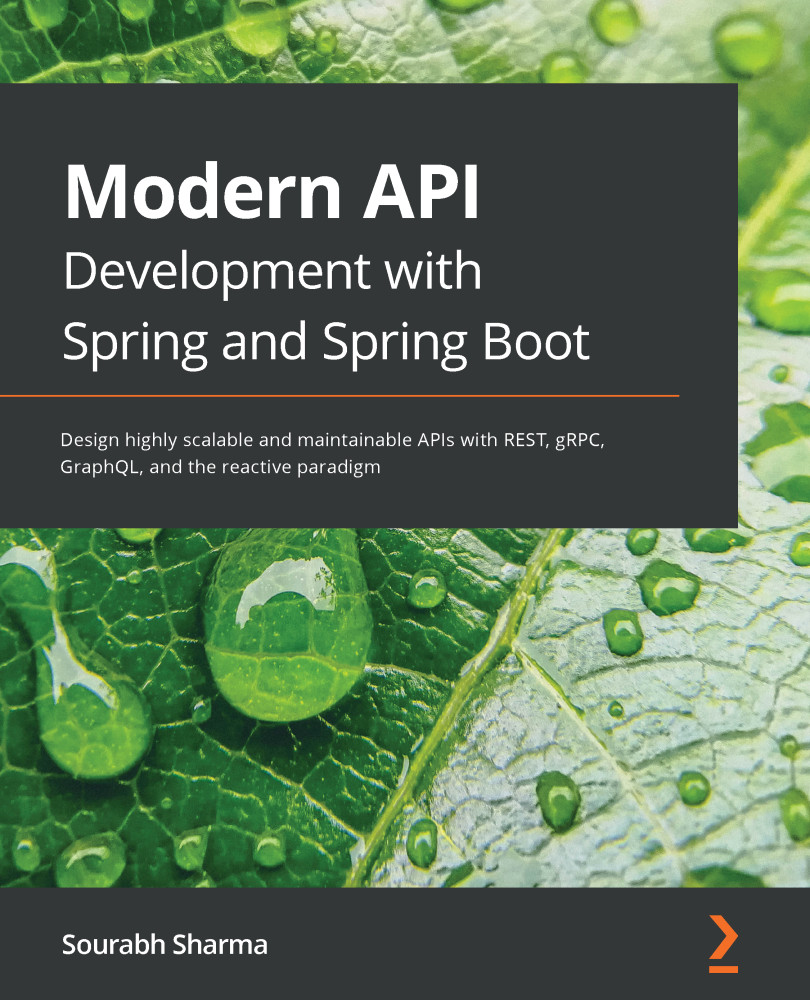
The philosophy of API development has evolved over the years to serve the modern needs of enterprise architecture, and developers need to know how to adapt to these modern API design principles. Apps are now developed with APIs that enable ease of integration for the cloud environment and distributed systems. With this Spring book, you'll discover various kinds of production-ready API implementation using REST APIs and explore async using the reactive paradigm, gRPC, and GraphQL.
You'll learn how to design evolving REST-based APIs supported by HATEOAS and ETAGs and develop reactive, async, non-blocking APIs. After that, you'll see how to secure REST APIs using Spring Security and find out how the APIs that you develop are consumed by the app's UI. The book then takes you through the process of testing, deploying, logging, and monitoring your APIs. You'll also explore API development using gRPC and GraphQL and design modern scalable architecture with microservices. The book helps you gain practical knowledge of modern API implementation using a sample e-commerce app.
By the end of this Spring book, you'll be able to develop, test, and deploy highly scalable, maintainable, and developer-friendly APIs to help your customers to transform their business.
Table of Contents (21 chapters)
Preface


Section 1: RESTful Web Services
 Free Chapter
Chapter 1: RESTful Web Service Fundamentals
Chapter 2: Spring Concepts and REST APIs
Chapter 3: API Specifications and Implementation
Chapter 4: Writing Business Logic for APIs
Chapter 5: Asynchronous API Design
Section 2: Security, UI, Testing, and Deployment
Chapter 6: Security (Authorization and Authentication)
Chapter 7: Designing a User Interface
Chapter 8: Testing APIs
Chapter 9: Deployment of Web Services
Section 3: gRPC, Logging, and Monitoring
Chapter 10: gRPC Fundamentals

Chapter 11: gRPC-based API Development and Testing
Chapter 12: Logging and Tracing
Section 4: GraphQL
Chapter 13: GraphQL Fundamentals
Chapter 14: GraphQL API Development and Testing
Assessments


