


-
Book Overview & Buying
-
Table Of Contents

Node.js Design Patterns - Fourth Edition
By :


Node.js Design Patterns
By:
Overview of this book
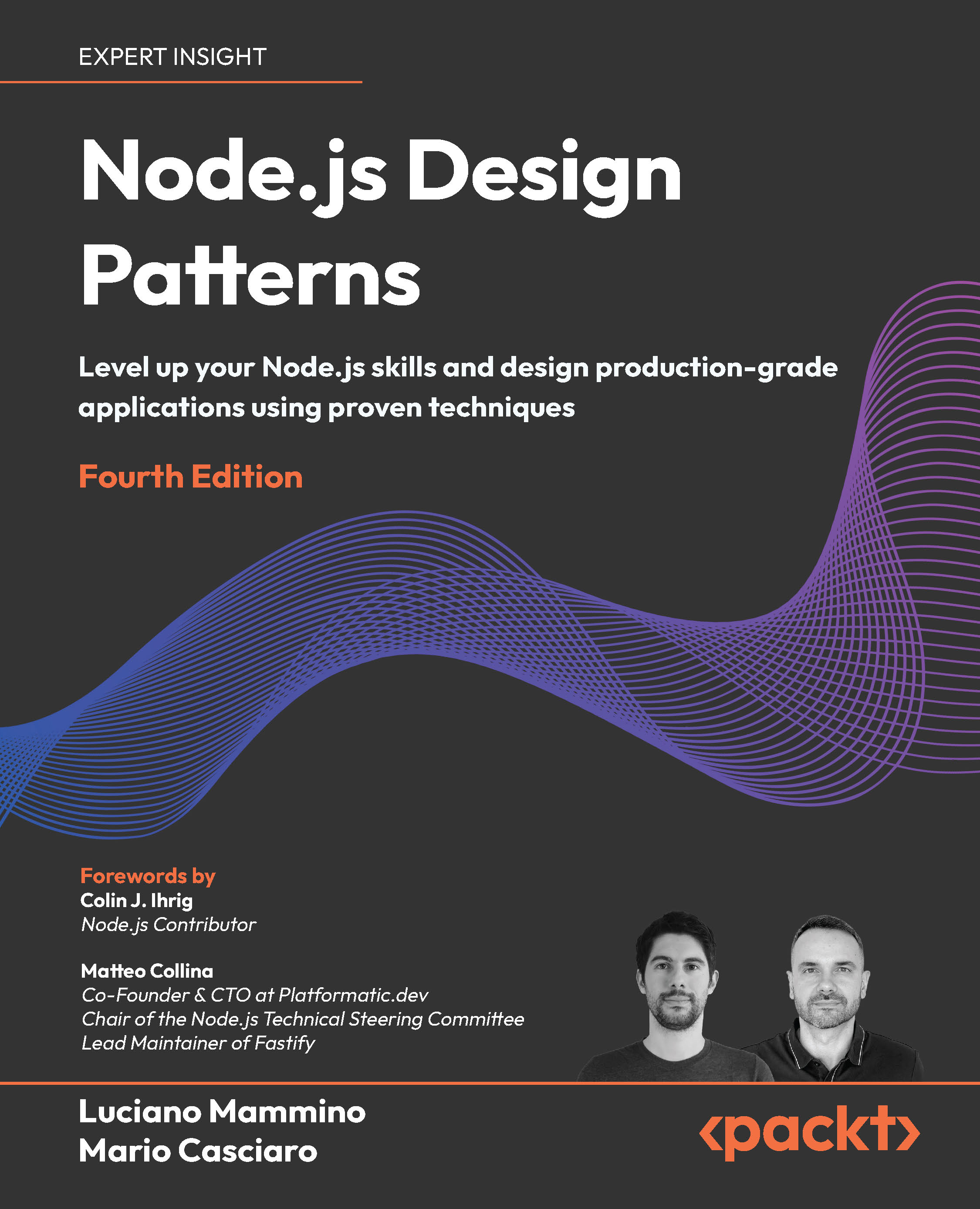
Node.js underpins much of modern web development, reliably powering APIs and full-stack apps across all industries. Authors Luciano Mammino and Mario Casciaro offer a practical guide that unpacks the JavaScript runtime so you can write reliable, high-performance Node.js apps.
Building on the highly rated third edition, this new edition adds fresh case studies and the latest Node.js developments: newer APIs and libraries, ESM improvements, practical security and production tips, and guidance on using Node.js with TypeScript. It also introduces a new chapter on testing that gives you a full introduction to testing philosophy and practical guidance on writing unit, integration, and end-to-end tests, giving you the confidence to write functional, stable, and reliable code.
Real-world, end-to-end examples throughout the book show how to build microservices and distributed systems with Node.js, integrating production-proven technologies such as Redis, RabbitMQ, LevelDB, and ZeroMQ, the same components you’ll find in scalable deployments at companies of all sizes. End-of-chapter exercises consolidate your understanding.
By the end of this Node.js book, you’ll have the design patterns, mindset, and hands-on skills every serious Node.js professional needs to confidently architect robust, efficient, and maintainable applications.
Table of Contents (16 chapters)
Preface


The Node.js Platform
The Module System
Callbacks and Events

Asynchronous Control Flow Patterns with Callbacks
Asynchronous Control Flow Patterns with Promises and Async/Await
 Free Chapter
Coding with Streams
Creational Design Patterns
Structural Design Patterns
Behavioral Design Patterns
Testing: Patterns and Best Practices
Advanced Recipes
Scalability and Architectural Patterns
Messaging and Integration Patterns
Other Books You May Enjoy
Index


