Sign In Start Free Trial
Account

Add to playlist

Create a Playlist

Modal Close icon
You need to login to use this feature.
  • Book Overview & Buying An Atypical ASP.NET Core 6 Design Patterns Guide
  • Table Of Contents Toc
An Atypical ASP.NET Core 6 Design Patterns Guide

An Atypical ASP.NET Core 6 Design Patterns Guide - Second Edition

By : Carl-Hugo Marcotte
4.7 (19)
close
close
An Atypical ASP.NET Core 6 Design Patterns Guide

An Atypical ASP.NET Core 6 Design Patterns Guide

4.7 (19)
By: Carl-Hugo Marcotte

Overview of this book

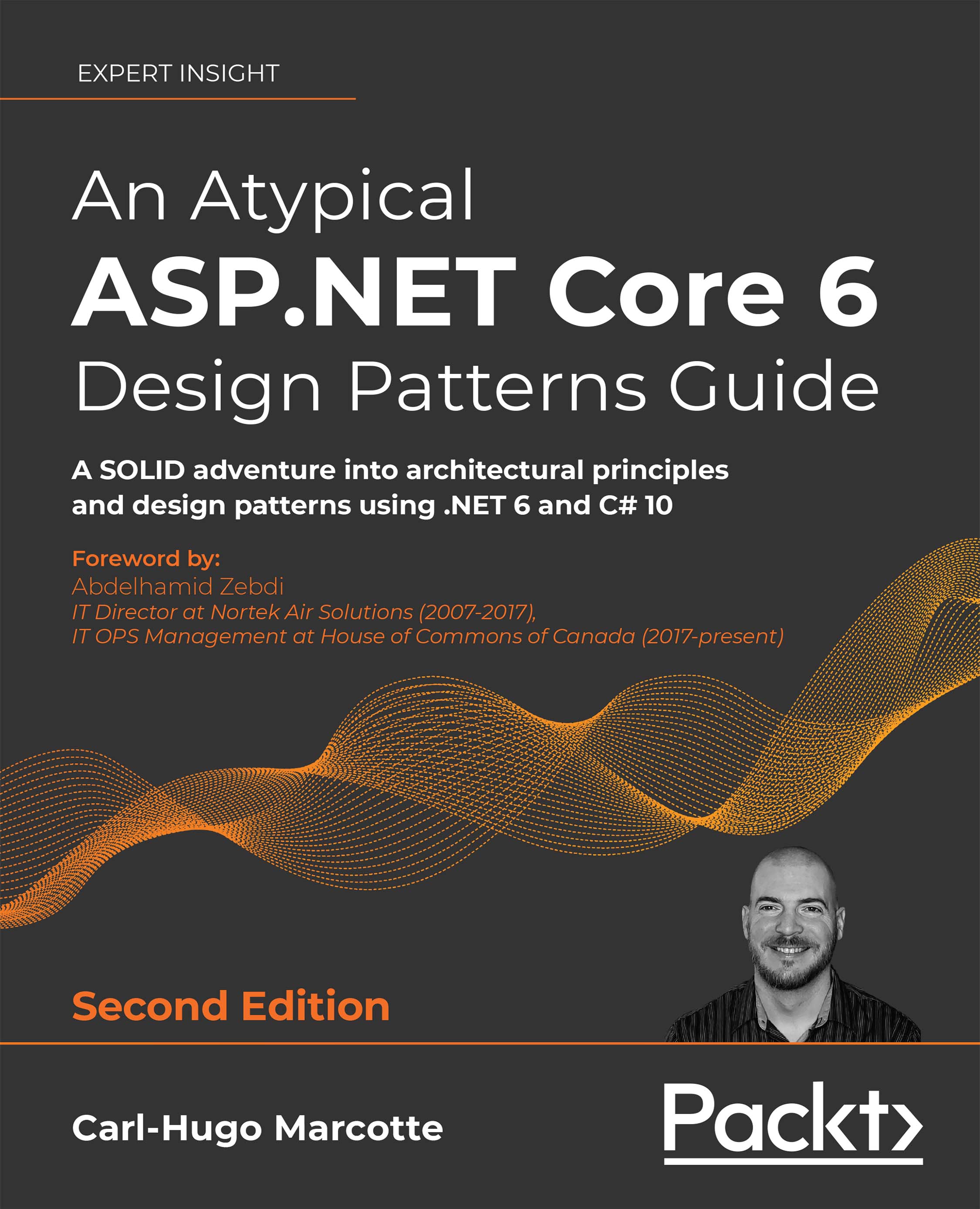
An Atypical ASP.NET Core 6 Design Patterns Guide, Second Edition approaches programming like playing with LEGO®: snapping small pieces together to create something beautiful. Thoroughly updated for ASP.NET Core 6, with further coverage of microservices patterns, data contracts, and event-driven architecture, this book gives you the tools to build and glue reliable components together to improve your programmatic masterpieces. The chapters are organized based on scale and topic, allowing you to start small and build on a strong base, the same way that you would develop a program. You will begin by exploring basic design patterns, SOLID architectural principles, dependency injection, and other ASP.NET Core 6 mechanisms. You will explore component-scale patterns, and then move to higher level application-scale patterns and techniques to better structure your applications. Finally, you'll advance to the client side to connect the dots with tools like Blazor and make ASP.NET Core a viable full-stack web development framework. You will supplement your learning with practical use cases and best practices, exploring a range of significant Gang of Four (GoF) design patterns along the way. By the end of the book, you will be comfortable combining and implementing patterns in different ways, and crafting software solutions of any scale.
Table of Contents (31 chapters)
close
close
Preface
Lock Free Chapter
1
Section 1: Principles and Methodologies
chevron up
5
Section 2: Designing for ASP.NET Core
11
Section 3: Designing at Component Scale
15
Section 4: Designing at Application Scale
21
Section 5: Designing the Client Side
25
Acronyms Lexicon
26
Other Books You May Enjoy
27
Index
1
Appendices

Principles and Methodologies

This section delves into the core architectural principles and testing methodologies that form the backbone of modern software engineering practices, setting a solid foundation for the book. By exploring these essential concepts, you gain the insights needed to navigate the complexities of software architecture and ASP.NET Core development.

We begin with an introduction to the book’s structure and the essential knowledge required to make the most out of it, including a brief overview of design patterns, their significance, and the role of experience in shaping architectural decisions. We emphasize understanding rather than memorizing patterns, encouraging you to experiment and learn through hands-on experimentation.

The journey continues with a look at automated testing, a critical component of software quality assurance. Chapter 2, Automated Testing, introduces the fundamentals of testing, including unit tests, integration tests, and the principles of test-driven development (TDD). With a focus on the xUnit framework, you will learn how to apply various testing strategies to improve code reliability and maintainability. This chapter introduces integrating testing into the development process, emphasizing its role in modern workflows.

We explore architectural principles in Chapter 3, Architectural Principles, where we dissect the building blocks of software architecture, including discussions on responsibility segregation, the significance of design patterns, and strategies for creating robust and scalable systems. The chapter aims to equip you with the knowledge to make informed architectural decisions, emphasizing the rationale behind common design choices.

Chapter 4, REST APIs, covers REST APIs, an essential aspect of modern web development. This chapter provides a practical guide to designing and implementing RESTful APIs, including best practices and considerations for security, performance, and scalability. Through this exploration, you will understand how REST APIs fit into the architectural landscape.

By the end of these chapters, you will understand crucial concepts and have a strong foundation in testing methodologies, architectural principles, and REST APIs. Tying these concepts together lays the groundwork for a successful journey into software architecture, development, and the rest of the book.

This section comprises the following chapters:

  • Chapter 1, Introduction
  • Chapter 2, Automated Testing
  • Chapter 3, Architectural Principles
  • Chapter 4, REST APIs
Visually different images
CONTINUE READING
83
Tech Concepts
36
Programming languages
73
Tech Tools
Icon Unlimited access to the largest independent learning library in tech of over 8,000 expert-authored tech books and videos.
Icon Innovative learning tools, including AI book assistants, code context explainers, and text-to-speech.
Icon 50+ new titles added per month and exclusive early access to books as they are being written.
An Atypical ASP.NET Core 6 Design Patterns Guide
notes
bookmark Notes and Bookmarks search Search in title playlist Add to playlist download Download options font-size Font size

Change the font size

margin-width Margin width

Change margin width

day-mode Day/Sepia/Night Modes

Change background colour

Close icon Search
Country selected

Close icon Your notes and bookmarks

Confirmation

Modal Close icon
claim successful

Buy this book with your credits?

Modal Close icon
Are you sure you want to buy this book with one of your credits?
Close
YES, BUY

Submit Your Feedback

Modal Close icon
Modal Close icon
Modal Close icon