


-
Book Overview & Buying
-
Table Of Contents

Architecting ASP.NET Core Applications - Third Edition
By :


Architecting ASP.NET Core Applications
By:
Overview of this book
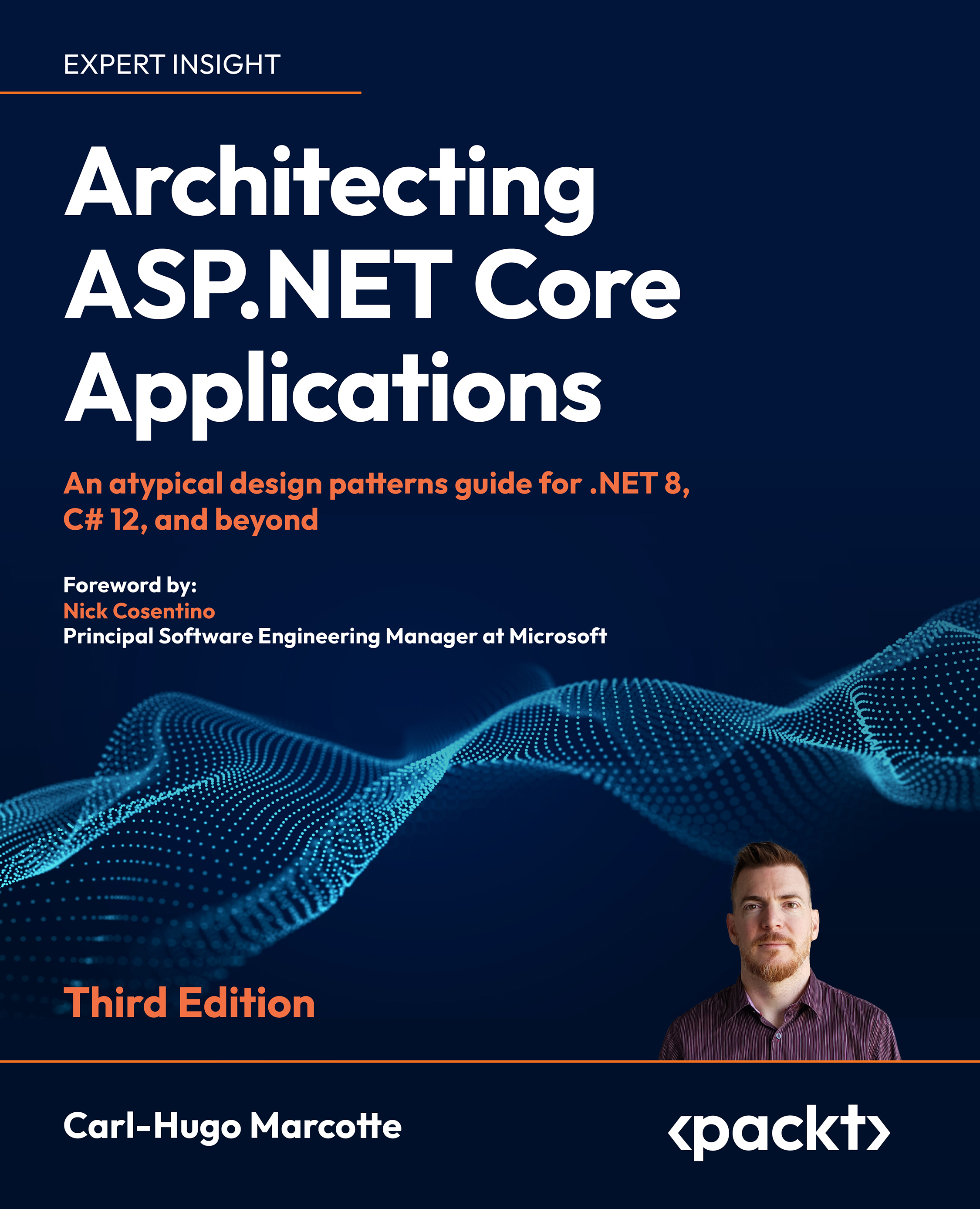
This unique ASP.NET Core book will fill in the gaps in your REST API and backend designs. Learn how to build robust, maintainable, and flexible apps using Gang of Four (GoF) design patterns and modern architectural principles. This new edition is updated for .NET 8 and focuses exclusively on the backend, with new content on REST APIs, the REPR pattern, and building modular monoliths.
You’ll start by covering foundational concepts like REST, the SOLID principles, Minimal APIs, dependency injection in .NET, and other ASP.NET Core 8 mechanisms. Then, you’ll learn to develop components using design patterns, including many from the GoF. Finally, you’ll explore organizing your application code with patterns that vary from layers to feature-oriented vertical slice designs, covering CQS and a deep dive into microservices along the way. A brand-new e-commerce project at the end of the book will tie it all together.
This how-to guide will teach you how to assemble your own APIs from building blocks, to suit whatever real-world requirements you may have.
Table of Contents (27 chapters)
Preface


Introduction
Automated Testing

Architectural Principles
REST APIs
Section 2: Designing with ASP.NET Core
Minimal APIs
Model-View-Controller
Strategy, Abstract Factory, and Singleton Design Patterns
Dependency Injection
Application Configuration and the Options Pattern
Logging Patterns
Section 3: Component Patterns
Structural Patterns
Behavioral Patterns
Operation Result Pattern
Section 4: Application Patterns
Layering and Clean Architecture
Object Mappers
Mediator and CQS Patterns
Getting Started with Vertical Slice Architecture
Request-EndPoint-Response (REPR)
Introduction to Microservices Architecture
Modular Monolith
Other Books You May Enjoy
Index


