


-
Book Overview & Buying
-
Table Of Contents

C# 13 and .NET 9 – Modern Cross-Platform Development Fundamentals - Ninth Edition
By :


C# 13 and .NET 9 – Modern Cross-Platform Development Fundamentals
By:
Overview of this book
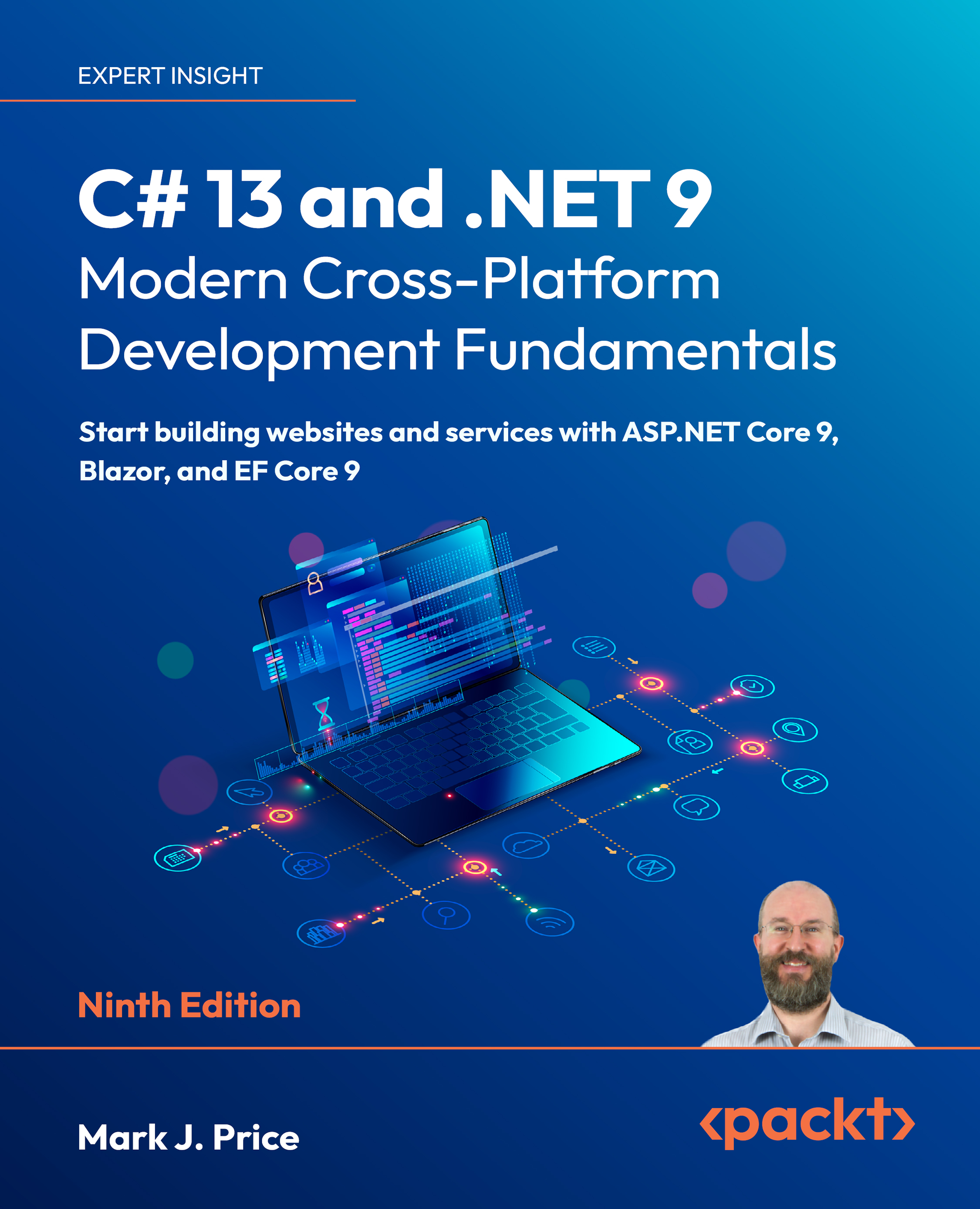
This Packt bestseller continues to be the definitive guide to modern cross-platform development. The 9th edition of C# 13 and .NET 9 – Modern Cross-Platform Development Fundamentals has been updated to cover the latest features and improvements in .NET 9 and C# 13. You'll start by mastering object-oriented programming, learning how to write, test, and debug functions, and implementing interfaces. You'll then dive into .NET APIs for data management, filesystem operations, and serialization.
This latest edition integrates .NET 9 enhancements into its examples: faster exceptions and new LINQ methods. New ASP.NET Core 9 features include optimized static assets, built-in OpenAPI document generation, and the HybridCache.
Practical examples, such as building websites and services with ASP.NET Core, have been refreshed to utilize the latest .NET 9 features. The book also introduces Blazor, with its new unified hosting model for unparalleled code reusability. With these updates, you'll learn how to build robust applications and services efficiently and effectively.
By the end of this book, you'll have the knowledge and confidence to create professional and high-performance web applications using the latest technologies in C# 13 and .NET 9.
Table of Contents (18 chapters)
Preface


 Free Chapter
Hello, C#! Welcome, .NET!
Speaking C#
Controlling Flow, Converting Types, and Handling Exceptions

Writing, Debugging, and Testing Functions
Building Your Own Types with Object-Oriented Programming
Implementing Interfaces and Inheriting Classes
Packaging and Distributing .NET Types
Working with Common .NET Types
Working with Files, Streams, and Serialization
Working with Data Using Entity Framework Core
Querying and Manipulating Data Using LINQ
Introducing Modern Web Development Using .NET
Building Websites Using ASP.NET Core
Building Interactive Web Components Using Blazor
Building and Consuming Web Services
Epilogue
Index


