Sign In Start Free Trial
Account

Add to playlist

Create a Playlist

Modal Close icon
You need to login to use this feature.
  • Book Overview & Buying Data Science Projects with Python
  • Table Of Contents Toc
Data Science Projects with Python

Data Science Projects with Python

By : Stephen Klosterman
4.3 (17)
close
close
Data Science Projects with Python

Data Science Projects with Python

4.3 (17)
By: Stephen Klosterman

Overview of this book

Data Science Projects with Python is designed to give you practical guidance on industry-standard data analysis and machine learning tools, by applying them to realistic data problems. You will learn how to use pandas and Matplotlib to critically examine datasets with summary statistics and graphs, and extract the insights you seek to derive. You will build your knowledge as you prepare data using the scikit-learn package and feed it to machine learning algorithms such as regularized logistic regression and random forest. You’ll discover how to tune algorithms to provide the most accurate predictions on new and unseen data. As you progress, you’ll gain insights into the working and output of these algorithms, building your understanding of both the predictive capabilities of the models and why they make these predictions. By then end of this book, you will have the necessary skills to confidently use machine learning algorithms to perform detailed data analysis and extract meaningful insights from unstructured data.
Table of Contents (9 chapters)
close
close
Data Science Projects with Python
Preface

Different Types of Data Science Problems


Much of your time as a data scientist is likely to be spent wrangling data: figuring out how to get it, getting it, examining it, making sure it's correct and complete, and joining it with other types of data. pandas will facilitate this process for you. However, if you aspire to be a machine learning data scientist, you will need to master the art and science of predictive modeling. This means using a mathematical model, or idealized mathematical formulation, to learn the relationships within the data, in the hope of making accurate and useful predictions when new data comes in.

For this purpose, data is typically organized in a tabular structure, with features and a response variable. For example, if you want to predict the price of a house based on some characteristics about it, such as area and number of bedrooms, these attributes would be considered the features and the price of the house would be the response variable. The response variable is sometimes called the target variable or dependent variable, while the features may also be called the independent variables.

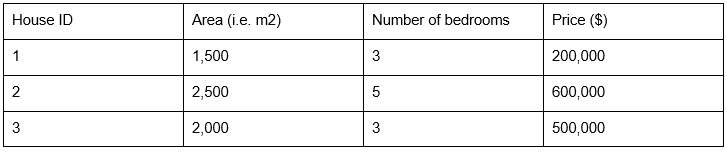
If you have a dataset of 1,000 houses including the values of these features and the prices of the houses, you can say you have 1,000 samples of labeled data, where the labels are the known values of the response variable: the prices of different houses. Most commonly, the tabular data structure is organized so that different rows are different samples, while features and the response occupy different columns, along with other metadata such as sample IDs, as shown in Figure 1.9.

Figure 1.9: Labeled data (the house prices are the known target variable)

Regression Problem

Once you have trained a model to learn the relationship between the features and response using your labeled data, you can then use it to make predictions for houses where you don't know the price, based on the information contained in the features. The goal of predictive modeling in this case is to be able to make a prediction that is close to the true value of the house. Since we are predicting a numerical value on a continuous scale, this is called a regression problem.

Classification Problem

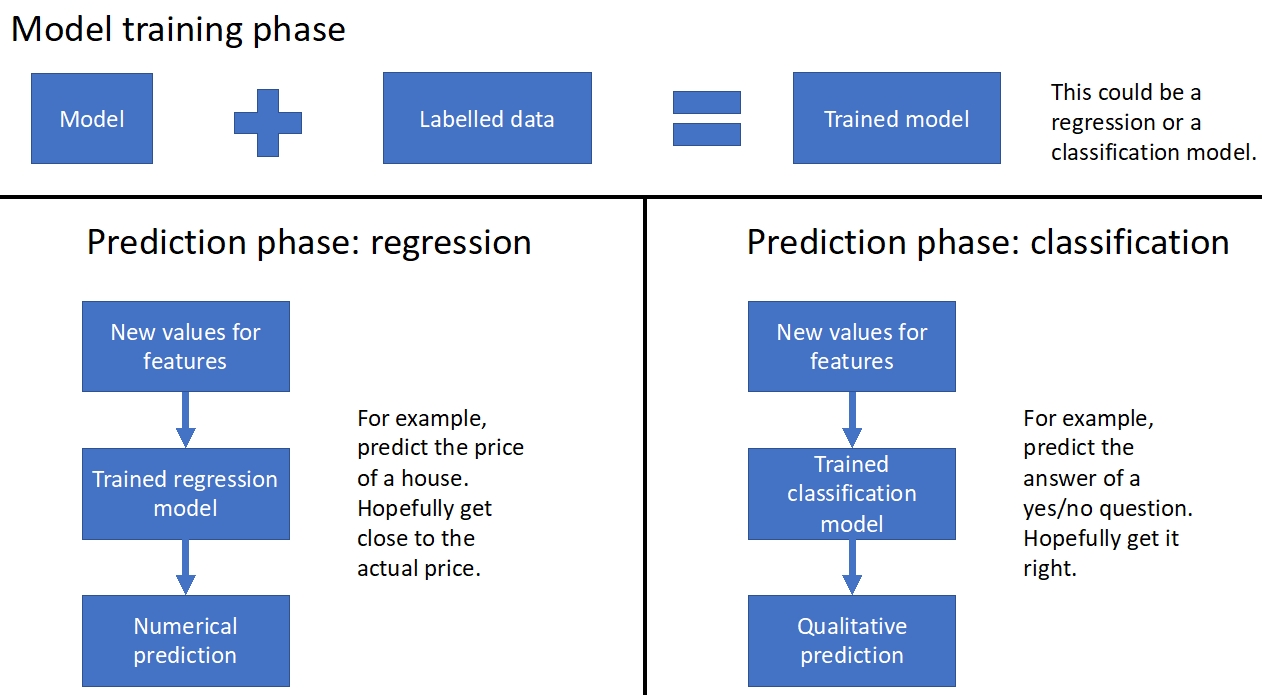
On the other hand, if we were trying to make a qualitative prediction about the house, to answer a yes or no question such as "will this house go on sale within the next five years?" or "will the owner default on the mortgage?", we would be solving what is known as a classification problem. Here, we would hope to answer the yes or no question correctly. The following figure is a schematic illustrating how model training works, and what the outcomes of regression or classification models might be:

Figure 1.10: Schematic of model training and prediction for regression and classification

Classification and regression tasks are called supervised learning, which is a class of problems that relies on labeled data. These problems can be thought of a needing "supervision" by the known values of the target variable. By contrast, there is also unsupervised learning, which relates to more open-ended questions of trying to find some sort of structure in a dataset that does not necessarily have labels. Taking a broader view, any kind of applied math problem, including fields as varied as optimization, statistical inference, and time series modeling, may potentially be considered an appropriate responsibility for a data scientist.

Visually different images
CONTINUE READING
83
Tech Concepts
36
Programming languages
73
Tech Tools
Icon Unlimited access to the largest independent learning library in tech of over 8,000 expert-authored tech books and videos.
Icon Innovative learning tools, including AI book assistants, code context explainers, and text-to-speech.
Icon 50+ new titles added per month and exclusive early access to books as they are being written.
Data Science Projects with Python
notes
bookmark Notes and Bookmarks search Search in title playlist Add to playlist font-size Font size

Change the font size

margin-width Margin width

Change margin width

day-mode Day/Sepia/Night Modes

Change background colour

Close icon Search
Country selected

Close icon Your notes and bookmarks

Confirmation

Modal Close icon
claim successful

Buy this book with your credits?

Modal Close icon
Are you sure you want to buy this book with one of your credits?
Close
YES, BUY

Submit Your Feedback

Modal Close icon
Modal Close icon
Modal Close icon