Sign In Start Free Trial
Account

Add to playlist

Create a Playlist

Modal Close icon
You need to login to use this feature.
  • Book Overview & Buying Learning jQuery, Third Edition
  • Table Of Contents Toc
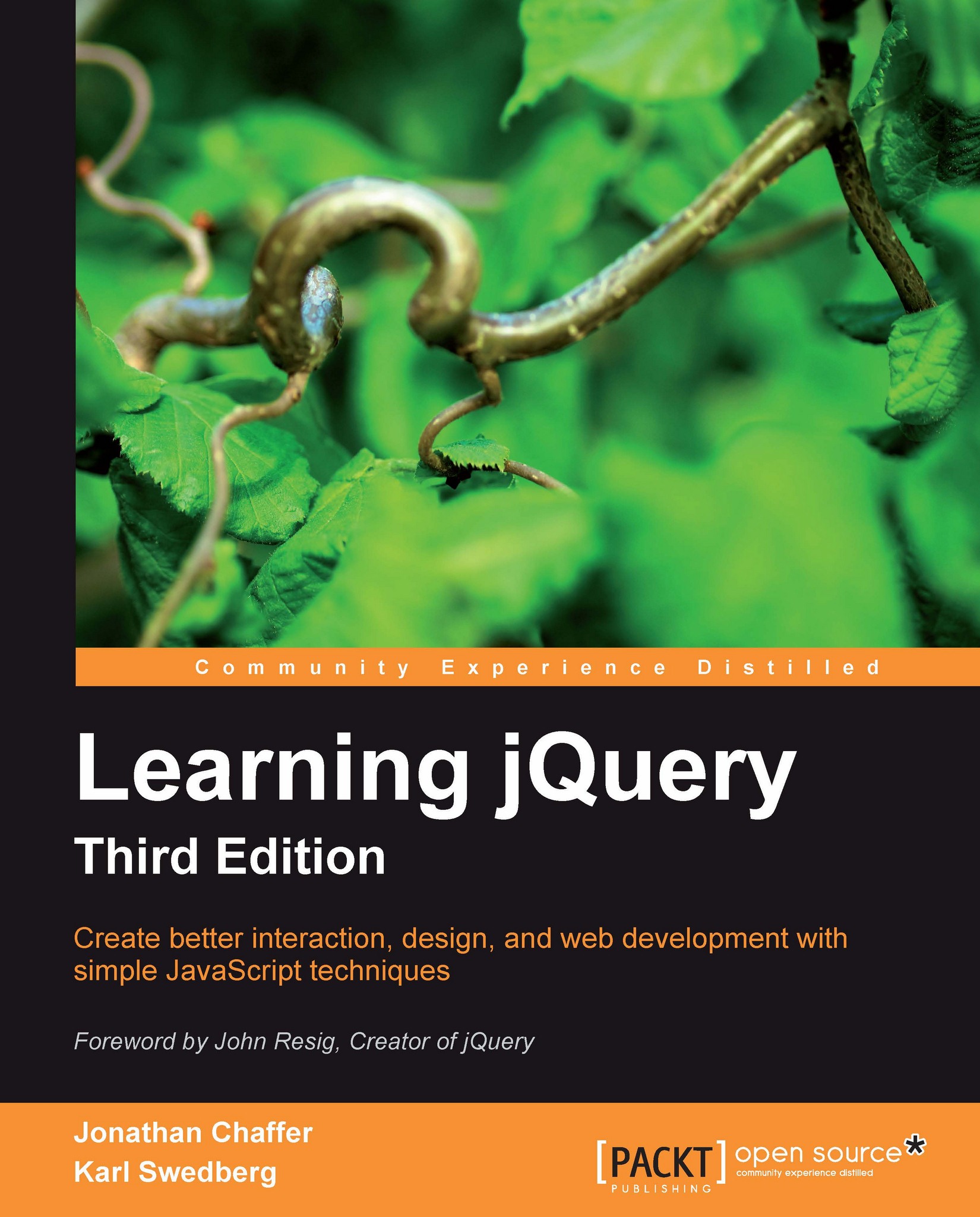
Learning jQuery, Third Edition

Learning jQuery, Third Edition

4.4 (23)
close
close
Learning jQuery, Third Edition

Learning jQuery, Third Edition

4.4 (23)

Overview of this book

To build interesting, interactive sites, developers are turning to JavaScript libraries such as jQuery to automate common tasks and simplify complicated ones. Because many web developers have more experience with HTML and CSS than with JavaScript, the library's design lends itself to a quick start for designers with little programming experience. Experienced programmers will also be aided by its conceptual consistency.Learning jQuery Third Edition is revised and updated for version 1.6 of jQuery. You will learn the basics of jQuery for adding interactions and animations to your pages. Even if previous attempts at writing JavaScript have left you baffled, this book will guide you past the pitfalls associated with AJAX, events, effects, and advanced JavaScript language features.Starting with an introduction to jQuery, you will first be shown how to write a functioning jQuery program in just three lines of code. Learn how to add impact to your actions through a set of simple visual effects and to create, copy, reassemble, and embellish content using jQuery's DOM modification methods. The book will step you through many detailed, real-world examples, and even equip you to extend the jQuery library itself with your own plug-ins.
Table of Contents (24 chapters)
close
close
Learning jQuery Third Edition
Credits
Foreword
About the Authors
About the Reviewers
www.PacktPub.com
Preface
4
Index

Performing tasks on page load


We have already seen how to make jQuery react to the loading of a web page. The $(document).ready() event handler can be used to fire off a function's worth of code, but there's a bit more to be said about it.

Timing of code execution

In Chapter 1, Getting Started, we noted that $(document).ready() was jQuery's primary way to perform tasks on page load. It is not, however, the only method at our disposal. The native window.onload event can achieve a similar effect. While the two methods are similar, it is important to recognize their difference in timing, even though it can be quite subtle depending on the number of resources being loaded.

The window.onload event fires when a document is completely downloaded to the browser. This means that every element on the page is ready to be manipulated by JavaScript, which is a boon for writing featureful code without worrying about load order.

On the other hand, a handler registered using $(document).ready() is invoked when...

CONTINUE READING
83
Tech Concepts
36
Programming languages
73
Tech Tools
Icon Unlimited access to the largest independent learning library in tech of over 8,000 expert-authored tech books and videos.
Icon Innovative learning tools, including AI book assistants, code context explainers, and text-to-speech.
Icon 50+ new titles added per month and exclusive early access to books as they are being written.
Learning jQuery, Third Edition
notes
bookmark Notes and Bookmarks search Search in title playlist Add to playlist font-size Font size

Change the font size

margin-width Margin width

Change margin width

day-mode Day/Sepia/Night Modes

Change background colour

Close icon Search
Country selected

Close icon Your notes and bookmarks

Confirmation

Modal Close icon
claim successful

Buy this book with your credits?

Modal Close icon
Are you sure you want to buy this book with one of your credits?
Close
YES, BUY

Submit Your Feedback

Modal Close icon
Modal Close icon
Modal Close icon