


-
Book Overview & Buying
-
Table Of Contents

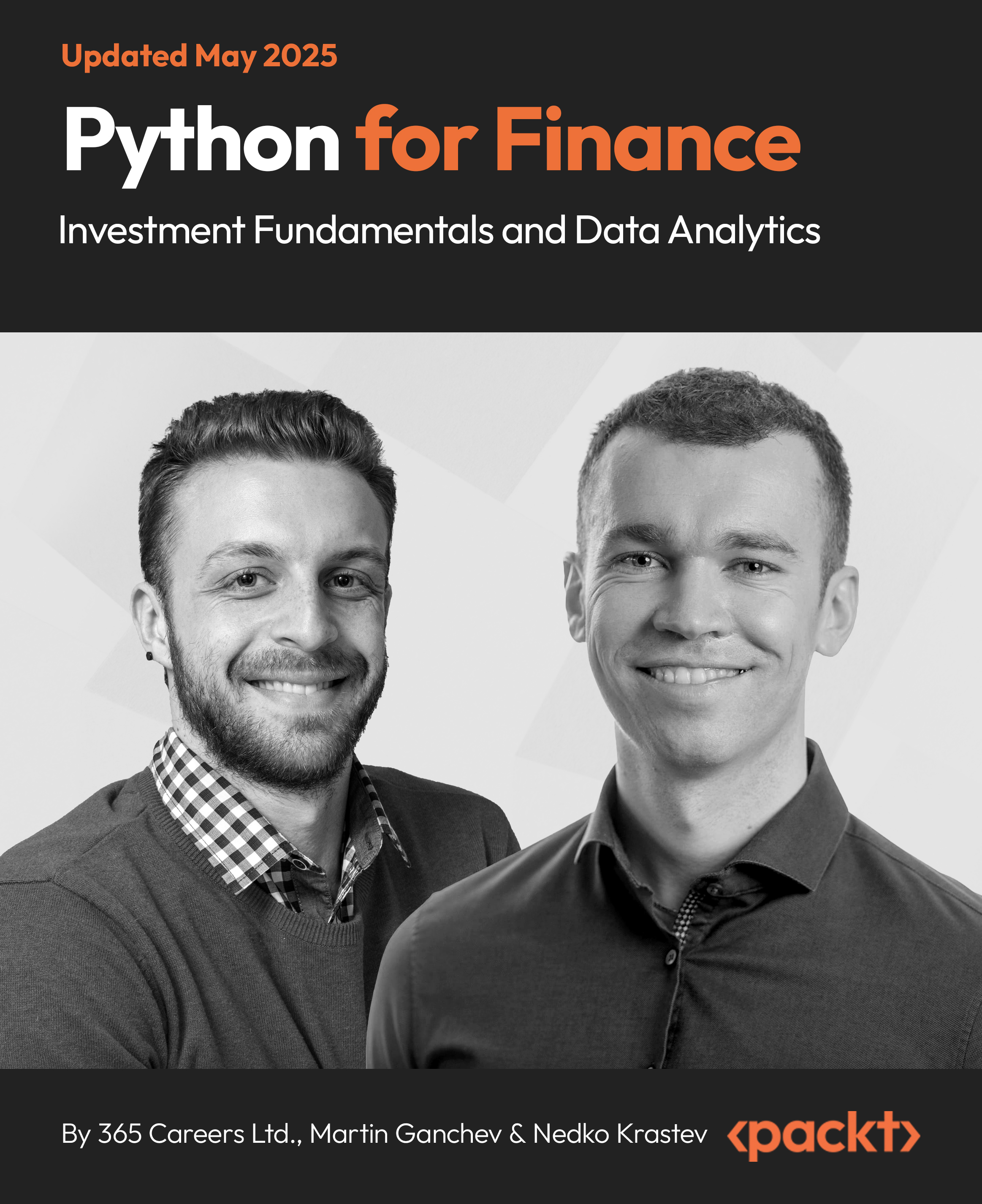
Python for Finance: Investment Fundamentals and Data Analytics
By :


Python for Finance: Investment Fundamentals and Data Analytics
By:
Overview of this book
Begin your journey with a structured introduction to programming through Python—one of the most versatile and beginner-friendly languages available. Early modules teach you to navigate Jupyter Notebooks, use Python 3, and work with variables, data types, and functions. You’ll build a solid foundation with sequences, loops, conditionals, and key syntax that underpins all professional coding environments.
Once you're comfortable with the language, you’ll delve into finance-specific applications. This includes calculating security and portfolio returns, analyzing financial risks, and measuring diversification effects using covariance and correlation. Regression models help deepen your insights, leading to the practical computation of alpha, beta, and other performance metrics. You'll also work with popular finance libraries and datasets to apply your knowledge in Python directly.
The final segments introduce quantitative tools such as Markowitz Portfolio Optimization, CAPM, and Monte Carlo simulations. Here, you'll build and visualize efficient frontiers, compute Sharpe ratios, and simulate asset price paths using real financial data. From predictive modeling to risk assessment, this course closes the gap between theoretical finance and hands-on data science, fully preparing you for roles that demand analytical and coding fluency.
Table of Contents (17 chapters)
Welcome! Course Introduction


Introduction to Programming with Python

Python Variables and Data Types
Basic Python Syntax
Python Operators Continued
Conditional Statements
Python Functions
Python Sequences
Using Iterations in Python
Advanced Python Tools
PART II FINANCE – Calculating and Comparing Rates of Return in Python
PART II FINANCE – Measuring Investment Risk
PART II FINANCE – Using Regressions for Financial Analysis
PART II FINANCE – Markowitz Portfolio Optimization
PART II FINANCE – The Capital Asset Pricing Model
PART II FINANCE – Multivariate Regression Analysis
PART II FINANCE – Monte Carlo Simulations as a Decision-Making Tool
 This video is locked


