Sign In Start Free Trial
Account

Add to playlist

Create a Playlist

Modal Close icon
You need to login to use this feature.
  • Book Overview & Buying Statistics for Machine Learning
  • Table Of Contents Toc
  • Feedback & Rating feedback
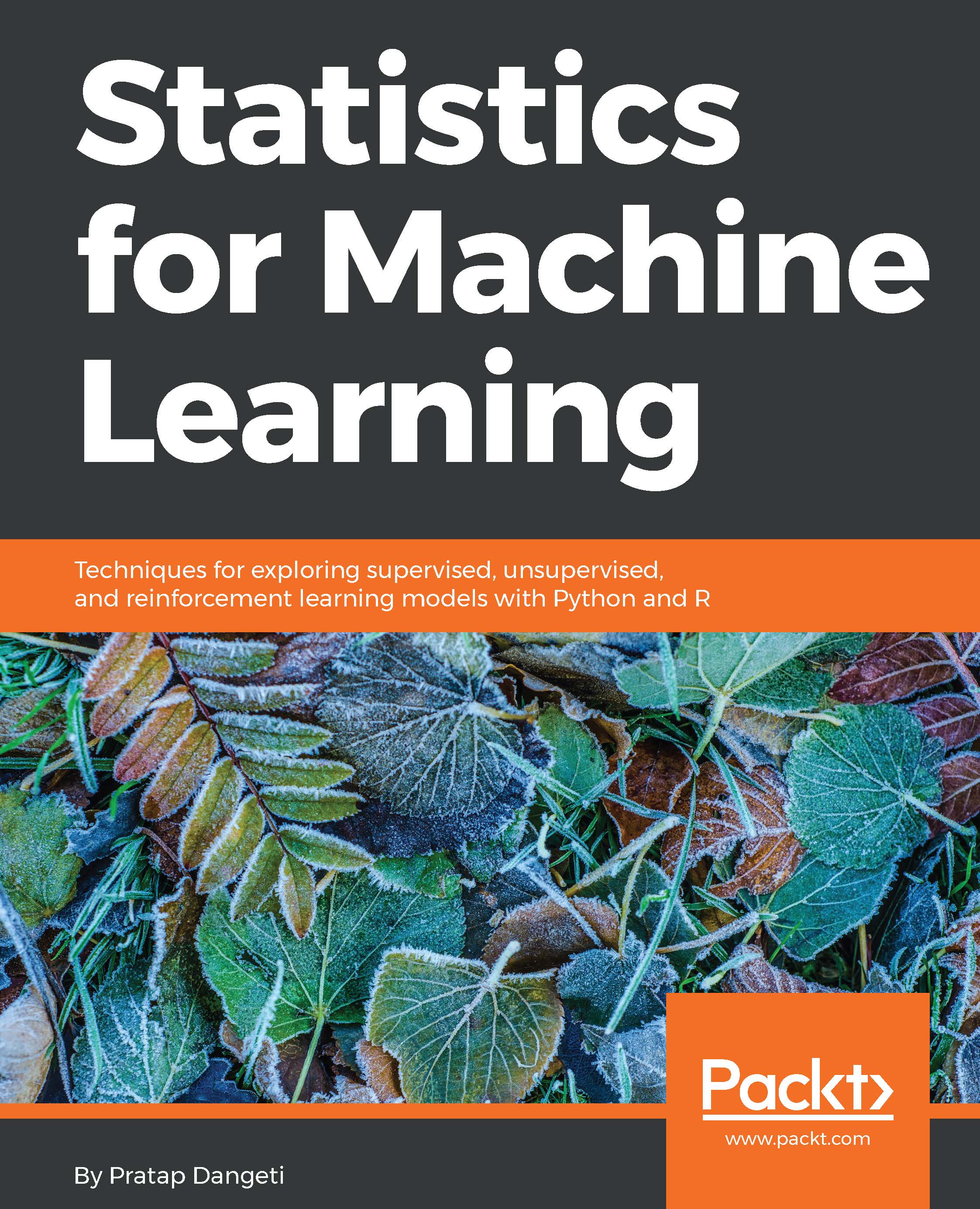
Statistics for Machine Learning

Statistics for Machine Learning

By : Pratap Dangeti
3.7 (6)
close
close
Statistics for Machine Learning

Statistics for Machine Learning

3.7 (6)
By: Pratap Dangeti

Overview of this book

Complex statistics in machine learning worry a lot of developers. Knowing statistics helps you build strong machine learning models that are optimized for a given problem statement. This book will teach you all it takes to perform the complex statistical computations that are required for machine learning. You will gain information on the statistics behind supervised learning, unsupervised learning, reinforcement learning, and more. You will see real-world examples that discuss the statistical side of machine learning and familiarize yourself with it. You will come across programs for performing tasks such as modeling, parameter fitting, regression, classification, density collection, working with vectors, matrices, and more. By the end of the book, you will have mastered the statistics required for machine learning and will be able to apply your new skills to any sort of industry problem.
Table of Contents (10 chapters)
close
close

Model building technique using encoder-decoder architecture


Training the auto encoder model is a bit tricky, hence a detailed illustration has been provided for better understanding for readers. During the training phase, the whole encoder-decoder section is trained against the same input as an output of decoder. In order to achieve the desired output, features will be compressed during the middle layer, as we are passing through the convergent and divergent layers. Once enough training has been done by reducing the error values over the number of iterations, we will use the trained encoder section to create the latent features for next stage of modeling, or for visualization, and so on.

In the following diagram, a sample has been shown. The input and output layers have five neurons, whereas the number of neurons has been gradually decreased in the middle sections. The compressed layer has only two neurons, which is the number of latent dimensions we would like to extract from the data.

The...

Visually different images
CONTINUE READING
83
Tech Concepts
36
Programming languages
73
Tech Tools
Icon Unlimited access to the largest independent learning library in tech of over 8,000 expert-authored tech books and videos.
Icon Innovative learning tools, including AI book assistants, code context explainers, and text-to-speech.
Icon 50+ new titles added per month and exclusive early access to books as they are being written.
Statistics for Machine Learning
notes
bookmark Notes and Bookmarks search Search in title playlist Add to playlist download Download options font-size Font size

Change the font size

margin-width Margin width

Change margin width

day-mode Day/Sepia/Night Modes

Change background colour

Close icon Search
Country selected

Close icon Your notes and bookmarks

Confirmation

Modal Close icon
claim successful

Buy this book with your credits?

Modal Close icon
Are you sure you want to buy this book with one of your credits?
Close
YES, BUY

Submit Your Feedback

Modal Close icon
Modal Close icon
Modal Close icon