


Recommendation engines (REs) are most famously used for explaining what machine learning is to any unknown person or a newbie who wants to understand the field of machine learning. A classic example could be how Amazon recommends books similar to the ones you have bought, which you may also like very much! Also, empirically, the recommender engine seems to be an example of large-scale machine learning that everyone understands, or perhaps already understood. But, nonetheless, recommendation engines are being used everywhere. For example, the people you may know feature in Facebook or LinkedIn, which recommends by showing the most probable people you might like to befriend or professionals in your network who you might be interested in connecting with. Of course, these features drive their businesses big time and it is at the heart of the company's driving...
-
Book Overview & Buying
-
Table Of Contents

Statistics for Machine Learning
By :


Statistics for Machine Learning
By:
Overview of this book
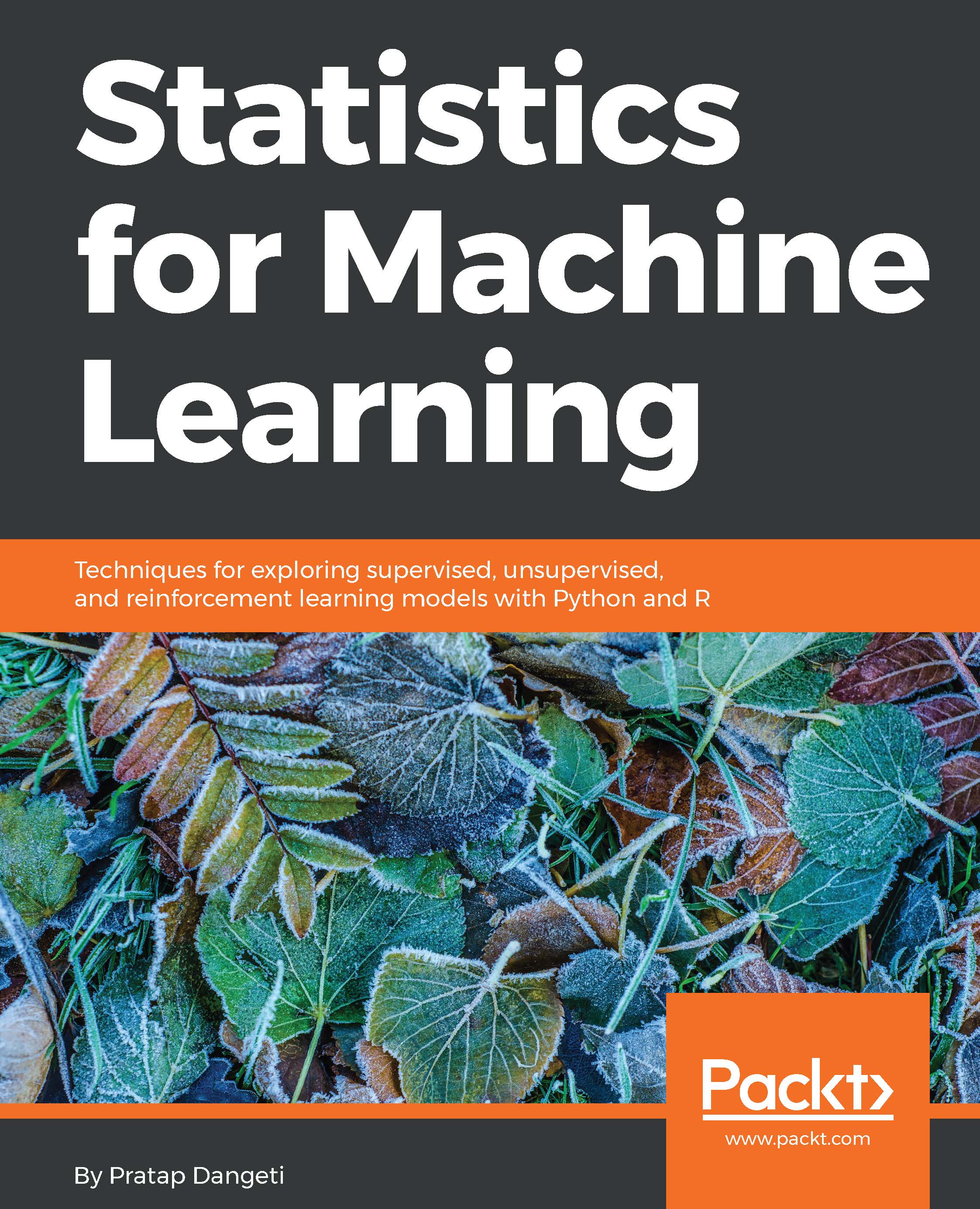
Complex statistics in machine learning worry a lot of developers. Knowing statistics helps you build strong machine learning models that are optimized for a given problem statement.
This book will teach you all it takes to perform the complex statistical computations that are required for machine learning. You will gain information on the statistics behind supervised learning, unsupervised learning, reinforcement learning, and more. You will see real-world examples that discuss the statistical side of machine learning and familiarize yourself with it. You will come across programs for performing tasks such as modeling, parameter fitting, regression, classification, density collection, working with vectors, matrices, and more.
By the end of the book, you will have mastered the statistics required for machine learning and will be able to apply your new skills to any sort of industry problem.
Table of Contents (10 chapters)
Preface

 Free Chapter
Journey from Statistics to Machine Learning
Parallelism of Statistics and Machine Learning
Logistic Regression Versus Random Forest
Tree-Based Machine Learning Models
K-Nearest Neighbors and Naive Bayes
Support Vector Machines and Neural Networks
Recommendation Engines

Unsupervised Learning
Reinforcement Learning


