Sign In Start Free Trial
Account

Add to playlist

Create a Playlist

Modal Close icon
You need to login to use this feature.
  • Book Overview & Buying Dynamic System Reliability
  • Table Of Contents Toc
Dynamic System Reliability

Dynamic System Reliability

By : Liudong Xing, Gregory Levitin, Chaonan Wang
close
close
Dynamic System Reliability

Dynamic System Reliability

By: Liudong Xing, Gregory Levitin, Chaonan Wang

Overview of this book

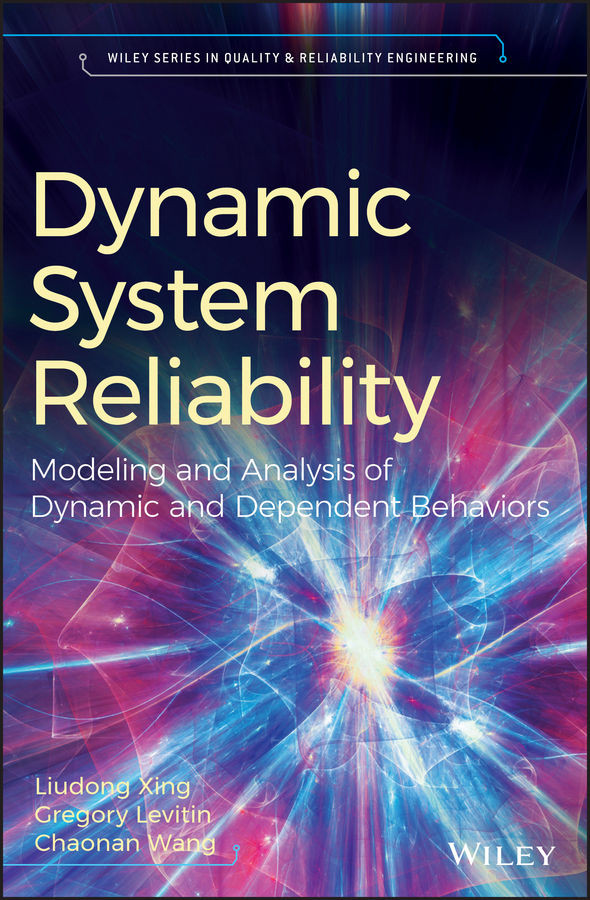
This book focuses on hot issues of dynamic system reliability, systematically introducing the reliability modeling and analysis methods for systems with imperfect fault coverage, systems with function dependence, systems subject to deterministic or probabilistic common-cause failures, systems subject to deterministic or probabilistic competing failures, and dynamic standby sparing systems. It presents recent developments of such extensions involving reliability modeling theory, reliability evaluation methods, and features numerous case studies based on real-world examples. The presented dynamic reliability theory can enable a more accurate representation of actual complex system behavior, thus more effectively guiding the reliable design of real-world critical systems. The book begins by describing the evolution from the traditional static reliability theory to the dynamic system reliability theory and provides a detailed investigation of dynamic and dependent behaviors in subsequent chapters. Although written for those with a background in basic probability theory and stochastic processes, the book includes a chapter reviewing the fundamentals that readers need to know in order to understand the contents of other chapters that cover advanced topics in reliability theory and case studies.
Table of Contents (14 chapters)
close
close
Preface
Lock Free Chapter
1
Nomenclature
2
1 Introduction
12
Index
13
End User License Agreement

6.4 Universal Generating Function–Based Method

This section presents a universal generating function (u‐function) based approach for the reliability analysis of nonrepairable series‐parallel systems with CCFs caused by propagation of failures of system components. The failure propagation may have selective effects, meaning that CCFs originating from different components can cause failures of different subsets of system components [21]. Moreover, the failure propagation can take time to take effect. For example, infection, fire, or corrosion takes time to propagate; some component failures cause factors (e.g. overheating or humidity) that affect other components, but not immediately [22]. In this section, the failure propagation time is assumed to be a random value following a certain given distribution. The set of components that can generate CCFs and the set of components affected by the CCFs are disjoint. Also, any system component can be affected by at most one...

CONTINUE READING
83
Tech Concepts
36
Programming languages
73
Tech Tools
Icon Unlimited access to the largest independent learning library in tech of over 8,000 expert-authored tech books and videos.
Icon Innovative learning tools, including AI book assistants, code context explainers, and text-to-speech.
Icon 50+ new titles added per month and exclusive early access to books as they are being written.
Dynamic System Reliability
notes
bookmark Notes and Bookmarks search Search in title playlist Add to playlist font-size Font size

Change the font size

margin-width Margin width

Change margin width

day-mode Day/Sepia/Night Modes

Change background colour

Close icon Search
Country selected

Close icon Your notes and bookmarks

Confirmation

Modal Close icon
claim successful

Buy this book with your credits?

Modal Close icon
Are you sure you want to buy this book with one of your credits?
Close
YES, BUY

Submit Your Feedback

Modal Close icon
Modal Close icon
Modal Close icon