
Sign In Start Free Trial
Account

Add to playlist

Create a Playlist

Modal Close icon
You need to login to use this feature.
  • Book Overview & Buying Linux Device Drivers Development
  • Table Of Contents Toc
  • Feedback & Rating feedback
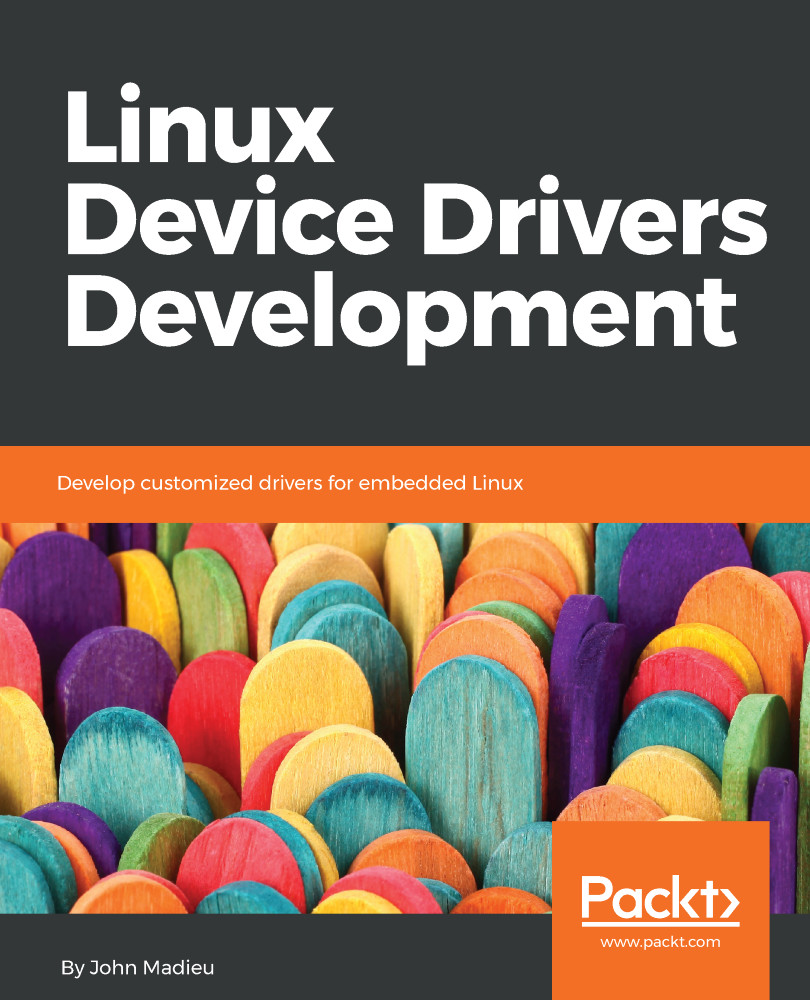
Linux Device Drivers Development

Linux Device Drivers Development

By : John Madieu
4 (30)
close
close
Linux Device Drivers Development

Linux Device Drivers Development

4 (30)
By: John Madieu

Overview of this book

Linux kernel is a complex, portable, modular and widely used piece of software, running on around 80% of servers and embedded systems in more than half of devices throughout the World. Device drivers play a critical role in how well a Linux system performs. As Linux has turned out to be one of the most popular operating systems used, the interest in developing proprietary device drivers is also increasing steadily. This book will initially help you understand the basics of drivers as well as prepare for the long journey through the Linux Kernel. This book then covers drivers development based on various Linux subsystems such as memory management, PWM, RTC, IIO, IRQ management, and so on. The book also offers a practical approach on direct memory access and network device drivers. By the end of this book, you will be comfortable with the concept of device driver development and will be in a position to write any device driver from scratch using the latest kernel version (v4.13 at the time of writing this book).
Table of Contents (23 chapters)
close
close
Lock Free Chapter
1
Introduction to Kernel Development

The Linux Device Model

Until version 2.5, the kernel had no way to describe and manage objects, and the code reusability was not as enhanced as it is now. In other words, there was no device topology nor organization. There was no information on subsystem relationships, nor on how the system is put together. Then came the Linux Device Model (LDM), which introduced the following:

  • The concept of class, to group devices of the same type or devices that expose the same functionalities (for example, mice and keyboards are both input devices).
  • Communication with the user space through a virtual filesystem called sysfs, in order to let user space manage and enumerate devices and the properties they expose.
  • Management of object life cycle, using reference counting (heavily used in managed resources).
  • Power management in order to handle the order in which devices should shut down.
  • The...
Visually different images
CONTINUE READING
83
Tech Concepts
36
Programming languages
73
Tech Tools
Icon Unlimited access to the largest independent learning library in tech of over 8,000 expert-authored tech books and videos.
Icon Innovative learning tools, including AI book assistants, code context explainers, and text-to-speech.
Icon 50+ new titles added per month and exclusive early access to books as they are being written.
Linux Device Drivers Development
notes
bookmark Notes and Bookmarks search Search in title playlist Add to playlist download Download options font-size Font size

Change the font size

margin-width Margin width

Change margin width

day-mode Day/Sepia/Night Modes

Change background colour

Close icon Search
Country selected

Close icon Your notes and bookmarks

Confirmation

Modal Close icon
claim successful

Buy this book with your credits?

Modal Close icon
Are you sure you want to buy this book with one of your credits?
Close
YES, BUY

Submit Your Feedback

Modal Close icon
Modal Close icon
Modal Close icon
