Sign In Start Free Trial
Account

Add to playlist

Create a Playlist

Modal Close icon
You need to login to use this feature.
  • Book Overview & Buying OpenStack Cloud Computing Cookbook
  • Table Of Contents Toc
OpenStack Cloud Computing Cookbook

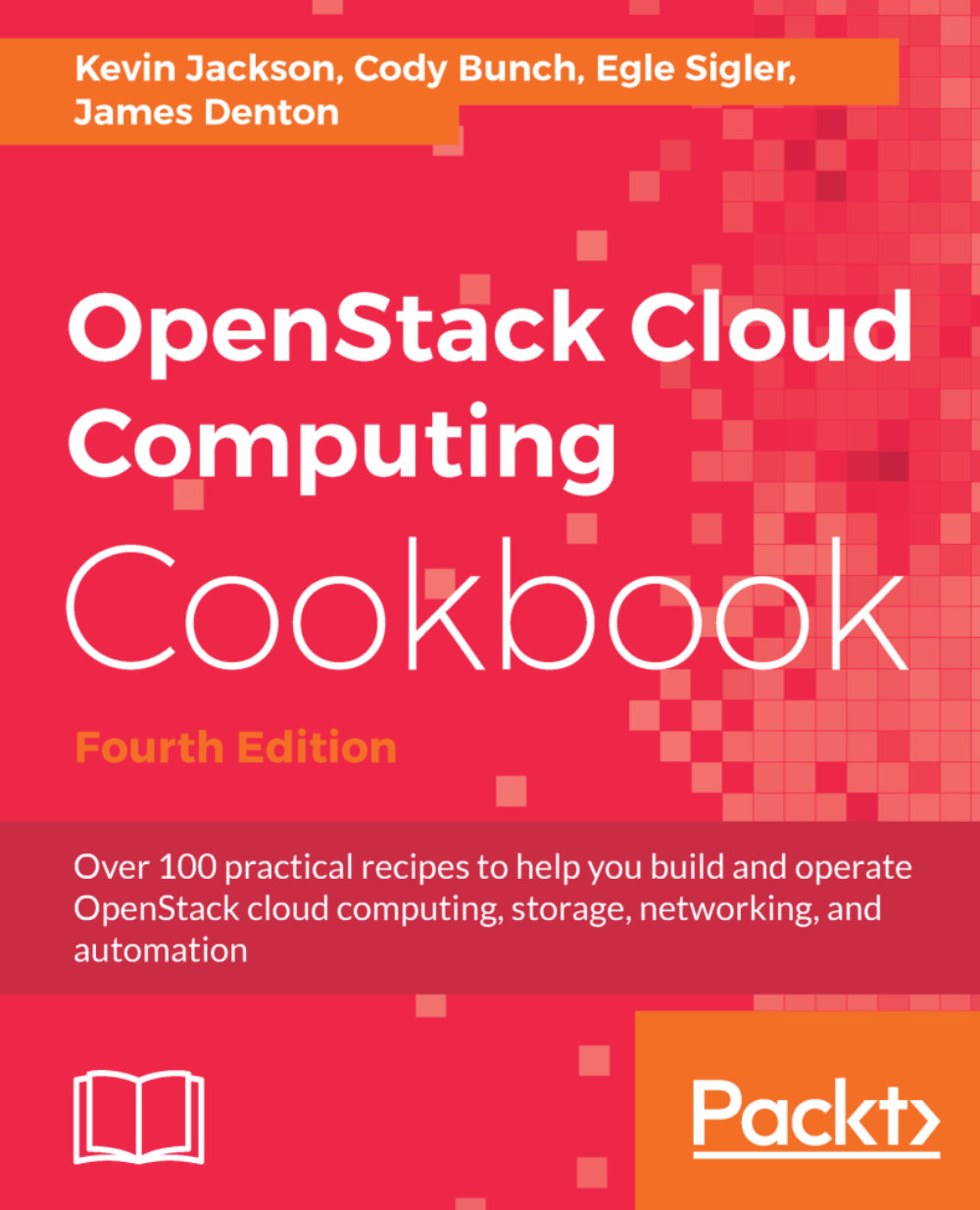
OpenStack Cloud Computing Cookbook - Fourth Edition

By : Kevin Jackson, Cody Bunch, Egle Sigler, James Denton
4.3 (10)
close
close
OpenStack Cloud Computing Cookbook

OpenStack Cloud Computing Cookbook

4.3 (10)
By: Kevin Jackson, Cody Bunch, Egle Sigler, James Denton

Overview of this book

This is the fourth edition of the industry-acclaimed OpenStack Cloud Computing Cookbook, created by four recognized OpenStack experts. It has now been updated to work with the latest OpenStack builds, using tools and processes based on their collective and vast OpenStack experience. OpenStack Open Source Cloud software is one of the most used cloud infrastructures to support a wide variety of use cases, from software development to big data analysis. It is developed by a thriving community of individual developers from around the globe and backed by most of the leading players in the cloud space today. We make it simple to implement, massively scalable, and able to store a large pool of data and networking resources. OpenStack has a strong ecosystem that helps you provision your cloud storage needs. Add OpenStack's enterprise features to reduce the cost of your business. This book will begin by showing you the steps to build up an OpenStack private cloud environment using Ansible. You'll then discover the uses of cloud services such as the identity service, image service, and compute service. You'll dive into Neutron, the OpenStack Networking service, and get your hands dirty with configuring networks, routers, load balancers, and more. You’ll then gather more expert knowledge on OpenStack cloud computing by managing your cloud's security and migration. After that, we delve into OpenStack Object storage and you’ll see how to manage servers and work with objects, cluster, and storage functionalities. Finally, you will learn about OpenStack dashboard, Ansible, Keystone, and other interesting topics.
Table of Contents (15 chapters)
close
close
OpenStack Cloud Computing Cookbook Fourth Edition
Contributors
Preface
Another Book You May Enjoy
1
Index

Modifying the OpenStack configuration


It would be ludicrous to think that all of the playbooks would be needed to run again for a small change such as changing the CPU contention ratio from 4:1 to 8:1. So instead, the playbooks have been developed and tagged so that specific playbooks can be run associated with that particular project that would reconfigure and restart the associated services to pick up the changes.

Getting ready

Ensure that you are root on the deployment host. In most cases, this is the first infrastructure controller node, infra01.

How to do it...

The following are the common changes and how they can be changed using Ansible. As we'll adjust the configuration, all of these commands are executed from the same host you used to perform the installation.

To adjust the CPU overcommit/allocation ratio, carry out the following steps:

  1. Edit the /etc/openstack_deploy/user_variables.yml file and modify (or add) the following line (adjust the figure to suit):

    nova_cpu_allocation_ratio: 8.0
    
  2. Now execute the following commands to make changes in the environment:

    cd /opt/openstack-ansible/playbooks
    openstack-ansible os-nova-install.yml --tags 'nova-config'
    

For more complex changes, for example, to add configuration that isn't a simple one-line change in a template, we can use an alternative in the form of overrides. To make changes to the default Nova Quotas, carry out the following as an example:

  1. Edit the /etc/openstack_deploy/user_variables.yml file and modify (or add) the following line (adjust the figure to suit):

    nova_nova_conf_overrides:  
      DEFAULT:
       quota_fixed_ips = -1
       quota_floating_ips = 20
       quota_instances = 20
  2. Now execute the following commands to make changes in the environment:

    cd /opt/openstack-ansible/playbooks
    openstack-ansible os-nova-install.yml --tag 'nova-config'
    

Changes for Neutron, Glance, Cinder, and all other services are modified in a similar way. Adjust the name of the service in the syntax used. For example, to change a configuration item in the neutron.conf file, you would use the following syntax:

neutron_neutron_conf_overrides:  
  DEFAULT:
   dhcp_lease_duration = -1

Then execute the following commands:

cd /opt/openstack-ansible/playbooks
openstack-ansible os-neutron-install.yml --tag 'neutron-config'

How it works…

We modified the same OpenStack-Ansible configuration files as in the Configuring the installation recipe and executed the openstack-ansible playbook command, specifying the playbook that corresponded to the service we wanted to change. As we were making configuration changes, we notified Ansible of this through the --tag parameter.

Refer to https://docs.openstack.org/ for all configuration options for each service.

CONTINUE READING
83
Tech Concepts
36
Programming languages
73
Tech Tools
Icon Unlimited access to the largest independent learning library in tech of over 8,000 expert-authored tech books and videos.
Icon Innovative learning tools, including AI book assistants, code context explainers, and text-to-speech.
Icon 50+ new titles added per month and exclusive early access to books as they are being written.
OpenStack Cloud Computing Cookbook
notes
bookmark Notes and Bookmarks search Search in title playlist Add to playlist font-size Font size

Change the font size

margin-width Margin width

Change margin width

day-mode Day/Sepia/Night Modes

Change background colour

Close icon Search
Country selected

Close icon Your notes and bookmarks

Confirmation

Modal Close icon
claim successful

Buy this book with your credits?

Modal Close icon
Are you sure you want to buy this book with one of your credits?
Close
YES, BUY

Submit Your Feedback

Modal Close icon
Modal Close icon
Modal Close icon