Sign In Start Free Trial
Account

Add to playlist

Create a Playlist

Modal Close icon
You need to login to use this feature.
  • Book Overview & Buying SQL Server on Azure Virtual Machines
  • Table Of Contents Toc
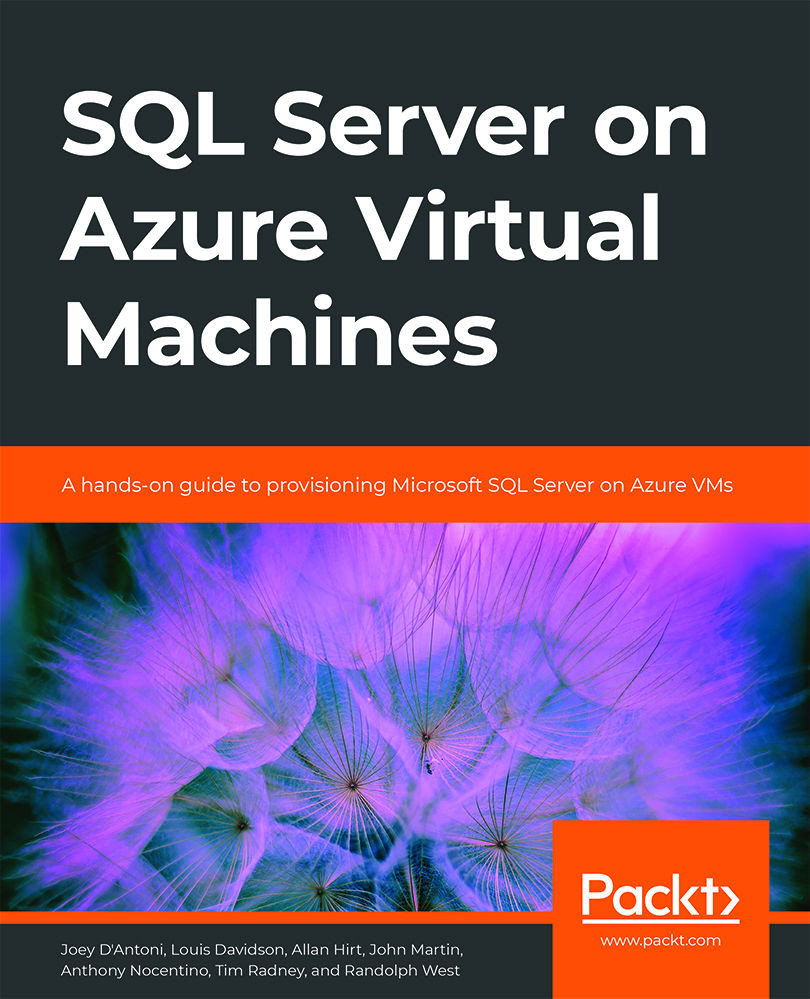
SQL Server on Azure Virtual Machines

SQL Server on Azure Virtual Machines

By : Joey D'Antoni, Louis Davidson, Allan Hirt , John Martin, Anthony Nocentino, Tim Radney, Randolph West
close
close
SQL Server on Azure Virtual Machines

SQL Server on Azure Virtual Machines

By: Joey D'Antoni, Louis Davidson, Allan Hirt , John Martin, Anthony Nocentino, Tim Radney, Randolph West

Overview of this book

Deploying SQL Server on Azure virtual machines allows you to work on full versions of SQL Server in the cloud without having to maintain on-premises hardware. The book begins by introducing you to the SQL portfolio in Azure and takes you through SQL Server IaaS scenarios, before explaining the factors that you need to consider while choosing an OS for SQL Server in Azure VMs. As you progress through the book, you'll explore different VM options and deployment choices for IaaS and understand platform availability, migration tools, and best practices in Azure. In later chapters, you'll learn how to configure storage to achieve optimized performance. Finally, you'll get to grips with the concept of Azure Hybrid Benefit and find out how you can use it to maximize the value of your existing on-premises SQL Server. By the end of this book, you'll be proficient in administering SQL Server on Microsoft Azure and leveraging the tools required for its deployment.
Table of Contents (10 chapters)
close
close
8
Index

Azure BlobCache

When configuring the VM or adding storage, you can set the caching for the disk. BlobCache provides a multi-tier capability by using the VM's memory and the local SSD for caching. This is only available for Premium disk and is the default for Azure Marketplace images. If you've self-installed SQL Server, then you'll have to manually set up Azure BlobCache.

There are three options for disk caching: ReadWrite, None, and ReadOnly.

For SQL Server workloads, ReadWrite should not be used. ReadWrite can lead to data consistency issues with SQL Server.

None should be used for SQL Server log files. SQL Server log files write data sequentially to disk. There would be no benefit to using ReadOnly caching in that scenario.

SQL Server data files should take advantage of the ReadOnly caching option. By using ReadOnly, reads are pulled from the cache, which are stored within the VM memory and the local SSD. Memory is fast, and the local SSD provides better...

Visually different images
CONTINUE READING
83
Tech Concepts
36
Programming languages
73
Tech Tools
Icon Unlimited access to the largest independent learning library in tech of over 8,000 expert-authored tech books and videos.
Icon Innovative learning tools, including AI book assistants, code context explainers, and text-to-speech.
Icon 50+ new titles added per month and exclusive early access to books as they are being written.
SQL Server on Azure Virtual Machines
notes
bookmark Notes and Bookmarks search Search in title playlist Add to playlist font-size Font size

Change the font size

margin-width Margin width

Change margin width

day-mode Day/Sepia/Night Modes

Change background colour

Close icon Search
Country selected

Close icon Your notes and bookmarks

Confirmation

Modal Close icon
claim successful

Buy this book with your credits?

Modal Close icon
Are you sure you want to buy this book with one of your credits?
Close
YES, BUY

Submit Your Feedback

Modal Close icon
Modal Close icon
Modal Close icon