Sign In Start Free Trial
Account

Add to playlist

Create a Playlist

Modal Close icon
You need to login to use this feature.
  • Book Overview & Buying Certified Kubernetes Administrator (CKA) Exam Guide
  • Table Of Contents Toc
Certified Kubernetes Administrator (CKA) Exam Guide

Certified Kubernetes Administrator (CKA) Exam Guide

By : Mélony Qin
4.4 (7)
close
close
Certified Kubernetes Administrator (CKA) Exam Guide

Certified Kubernetes Administrator (CKA) Exam Guide

4.4 (7)
By: Mélony Qin

Overview of this book

Kubernetes is the most popular container orchestration tool in the industry. The Kubernetes Administrator certification will help you establish your credibility and enable you to efficiently support the business growth of individual organizations with the help of this open source platform. The book begins by introducing you to Kubernetes architecture and the core concepts of Kubernetes. You'll then get to grips with the main Kubernetes API primitives, before diving into cluster installation, configuration, and management. Moving ahead, you’ll explore different approaches while maintaining the Kubernetes cluster, perform upgrades for the Kubernetes cluster, as well as backup and restore etcd. As you advance, you'll deploy and manage workloads on Kubernetes and work with storage for Kubernetes stateful workloads with the help of practical scenarios. You'll also delve into managing the security of Kubernetes applications and understand how different components in Kubernetes communicate with each other and with other applications. The concluding chapters will show you how to troubleshoot cluster- and application-level logging and monitoring, cluster components, and applications in Kubernetes. By the end of this Kubernetes book, you'll be fully prepared to pass the CKA exam and gain practical knowledge that can be applied in your day-to-day work.
Table of Contents (17 chapters)
close
close
1
Part 1: Cluster Architecture, Installation, and Configuration
5
Part 2: Managing Kubernetes
10
Part 3: Troubleshooting

Sharing a cluster with namespaces

Understanding the basic Kubernetes objects will give you a glimpse of how Kubernetes works on a workload level, and we’ll cover more details and other related objects as we go. Those objects running on the Kubernetes cluster will work just fine when we’re doing the development or test ourselves or a quick onboarding exercise, although we’ll need to think about the separation of the workloads when it comes to the production environment for those enterprise-grade organizations. That’s where the namespace comes in.

A namespace is a logical separation of all the namespaced objects deployed in a single Kubernetes cluster. Examples of namespaced objects are Deployments, Services, Secrets, and more. Some other Kubernetes objects are cluster-wide, such as StorageClasses, Nodes, and PersistentVolumes. The name of a resource has to be unique within a namespace, but it’s labeled by a namespace name and an object name across all namespaces.

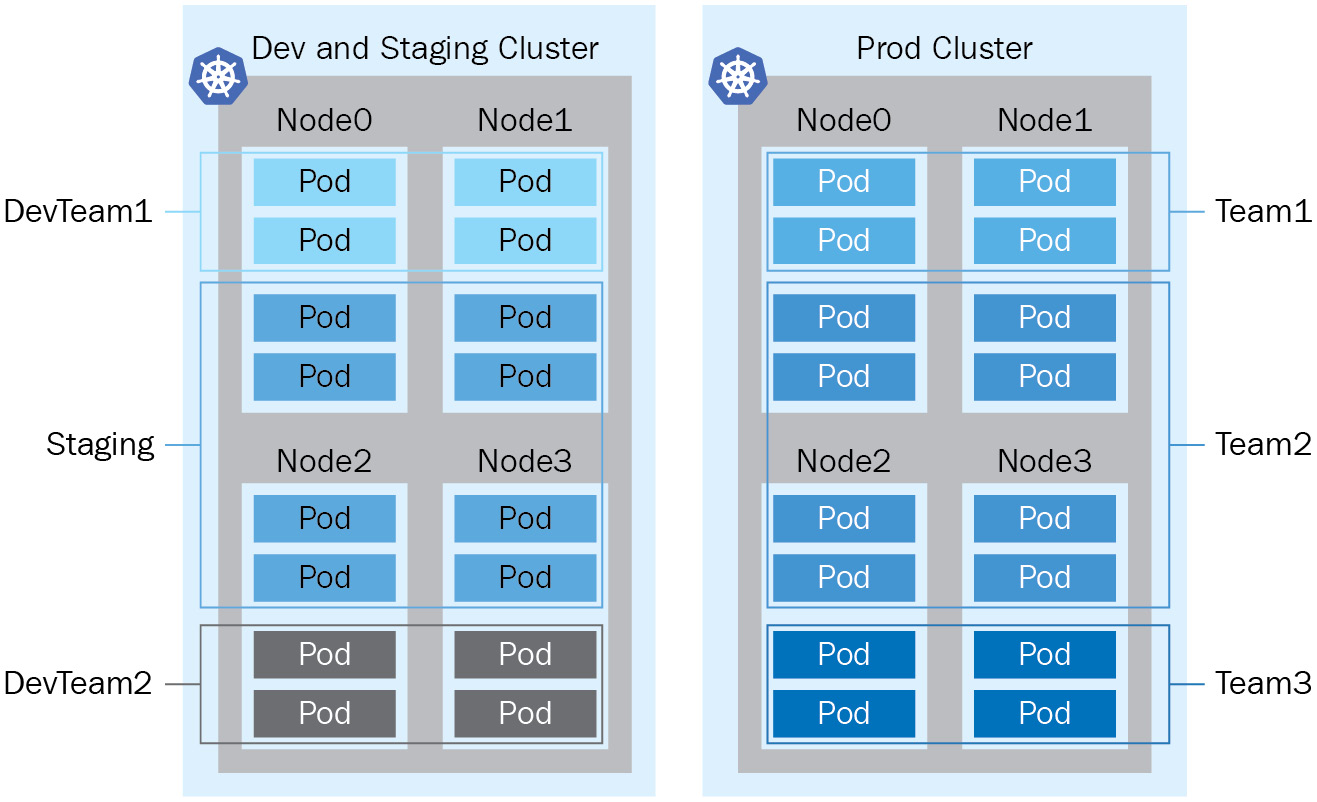
Namespaces are intended to separate cluster resources between multiple users, which creates the possibility of sharing a cluster for multiple projects within an organization. We call this model the Kubernetes multi-tenant model. The multi-tenant model is an effective way to help different projects and teams share the cluster and get the most use out of the same cluster. The multi-tenant model helps minimize resource wasting. It comes in handy in particular when working with Kubernetes in the cloud as there is always a reservation of resources by the cloud vendors. Despite all the upsides, the multi-tenant model is also bringing extra challenges to resource management and security aspects. We’ll cover resource management in Chapter 4, Application Scheduling and Lifecycle Management.

For better physical isolation, we recommend that organizations use multiple Kubernetes clusters. It will bring a physical boundary for different projects and teams, although the resources reserved by the Kubernetes system are also replicated across clusters. Beyond that, working across different Kubernetes clusters is also challenging, as it involves setting up an effective mechanism by switching the security context, as well as dealing with the complexity of the networking aspects. We’ll cover Kubernetes security in Chapter 6, Securing Kubernetes, and Kubernetes networking in Chapter 7, Demystifying Kubernetes Networking. The following is a diagram showing a Kubernetes multi-tenancy and multi-cluster comparison:

Figure 1.7 – Kubernetes multi-tenancy versus multi-cluster

Figure 1.7 – Kubernetes multi-tenancy versus multi-cluster

CONTINUE READING
83
Tech Concepts
36
Programming languages
73
Tech Tools
Icon Unlimited access to the largest independent learning library in tech of over 8,000 expert-authored tech books and videos.
Icon Innovative learning tools, including AI book assistants, code context explainers, and text-to-speech.
Icon 50+ new titles added per month and exclusive early access to books as they are being written.
Certified Kubernetes Administrator (CKA) Exam Guide
notes
bookmark Notes and Bookmarks search Search in title playlist Add to playlist font-size Font size

Change the font size

margin-width Margin width

Change margin width

day-mode Day/Sepia/Night Modes

Change background colour

Close icon Search
Country selected

Close icon Your notes and bookmarks

Confirmation

Modal Close icon
claim successful

Buy this book with your credits?

Modal Close icon
Are you sure you want to buy this book with one of your credits?
Close
YES, BUY

Submit Your Feedback

Modal Close icon
Modal Close icon
Modal Close icon