


-
Book Overview & Buying
-
Table Of Contents

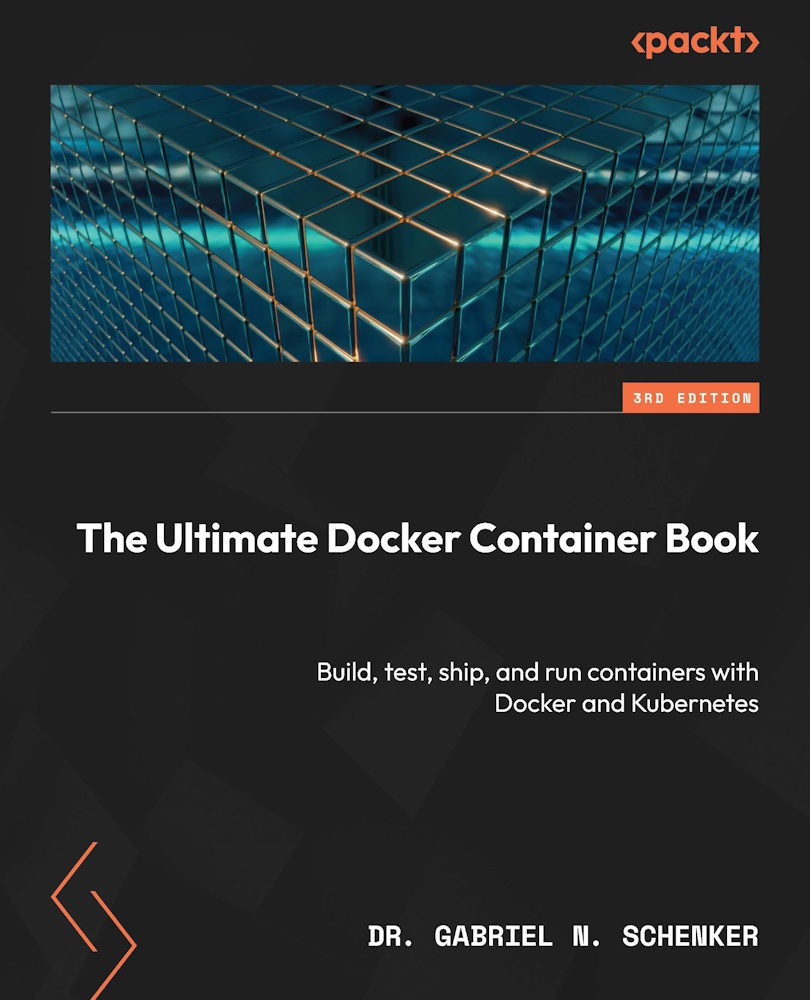
The Ultimate Docker Container Book - Third Edition
By :


The Ultimate Docker Container Book
By:
Overview of this book
The Ultimate Docker Container Book, 3rd edition enables you to leverage Docker containers for streamlined software development. You’ll uncover Docker fundamentals and how containers improve software supply chain efficiency and enhance security.
You’ll start by learning practical skills such as setting up Docker environments, handling stateful components, running and testing code within containers, and managing Docker images. You’ll also explore how to adapt legacy applications for containerization and understand distributed application architecture. Next, you’ll delve into Docker's networking model, software-defined networks for secure applications, and Docker compose for managing multi-service applications along with tools for log analysis and metrics. You’ll further deepen your understanding of popular orchestrators like Kubernetes and Docker swarmkit, exploring their key concepts, and deployment strategies for resilient applications. In the final sections, you’ll gain insights into deploying containerized applications on major cloud platforms, including Azure, AWS, and GCE and discover techniques for production monitoring and troubleshooting.
By the end of this book, you’ll be well-equipped to manage and scale containerized applications effectively.
Table of Contents (26 chapters)
Preface


Part 1:Introduction
 Free Chapter
Chapter 1: What Are Containers and Why Should I Use Them?

Chapter 2: Setting Up a Working Environment
Part 2:Containerization Fundamentals
Chapter 3: Mastering Containers
Chapter 4: Creating and Managing Container Images
Chapter 5: Data Volumes and Configuration
Chapter 6: Debugging Code Running in Containers
Chapter 7: Testing Applications Running in Containers
Chapter 8: Increasing Productivity with Docker Tips and Tricks
Part 3:Orchestration Fundamentals
Chapter 9: Learning about Distributed Application Architecture
Chapter 10: Using Single-Host Networking
Chapter 11: Managing Containers with Docker Compose
Chapter 12: Shipping Logs and Monitoring Containers
Chapter 13: Introducing Container Orchestration
Chapter 14: Introducing Docker Swarm
Chapter 15: Deploying and Running a Distributed Application on Docker Swarm
Part 4:Docker, Kubernetes, and the Cloud
Chapter 16: Introducing Kubernetes
Chapter 17: Deploying, Updating, and Securing an Application with Kubernetes
Chapter 18: Running a Containerized Application in the Cloud
Chapter 19: Monitoring and Troubleshooting an Application Running in Production
Index


