


-
Book Overview & Buying
-
Table Of Contents

Kubernetes Autoscaling
By :


Kubernetes Autoscaling
By:
Overview of this book
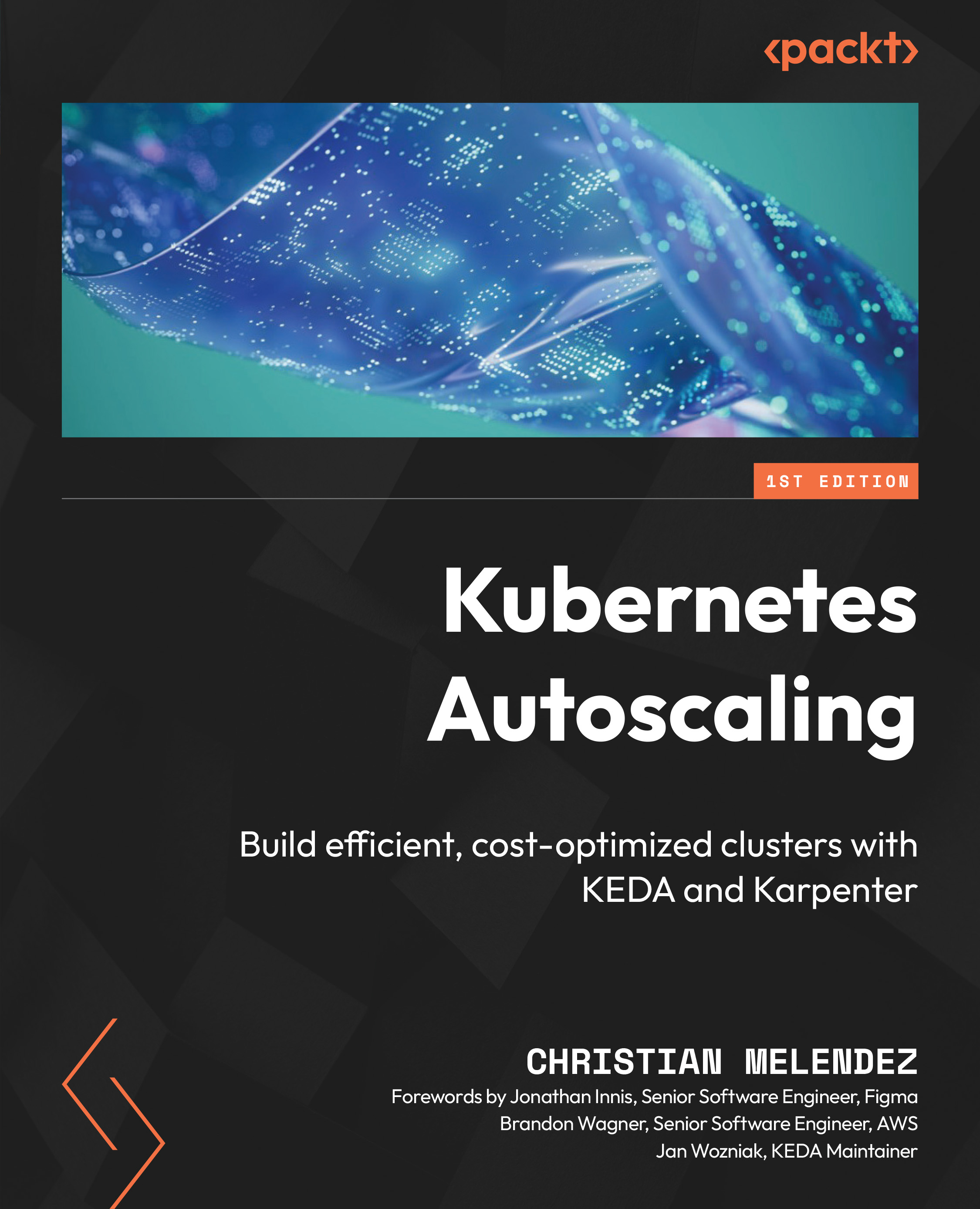
Kubernetes is the backbone of modern containerized infrastructure, but scaling it efficiently remains a challenge. Kubernetes Autoscaling equips cloud professionals with this comprehensive guide to dynamically scaling applications and infrastructure using the powerful combination of Kubernetes Event-Driven Autoscaler (KEDA) and Karpenter, AWS’s next-generation cluster autoscaler.
You’ll begin with autoscaling fundamentals, move through HPA and VPA, and then get hands-on KEDA for event-driven workloads and Karpenter for data plane scaling. With the help of real-world use cases, best practices, and detailed patterns, you’ll deploy resilient, scalable, and cost-effective Kubernetes clusters across production environments.
By the end of this book, you’ll be able to implement practical autoscaling strategies to improve performance, reduce cloud costs, and eliminate over-provisioning.
Table of Contents (20 chapters)
Preface


 Free Chapter
Part 1: Getting started with Kubernetes Autoscaling
Introduction to Kubernetes Autoscaling

Workload Autoscaling Overview
Workload Autoscaling with HPA and VPA
Part 2: Workload Autoscaling and KEDA
Kubernetes Event-Driven Autoscaling – Part 1
Kubernetes Event-Driven Autoscaling – Part 2
Workload Autoscaling Operations
Part 3: Node Autoscaling and Karpenter
Data Plane Autoscaling Overview
Node Autoscaling with Karpenter — Part 1
Node Autoscaling with Karpenter — Part 2
Karpenter Management Operations
Part 4: Use Cases, Patterns, and Recommendations
Practical Use Cases for Autoscaling in Kubernetes
Patterns and Recommendations
Unlock Your Exclusive Benefits
Other Books You May Enjoy
Index



