Sign In Start Free Trial
Account

Add to playlist

Create a Playlist

Modal Close icon
You need to login to use this feature.
  • Book Overview & Buying Networking Fundamentals
  • Table Of Contents Toc
  • Feedback & Rating feedback
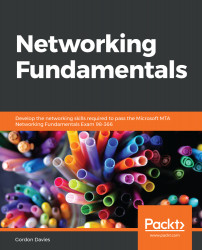
Networking Fundamentals

Networking Fundamentals

By : Gordon Davies
4.2 (13)
close
close
Networking Fundamentals

Networking Fundamentals

4.2 (13)
By: Gordon Davies

Overview of this book

A network is a collection of computers, servers, mobile devices, or other computing devices connected for sharing data. This book will help you become well versed in basic networking concepts and prepare to pass Microsoft's MTA Networking Fundamentals Exam 98-366. Following Microsoft's official syllabus, the book starts by covering network infrastructures to help you differentiate intranets, internets, and extranets, and learn about network topologies. You’ll then get up to date with common network hardware devices such as routers and switches and the media types used to connect them together. As you advance, the book will take you through different protocols and services and the requirements to follow a standardized approach to networking. You’ll get to grips with the OSI and TCP/IP models as well as IPv4 and IPv6. The book also shows you how to recall IP addresses through name resolution. Finally, you’ll be able to practice everything you’ve learned and take the exam confidently with the help of mock tests. By the end of this networking book, you’ll have developed a strong foundation in the essential networking concepts needed to pass Exam 98-366.
Table of Contents (23 chapters)
close
close
Lock Free Chapter
1
Section 1: Network Infrastructure
7
Section 2: Network Hardware
11
Section 3: Protocols and Services
18
Section 4: Mock Exams
19
Mock Exam 1
20
Mock Exam 2

Summary

We began this chapter by differentiating between logical and physical topologies before looking at the various topologies. The topologies covered included bus, ring, star, mesh, and hybrid, and we highlighted the benefits and disadvantages of each in terms of performance, resiliency, and cost.

You have learned how to understand the flow of the data using logical topologies and from that to understand some of the areas to troubleshoot on each topology in the event of a failure. On bus topologies, you have also learned about the importance of terminators to avoid signal bounce. In addition, you have learned the two calculations needed to identify the number of interfaces and cables in a full mesh topology, which will assist you greatly in planning such a deployment.

In the next chapter, you will be introduced to the first of the two intermediary network devices this book...

Visually different images
CONTINUE READING
83
Tech Concepts
36
Programming languages
73
Tech Tools
Icon Unlimited access to the largest independent learning library in tech of over 8,000 expert-authored tech books and videos.
Icon Innovative learning tools, including AI book assistants, code context explainers, and text-to-speech.
Icon 50+ new titles added per month and exclusive early access to books as they are being written.
Networking Fundamentals
notes
bookmark Notes and Bookmarks search Search in title playlist Add to playlist font-size Font size

Change the font size

margin-width Margin width

Change margin width

day-mode Day/Sepia/Night Modes

Change background colour

Close icon Search
Country selected

Close icon Your notes and bookmarks

Confirmation

Modal Close icon
claim successful

Buy this book with your credits?

Modal Close icon
Are you sure you want to buy this book with one of your credits?
Close
YES, BUY

Submit Your Feedback

Modal Close icon
Modal Close icon
Modal Close icon