


-
Book Overview & Buying
-
Table Of Contents

The Kubernetes Workshop
By :


The Kubernetes Workshop
By:
Overview of this book
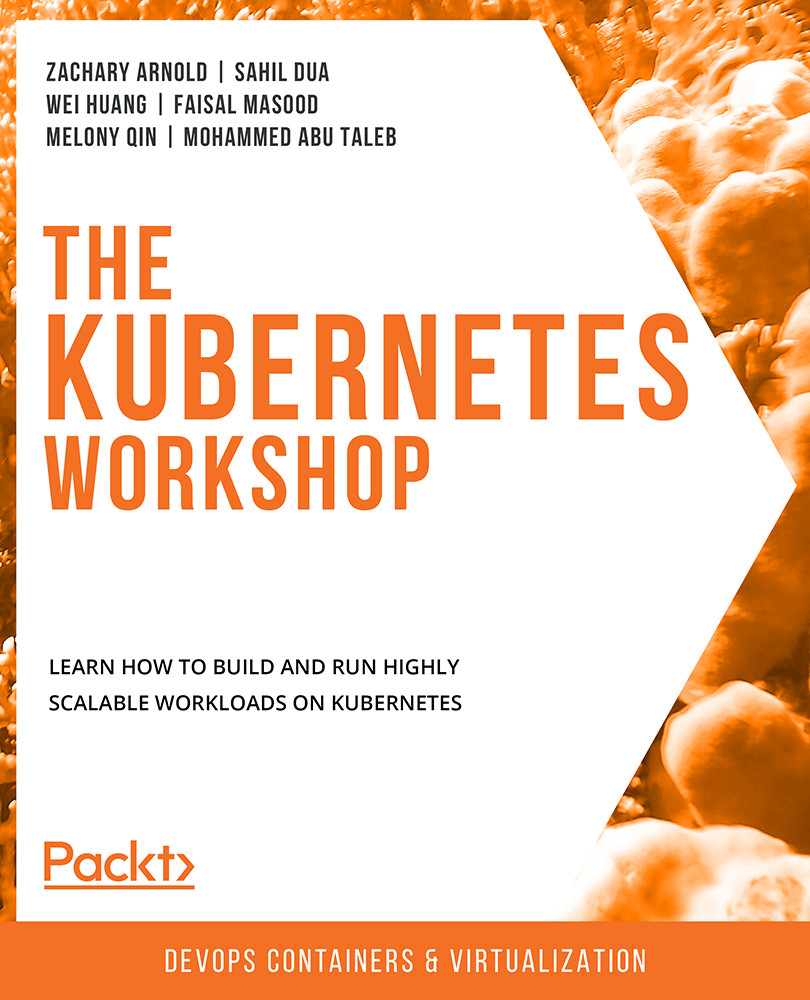
Thanks to its extensive support for managing hundreds of containers that run cloud-native applications, Kubernetes is the most popular open source container orchestration platform that makes cluster management easy. This workshop adopts a practical approach to get you acquainted with the Kubernetes environment and its applications.
Starting with an introduction to the fundamentals of Kubernetes, you’ll install and set up your Kubernetes environment. You’ll understand how to write YAML files and deploy your first simple web application container using Pod. You’ll then assign human-friendly names to Pods, explore various Kubernetes entities and functions, and discover when to use them. As you work through the chapters, this Kubernetes book will show you how you can make full-scale use of Kubernetes by applying a variety of techniques for designing components and deploying clusters. You’ll also get to grips with security policies for limiting access to certain functions inside the cluster. Toward the end of the book, you’ll get a rundown of Kubernetes advanced features for building your own controller and upgrading to a Kubernetes cluster without downtime.
By the end of this workshop, you’ll be able to manage containers and run cloud-based applications efficiently using Kubernetes.
Table of Contents (20 chapters)
Preface


1. Introduction to Kubernetes and Containers
 Free Chapter
2. An Overview of Kubernetes
3. kubectl – Kubernetes Command Center
4. How to Communicate with Kubernetes (API Server)
6. Labels and Annotations
7. Kubernetes Controllers
8. Service Discovery
9. Storing and Reading Data on Disk

10. ConfigMaps and Secrets
11. Build Your Own HA Cluster
12. Your Application and HA
13. Runtime and Network Security in Kubernetes
14. Running Stateful Components in Kubernetes
15. Monitoring and Autoscaling in Kubernetes
16. Kubernetes Admission Controllers
17. Advanced Scheduling in Kubernetes
18. Upgrading Your Cluster without Downtime
19. Custom Resource Definitions in Kubernetes


