Sign In Start Free Trial
Account

Add to playlist

Create a Playlist

Modal Close icon
You need to login to use this feature.
  • Book Overview & Buying NumPy Essentials
  • Table Of Contents Toc
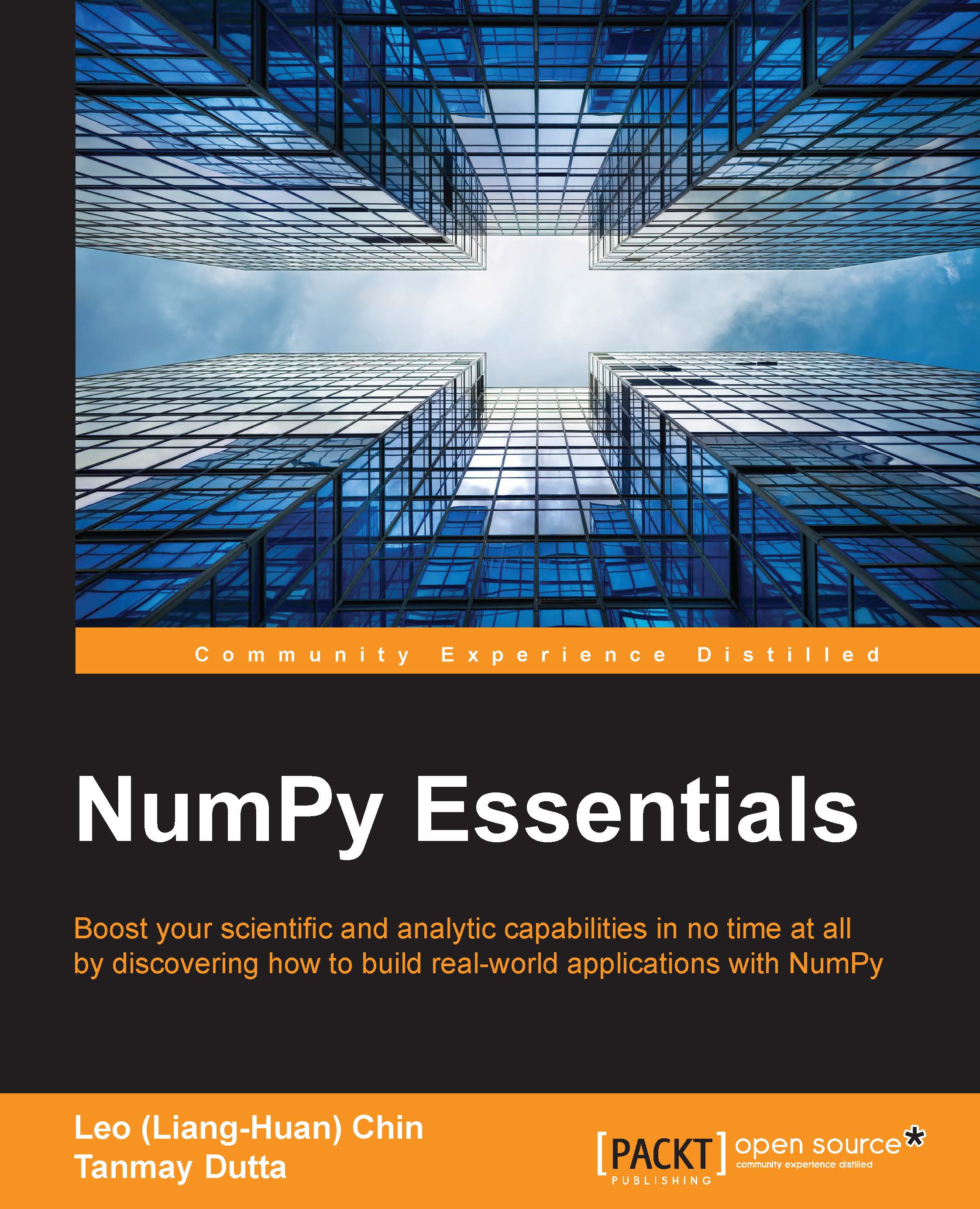
NumPy Essentials

NumPy Essentials

By : Jaidev Deshpande, Chin, Tanmay Dutta, Shane Holloway
3.3 (3)
close
close
NumPy Essentials

NumPy Essentials

3.3 (3)
By: Jaidev Deshpande, Chin, Tanmay Dutta, Shane Holloway

Overview of this book

In today’s world of science and technology, it’s all about speed and flexibility. When it comes to scientific computing, NumPy tops the list. NumPy gives you both the speed and high productivity you need. This book will walk you through NumPy using clear, step-by-step examples and just the right amount of theory. We will guide you through wider applications of NumPy in scientific computing and will then focus on the fundamentals of NumPy, including array objects, functions, and matrices, each of them explained with practical examples. You will then learn about different NumPy modules while performing mathematical operations such as calculating the Fourier Transform; solving linear systems of equations, interpolation, extrapolation, regression, and curve fitting; and evaluating integrals and derivatives. We will also introduce you to using Cython with NumPy arrays and writing extension modules for NumPy code using the C API. This book will give you exposure to the vast NumPy library and help you build efficient, high-speed programs using a wide range of mathematical features.
Table of Contents (11 chapters)
close
close

Creating an array squared function using Python C-API


The Python function passes a reference to itself as the first argument, followed by real arguments given to the function. The PyArg_ParseTuple function is used to parse values from the Python function to local variables in the C function. In this function, we cast a value to a double, and hence we use d as the second argument. You can see a full list of strings that are accepted by this function at  https://docs.python.org/2/c-api/arg.html .

The final result of the computations is returned using Py_Buildvalue, which takes a similar type of format string to create a Python value from your answer. We use f here, which stands for float, to demonstrate that double and float are treated similarly:

/* 
Implementation of the actual C funtions 
*/ 
 
static PyObject* square_func(PyObject* self, PyObject* args) 
{ 
double value; 
double answer; 
 
/*  parse the input, from python float to c double */...
Visually different images
CONTINUE READING
83
Tech Concepts
36
Programming languages
73
Tech Tools
Icon Unlimited access to the largest independent learning library in tech of over 8,000 expert-authored tech books and videos.
Icon Innovative learning tools, including AI book assistants, code context explainers, and text-to-speech.
Icon 50+ new titles added per month and exclusive early access to books as they are being written.
NumPy Essentials
notes
bookmark Notes and Bookmarks search Search in title playlist Add to playlist font-size Font size

Change the font size

margin-width Margin width

Change margin width

day-mode Day/Sepia/Night Modes

Change background colour

Close icon Search
Country selected

Close icon Your notes and bookmarks

Confirmation

Modal Close icon
claim successful

Buy this book with your credits?

Modal Close icon
Are you sure you want to buy this book with one of your credits?
Close
YES, BUY

Submit Your Feedback

Modal Close icon
Modal Close icon
Modal Close icon