
Sign In Start Free Trial
Account

Add to playlist

Create a Playlist

Modal Close icon
You need to login to use this feature.
  • Book Overview & Buying Mastering Machine Learning with Spark 2.x
  • Table Of Contents Toc
  • Feedback & Rating feedback
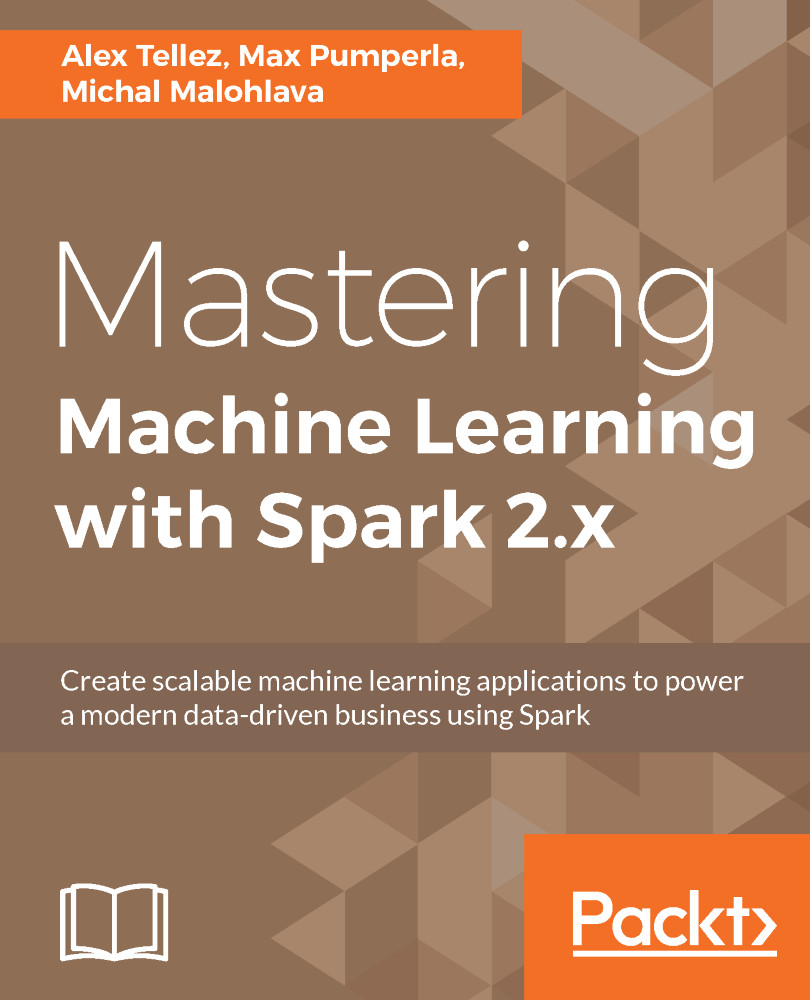
Mastering Machine Learning with Spark 2.x

Mastering Machine Learning with Spark 2.x

By : Malohlava, Tellez, Max Pumperla
5 (1)
close
close
Mastering Machine Learning with Spark 2.x

Mastering Machine Learning with Spark 2.x

5 (1)
By: Malohlava, Tellez, Max Pumperla

Overview of this book

The purpose of machine learning is to build systems that learn from data. Being able to understand trends and patterns in complex data is critical to success; it is one of the key strategies to unlock growth in the challenging contemporary marketplace today. With the meteoric rise of machine learning, developers are now keen on finding out how can they make their Spark applications smarter. This book gives you access to transform data into actionable knowledge. The book commences by defining machine learning primitives by the MLlib and H2O libraries. You will learn how to use Binary classification to detect the Higgs Boson particle in the huge amount of data produced by CERN particle collider and classify daily health activities using ensemble Methods for Multi-Class Classification. Next, you will solve a typical regression problem involving flight delay predictions and write sophisticated Spark pipelines. You will analyze Twitter data with help of the doc2vec algorithm and K-means clustering. Finally, you will build different pattern mining models using MLlib, perform complex manipulation of DataFrames using Spark and Spark SQL, and deploy your app in a Spark streaming environment.
Table of Contents (9 chapters)
close
close
3
Ensemble Methods for Multi-Class Classification

Preface

Big data – that was our motivation to explore the world of machine learning with Spark a couple of years ago. We wanted to build machine learning applications that would leverag models trained on large amounts of data, but the beginning was not easy. Spark was still evolving, it did not contain a powerful machine learning library, and we were still trying to figure out what it means to build a machine learning application.

But, step by step, we started to explore different corners of the Spark ecosystem and followed Spark’s evolution. For us, the crucial part was a powerful machine learning library, which would provide features such as R or Python libraries did. This was an easy task for us, since we are actively involved in the development of H2O’s machine learning library and its branch called Sparkling Water, which enables the use of the H2O library from Spark applications. However, model training is just the tip of the machine learning iceberg. We still had to explore how to connect Sparkling Water to Spark RDDs, DataFrames, and DataSets, how to connect Spark to different data sources and read data, or how to export models and reuse them in different applications.

During our journey, Spark evolved as well. Originally, being a pure Scala project, it started to expose Python and, later, R interfaces. It also took its Spark API on a long journey from low-level RDDs to a high-level DataSet, exposing a SQL-like interface. Furthermore, Spark also introduced the concept of machine learning pipelines, adopted from the scikit-learn library known from Python. All these improvements made Spark a great tool for data transformation and data processing.

Based on this experience, we decided to share our knowledge with the rest of the world via this book. Its intention is simple: to demonstrate different aspects of building Spark machine learning applications on examples, and show how to use not only the latest Spark features, but also low-level Spark interfaces. On our journey, we also figure out many tricks and shortcuts not only connected to Spark, but also to the process of developing machine learning applications or source code organization. And all of them are shared in this book to help keep readers from making the mistakes we made.

The book adopted the Scala language as the main implementation language for our examples. It was a hard decision between using Python and Scala, but at the end Scala won. There were two main reasons to use Scala: it provides the most mature Spark interface and most applications deployed in production use Scala, mostly because of its performance benefits due to the JVM. Moreover, all source code shown in this book is also available online.

We hope you enjoy our book and it helps you navigate the Spark world and the development of machine learning applications.

Visually different images
CONTINUE READING
83
Tech Concepts
36
Programming languages
73
Tech Tools
Icon Unlimited access to the largest independent learning library in tech of over 8,000 expert-authored tech books and videos.
Icon Innovative learning tools, including AI book assistants, code context explainers, and text-to-speech.
Icon 50+ new titles added per month and exclusive early access to books as they are being written.
Mastering Machine Learning with Spark 2.x
notes
bookmark Notes and Bookmarks search Search in title playlist Add to playlist download Download options font-size Font size

Change the font size

margin-width Margin width

Change margin width

day-mode Day/Sepia/Night Modes

Change background colour

Close icon Search
Country selected

Close icon Your notes and bookmarks

Confirmation

Modal Close icon
claim successful

Buy this book with your credits?

Modal Close icon
Are you sure you want to buy this book with one of your credits?
Close
YES, BUY

Submit Your Feedback

Modal Close icon
Modal Close icon
Modal Close icon