Sign In Start Free Trial
Account

Add to playlist

Create a Playlist

Modal Close icon
You need to login to use this feature.
  • Book Overview & Buying Julia Cookbook
  • Table Of Contents Toc
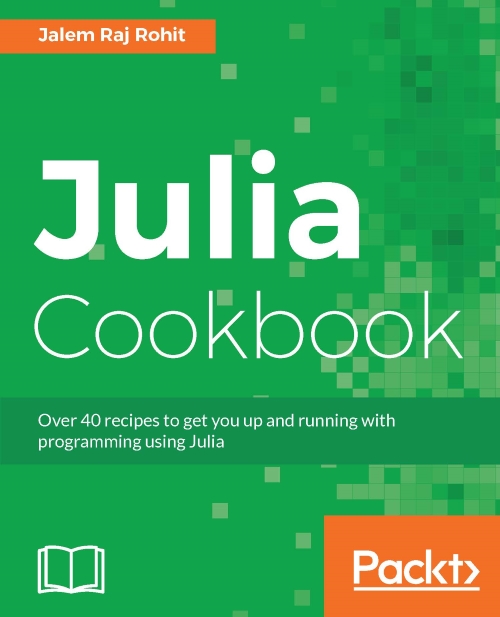
Julia Cookbook

Julia Cookbook

By : Raj R Jalem, Rohit
2.3 (3)
close
close
Julia Cookbook

Julia Cookbook

2.3 (3)
By: Raj R Jalem, Rohit

Overview of this book

Want to handle everything that Julia can throw at you and get the most of it every day? This practical guide to programming with Julia for performing numerical computation will make you more productive and able work with data more efficiently. The book starts with the main features of Julia to help you quickly refresh your knowledge of functions, modules, and arrays. We’ll also show you how to utilize the Julia language to identify, retrieve, and transform data sets so you can perform data analysis and data manipulation. Later on, you’ll see how to optimize data science programs with parallel computing and memory allocation. You’ll get familiar with the concepts of package development and networking to solve numerical problems using the Julia platform. This book includes recipes on identifying and classifying data science problems, data modelling, data analysis, data manipulation, meta-programming, multidimensional arrays, and parallel computing. By the end of the book, you will acquire the skills to work more effectively with your data.
Table of Contents (7 chapters)
close
close

Dimensionality reduction


In this recipe, you will learn about the concept of dimensionality reduction. This is the set of algorithms used by statisticians and data scientists when data has a large number of dimensions. It helps make computations and model designing easy. We will use the Principal Component Analysis (PCA) algorithm for this recipe.

Getting ready

To get started with this recipe, you have to have the MultivariateStats Julia package installed and running. This can be done by entering Pkg.add("MultivariateStats") in the Julia REPL. When using it for the first time, it might show a long list of warnings; however you can safely ignore them for the time being. They in no way affect the algorithms and techniques that we will use in this chapter.

How to do it...

  1. Firstly, let's simulate about a hundred random observations, as a training set for the PCA algorithm which we will use. This can be done using the randn() function:

    X = randn(100,3) * [0.8 0.7; 0.9 0.5; 0.2 0.6]
    

  2. Now, to fit...

Visually different images
CONTINUE READING
83
Tech Concepts
36
Programming languages
73
Tech Tools
Icon Unlimited access to the largest independent learning library in tech of over 8,000 expert-authored tech books and videos.
Icon Innovative learning tools, including AI book assistants, code context explainers, and text-to-speech.
Icon 50+ new titles added per month and exclusive early access to books as they are being written.
Julia Cookbook
notes
bookmark Notes and Bookmarks search Search in title playlist Add to playlist font-size Font size

Change the font size

margin-width Margin width

Change margin width

day-mode Day/Sepia/Night Modes

Change background colour

Close icon Search
Country selected

Close icon Your notes and bookmarks

Confirmation

Modal Close icon
claim successful

Buy this book with your credits?

Modal Close icon
Are you sure you want to buy this book with one of your credits?
Close
YES, BUY

Submit Your Feedback

Modal Close icon
Modal Close icon
Modal Close icon