Sign In Start Free Trial
Account

Add to playlist

Create a Playlist

Modal Close icon
You need to login to use this feature.
  • Book Overview & Buying Designing Machine Learning Systems with Python
  • Table Of Contents Toc
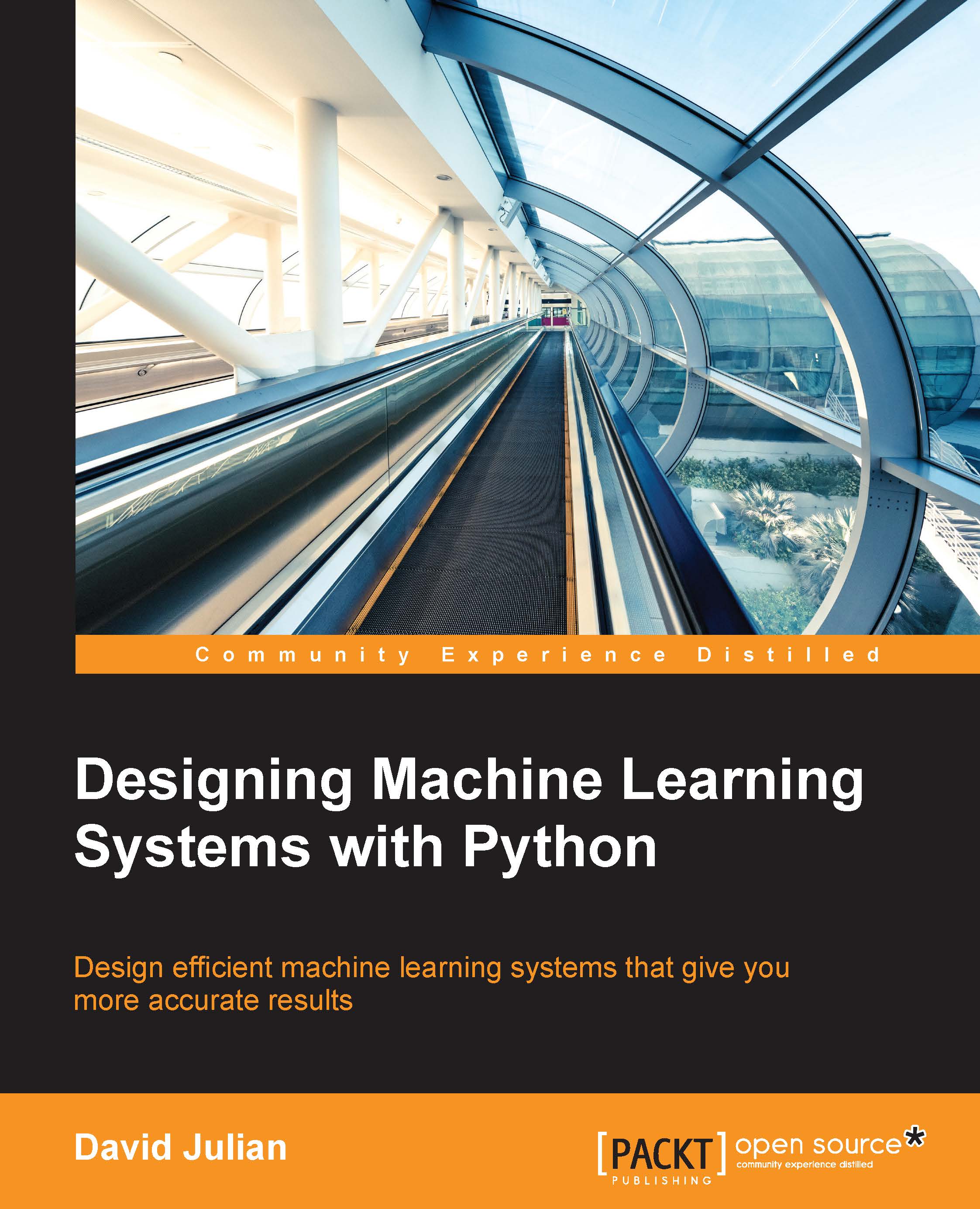
Designing Machine Learning Systems with Python

Designing Machine Learning Systems with Python

By : David Julian
2 (1)
close
close
Designing Machine Learning Systems with Python

Designing Machine Learning Systems with Python

2 (1)
By: David Julian

Overview of this book

Machine learning is one of the fastest growing trends in modern computing. It has applications in a wide range of fields, including economics, the natural sciences, web development, and business modeling. In order to harness the power of these systems, it is essential that the practitioner develops a solid understanding of the underlying design principles. There are many reasons why machine learning models may not give accurate results. By looking at these systems from a design perspective, we gain a deeper understanding of the underlying algorithms and the optimisational methods that are available. This book will give you a solid foundation in the machine learning design process, and enable you to build customised machine learning models to solve unique problems. You may already know about, or have worked with, some of the off-the-shelf machine learning models for solving common problems such as spam detection or movie classification, but to begin solving more complex problems, it is important to adapt these models to your own specific needs. This book will give you this understanding and more.
Table of Contents (11 chapters)
close
close
Lock Free Chapter
1
1. Thinking in Machine Learning
10
Index

NumPY

We should know that there is a hierarchy of types for representing data in Python. At the root are immutable objects such as integers, floats, and Boolean. Built on this, we have sequence types. These are ordered sets of objects indexed by non-negative integers. They are iterative objects that include strings, lists, and tuples. Sequence types have a common set of operations such as returning an element (s[i]) or a slice (s[i:j]), and finding the length (len(s)) or the sum (sum(s)). Finally, we have mapping types. These are collections of objects indexed by another collection of key objects. Mapping objects are unordered and are indexed by numbers, strings, or other objects. The built-in Python mapping type is the dictionary.

NumPy builds on these data objects by providing two further objects: an N-dimensional array object (ndarray) and a universal function object (ufunc). The ufunc object provides element-by-element operations on ndarray objects, allowing typecasting and array broadcasting...

CONTINUE READING
83
Tech Concepts
36
Programming languages
73
Tech Tools
Icon Unlimited access to the largest independent learning library in tech of over 8,000 expert-authored tech books and videos.
Icon Innovative learning tools, including AI book assistants, code context explainers, and text-to-speech.
Icon 50+ new titles added per month and exclusive early access to books as they are being written.
Designing Machine Learning Systems with Python
notes
bookmark Notes and Bookmarks search Search in title playlist Add to playlist font-size Font size

Change the font size

margin-width Margin width

Change margin width

day-mode Day/Sepia/Night Modes

Change background colour

Close icon Search
Country selected

Close icon Your notes and bookmarks

Confirmation

Modal Close icon
claim successful

Buy this book with your credits?

Modal Close icon
Are you sure you want to buy this book with one of your credits?
Close
YES, BUY

Submit Your Feedback

Modal Close icon
Modal Close icon
Modal Close icon