Sign In Start Free Trial
Account

Add to playlist

Create a Playlist

Modal Close icon
You need to login to use this feature.
  • Book Overview & Buying Scientific Computing with Scala
  • Table Of Contents Toc
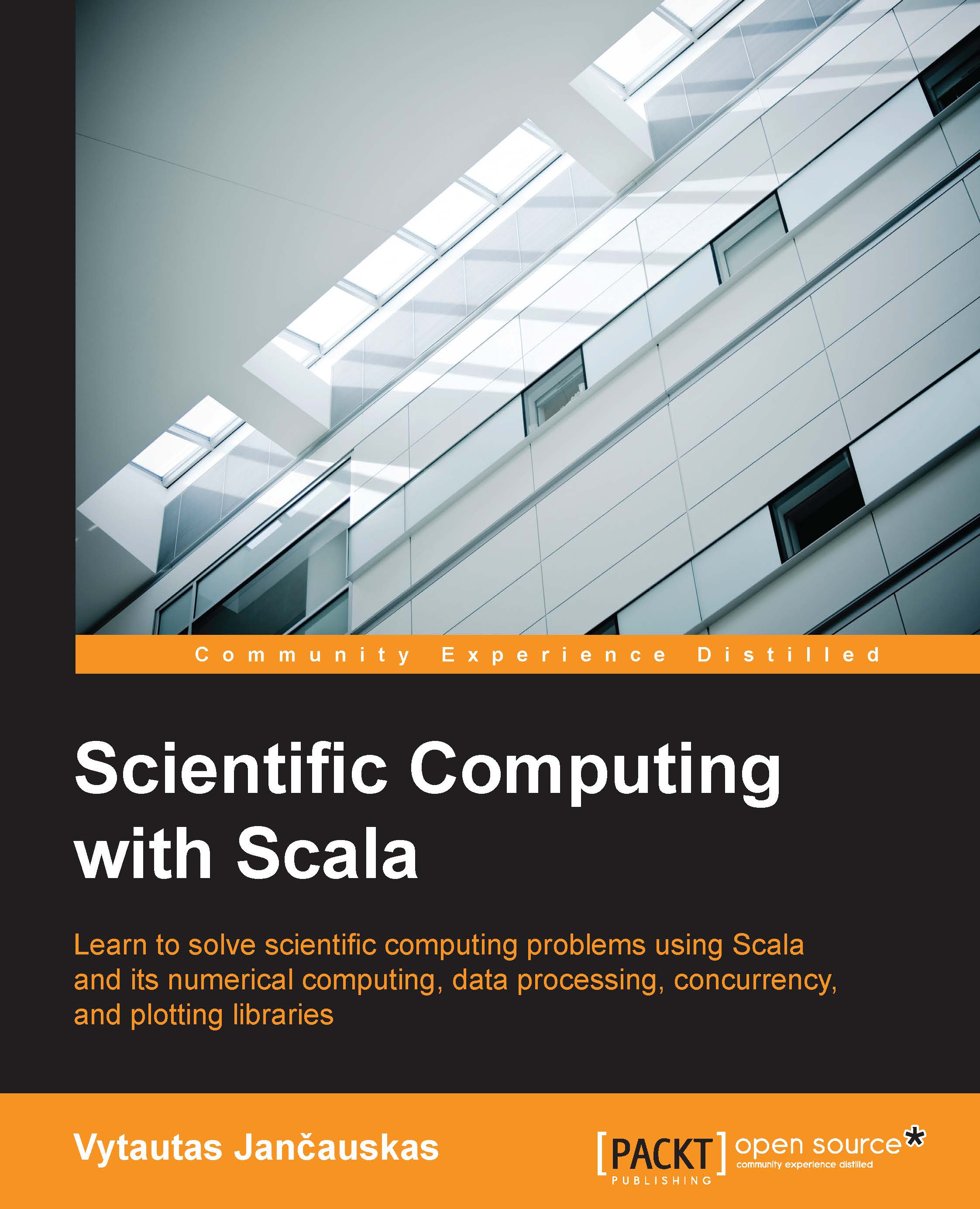
Scientific Computing with Scala

Scientific Computing with Scala

By : Vytautas Jancauskas
4 (1)
close
close
Scientific Computing with Scala

Scientific Computing with Scala

4 (1)
By: Vytautas Jancauskas

Overview of this book

Scala is a statically typed, Java Virtual Machine (JVM)-based language with strong support for functional programming. There exist libraries for Scala that cover a range of common scientific computing tasks – from linear algebra and numerical algorithms to convenient and safe parallelization to powerful plotting facilities. Learning to use these to perform common scientific tasks will allow you to write programs that are both fast and easy to write and maintain. We will start by discussing the advantages of using Scala over other scientific computing platforms. You will discover Scala packages that provide the functionality you have come to expect when writing scientific software. We will explore using Scala's Breeze library for linear algebra, optimization, and signal processing. We will then proceed to the Saddle library for data analysis. If you have experience in R or with Python's popular pandas library you will learn how to translate those skills to Saddle. If you are new to data analysis, you will learn basic concepts of Saddle as well. Well will explore the numerical computing environment called ScalaLab. It comes bundled with a lot of scientific software readily available. We will use it for interactive computing, data analysis, and visualization. In the following chapters, we will explore using Scala's powerful parallel collections for safe and convenient parallel programming. Topics such as the Akka concurrency framework will be covered. Finally, you will learn about multivariate data visualization and how to produce professional-looking plots in Scala easily. After reading the book, you should have more than enough information on how to start using Scala as your scientific computing platform
Table of Contents (11 chapters)
close
close
10
Index

Summary

In this chapter, we discussed the advantages of using Scala over other programming languages and environments for scientific computing. These include static typing and strong support for functional programming. We discussed how this will help you write better scientific software. We compared Scala to other popular programming languages and discussed their comparative merits and demerits; that is, Scala will allow you to write faster, better structured software while also keeping most of the advantages of dynamic languages.

We had a quick overview of the major scientific packages available for use in Scala. These cover a range from linear algebra and data analysis to statistical modeling. Using the ENSIME mode for Emacs and other text editors as a Scala IDE was discussed; we have also shown how to use ENSIME when debugging Scala code. Finally, and perhaps most importantly, we showed you how to use SBT to package, build, test, and distribute your software. Using well-established, convenient, and powerful build tools is very important since it removes a lot of the chores from writing software and allows you to concentrate on what is important.

We guided you through the process of writing, building, testing, and distributing an example library written in Scala. After all, you probably want your software to be used by other people. We also briefly describe how one would use Java libraries from a Scala program. You will want to know this since you will probably want your standalone program to have a nice Swing interface, or you could take advantage of JFreeChart when performing scientific plotting.

Tip

Downloading the example code

You can download the example code files for this book from your account at http://www.packtpub.com. If you purchased this book elsewhere, you can visit http://www.packtpub.com/support and register to have the files e-mailed directly to you.

  • You can download the code files by following these steps:
  • Log in or register to our website using your e-mail address and password.
  • Hover the mouse pointer on the SUPPORT tab at the top.
  • Click on Code Downloads & Errata.
  • Enter the name of the book in the Search box.
  • Select the book for which you're looking to download the code files.
  • Choose from the drop-down menu where you purchased this book from.
  • Click on Code Download.

You can also download the code files by clicking on the Code Files button on the book's webpage at the Packt Publishing website. This page can be accessed by entering the book's name in the Search box. Please note that you need to be logged in to your Packt account.

Once the file is downloaded, please make sure that you unzip or extract the folder using the latest version of:

  • WinRAR / 7-Zip for Windows
  • Zipeg / iZip / UnRarX for Mac
  • 7-Zip / PeaZip for Linux
CONTINUE READING
83
Tech Concepts
36
Programming languages
73
Tech Tools
Icon Unlimited access to the largest independent learning library in tech of over 8,000 expert-authored tech books and videos.
Icon Innovative learning tools, including AI book assistants, code context explainers, and text-to-speech.
Icon 50+ new titles added per month and exclusive early access to books as they are being written.
Scientific Computing with Scala
notes
bookmark Notes and Bookmarks search Search in title playlist Add to playlist download Download options font-size Font size

Change the font size

margin-width Margin width

Change margin width

day-mode Day/Sepia/Night Modes

Change background colour

Close icon Search
Country selected

Close icon Your notes and bookmarks

Confirmation

Modal Close icon
claim successful

Buy this book with your credits?

Modal Close icon
Are you sure you want to buy this book with one of your credits?
Close
YES, BUY

Submit Your Feedback

Modal Close icon
Modal Close icon
Modal Close icon