
Sign In Start Free Trial
Account

Add to playlist

Create a Playlist

Modal Close icon
You need to login to use this feature.
  • Book Overview & Buying Machine Learning Algorithms
  • Table Of Contents Toc
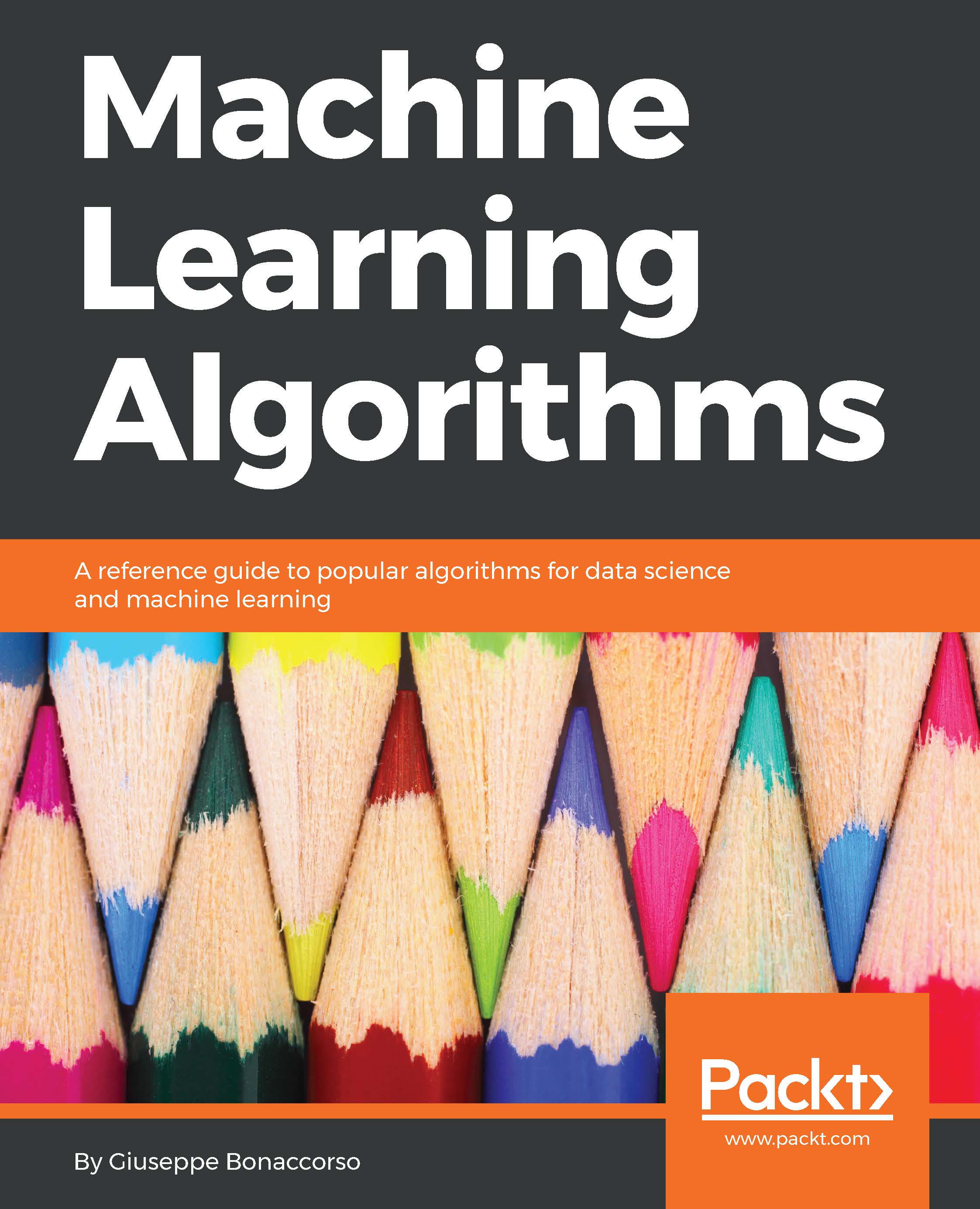
Machine Learning Algorithms

Machine Learning Algorithms

By : Giuseppe Bonaccorso
4.5 (4)
close
close
Machine Learning Algorithms

Machine Learning Algorithms

4.5 (4)
By: Giuseppe Bonaccorso

Overview of this book

In this book, you will learn all the important machine learning algorithms that are commonly used in the field of data science. These algorithms can be used for supervised as well as unsupervised learning, reinforcement learning, and semi-supervised learning. The algorithms that are covered in this book are linear regression, logistic regression, SVM, naïve Bayes, k-means, random forest, TensorFlow and feature engineering. In this book, you will how to use these algorithms to resolve your problems, and how they work. This book will also introduce you to natural language processing and recommendation systems, which help you to run multiple algorithms simultaneously. On completion of the book, you will know how to pick the right machine learning algorithm for clustering, classification, or regression for your problem
Table of Contents (16 chapters)
close
close

Summary

In this chapter, we introduced the concept of adaptive systems; they can learn from their experiences and modify their behavior in order to maximize the possibility of reaching a specific goal. Machine learning is the name given to a set of techniques that allow implementing adaptive algorithms to make predictions and to auto-organize input data according to their common features.

The three main learning strategies are supervised, unsupervised, and reinforcement. The first one assumes the presence of a teacher that provides a precise feedback on errors. The algorithm can hence compare its output with the right one and correct its parameters accordingly. In an unsupervised scenario, there are no external teachers, so everything is learned directly from the data. An algorithm will try to find out all features common to a group of elements to be able to associate new samples with the right cluster. Examples of the former type are provided by all the automatic classifications of objects into a specific category according to some known features, while common applications of unsupervised learning are the automatic groupings of items with a subsequent labeling or processing. The third kind of learning is similar to supervised, but it receives only an environmental feedback about the quality of its actions. It doesn't know exactly what is wrong or the magnitude of its error but receives generic information that helps it in deciding whether to continue to adopt a policy or to pick another one.  

In the next chapter, we're going to discuss some fundamental elements of machine learning, with particular focus on the mathematical notation and the main definitions that we'll need in all the other chapters. We'll also discuss important statistical learning concepts and some theory about learnability and its limits.

CONTINUE READING
83
Tech Concepts
36
Programming languages
73
Tech Tools
Icon Unlimited access to the largest independent learning library in tech of over 8,000 expert-authored tech books and videos.
Icon Innovative learning tools, including AI book assistants, code context explainers, and text-to-speech.
Icon 50+ new titles added per month and exclusive early access to books as they are being written.
Machine Learning Algorithms
notes
bookmark Notes and Bookmarks search Search in title playlist Add to playlist download Download options font-size Font size

Change the font size

margin-width Margin width

Change margin width

day-mode Day/Sepia/Night Modes

Change background colour

Close icon Search
Country selected

Close icon Your notes and bookmarks

Confirmation

Modal Close icon
claim successful

Buy this book with your credits?

Modal Close icon
Are you sure you want to buy this book with one of your credits?
Close
YES, BUY

Submit Your Feedback

Modal Close icon
Modal Close icon
Modal Close icon