Sign In Start Free Trial
Account

Add to playlist

Create a Playlist

Modal Close icon
You need to login to use this feature.
  • Book Overview & Buying MDX with Microsoft SQL Server 2016 Analysis Services Cookbook
  • Table Of Contents Toc
MDX with Microsoft SQL Server 2016 Analysis Services Cookbook

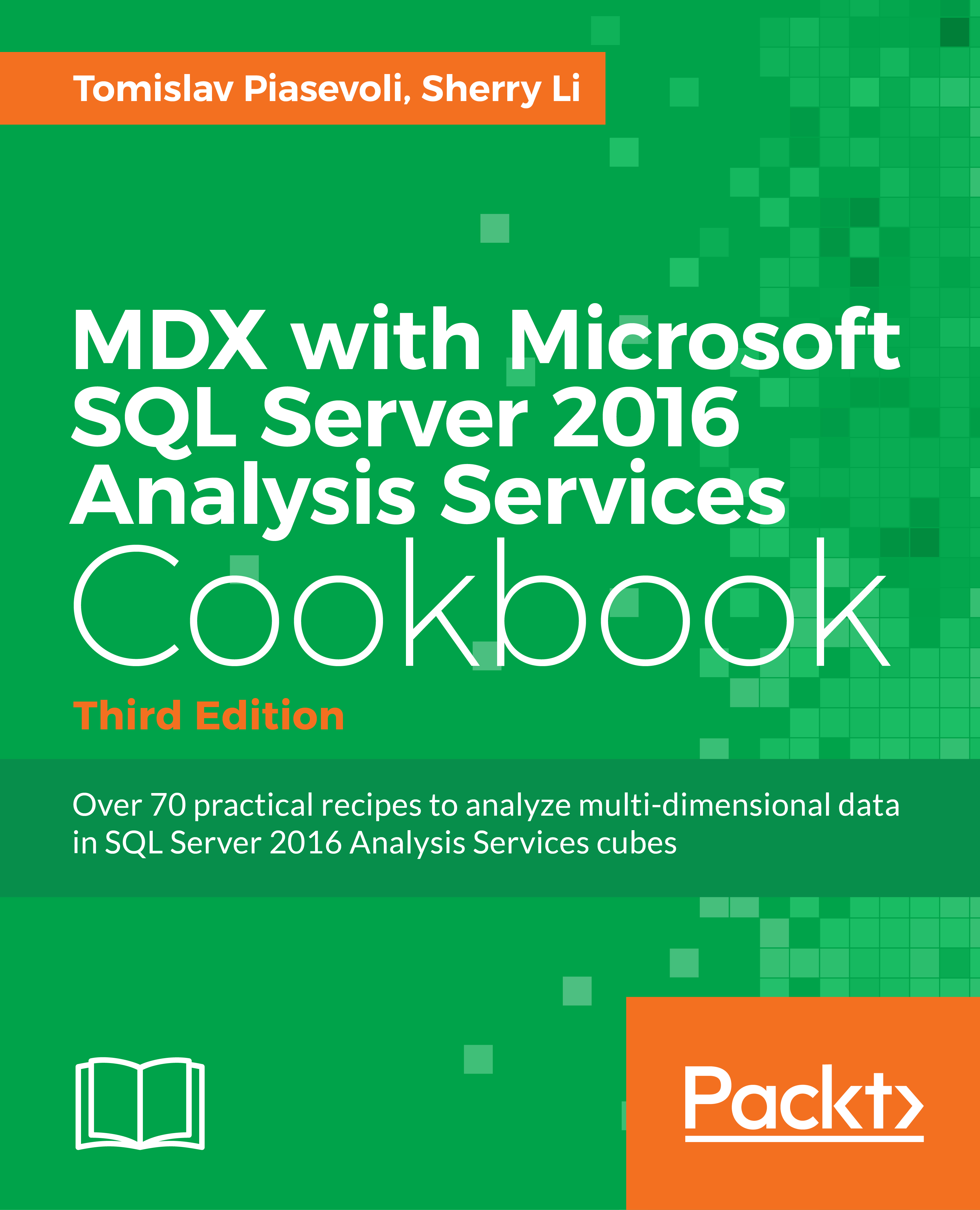
MDX with Microsoft SQL Server 2016 Analysis Services Cookbook - Third Edition

By : Tomislav Piasevoli, Sherry Li
5 (3)
close
close
MDX with Microsoft SQL Server 2016 Analysis Services Cookbook

MDX with Microsoft SQL Server 2016 Analysis Services Cookbook

5 (3)
By: Tomislav Piasevoli, Sherry Li

Overview of this book

If you're often faced with MDX challenges, this is a book for you. It will teach you how to solve various real-world business requirements using MDX queries and calculations. Examples in the book introduce an idea or a problem and then guide you through the process of implementing the solution in a step-by-step manner, inform you about the best practices and offer a deep knowledge in terms of how the solution works. Recipes are organized by chapters, each covering a single topic. They start slowly and logically progress to more advanced techniques. In case of complexity, things are broken down. Instead of one, there are series of recipes built one on top of another. This way you are able to see intermediate results and debug potential errors faster. Finally, the cookbook format is here to help you quickly identify the topic of interest and in it a wide range of practical solutions, that is – MDX recipes for your success.
Table of Contents (11 chapters)
close
close

Using a new attribute to separate members on a level


In reporting and analysis, there are situations when a certain member (often named NA, unknown, or similar) corrupts the analysis. It makes it hard for end users to focus on the rest of the data. It distracts them by making them think about what this member represents, why it is here, and why it has data associated to it. Other times, the reason may be that the end users need a total without that member. In both of these situations, they remove that member from the result which generates a new MDX query.

It is true, that a combination of a named set without that member and a calculated member as an aggregate of that set can be created in MDX script to simplify the rest of the calculations and the usage of that hierarchy in general. However, this is not the optimal solution.

Is there a better way? Yes, but it requires a dimension redesign. If that's applicable in your case, read on because this recipe shows how to keep your cube design simple...

CONTINUE READING
83
Tech Concepts
36
Programming languages
73
Tech Tools
Icon Unlimited access to the largest independent learning library in tech of over 8,000 expert-authored tech books and videos.
Icon Innovative learning tools, including AI book assistants, code context explainers, and text-to-speech.
Icon 50+ new titles added per month and exclusive early access to books as they are being written.
MDX with Microsoft SQL Server 2016 Analysis Services Cookbook
notes
bookmark Notes and Bookmarks search Search in title playlist Add to playlist download Download options font-size Font size

Change the font size

margin-width Margin width

Change margin width

day-mode Day/Sepia/Night Modes

Change background colour

Close icon Search
Country selected

Close icon Your notes and bookmarks

Confirmation

Modal Close icon
claim successful

Buy this book with your credits?

Modal Close icon
Are you sure you want to buy this book with one of your credits?
Close
YES, BUY

Submit Your Feedback

Modal Close icon
Modal Close icon
Modal Close icon