


Feedback from our readers is always welcome. Let us know what you think about this book-what you liked or disliked. Reader feedback is important for us as it helps us develop titles that you will really get the most out of. To send us general feedback, simply email [email protected], and mention the book's title in the subject of your message. If there is a topic that you have expertise in and you are interested in either writing or contributing to a book, see our author guide at www.packtpub.com/authors.
-
Book Overview & Buying
-
Table Of Contents

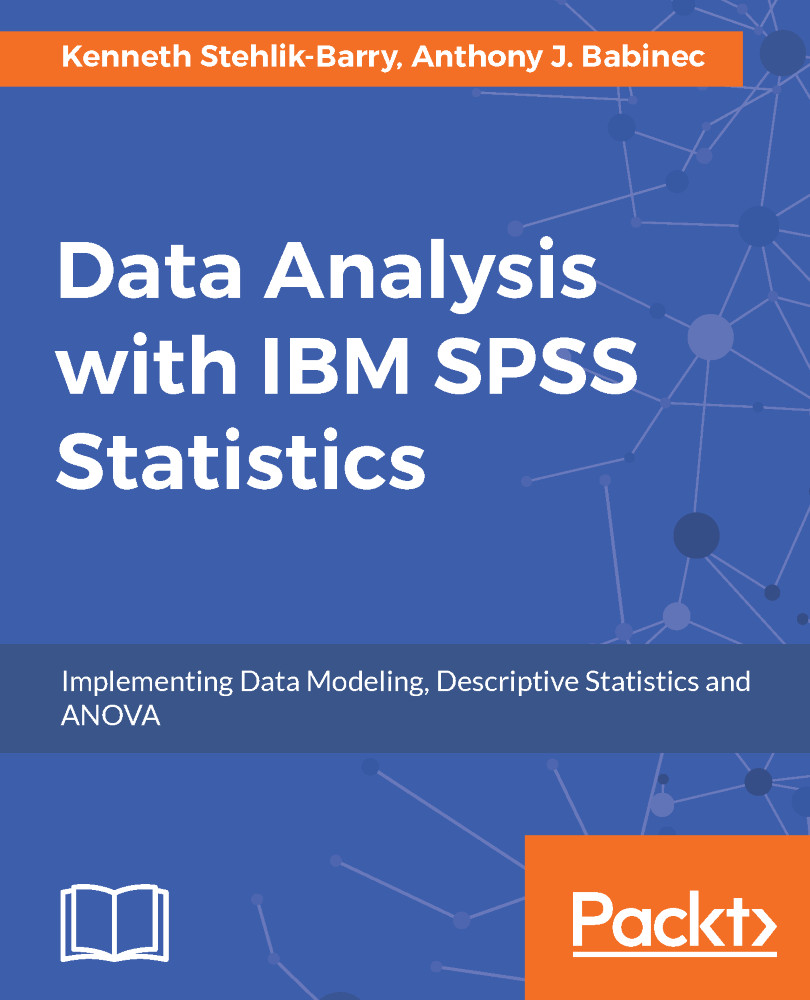
Data Analysis with IBM SPSS Statistics
By :


Data Analysis with IBM SPSS Statistics
By:
Overview of this book
SPSS Statistics is a software package used for logical batched and non-batched statistical analysis. Analytical tools such as SPSS can readily provide even a novice user with an overwhelming amount of information and a broad range of options for analyzing patterns in the data.
The journey starts with installing and configuring SPSS Statistics for first use and exploring the data to understand its potential (as well as its limitations). Use the right statistical analysis technique such as regression, classification and more, and analyze your data in the best possible manner. Work with graphs and charts to visualize your findings. With this information in hand, the discovery of patterns within the data can be undertaken. Finally, the high level objective of developing predictive models that can be applied to other situations will be addressed.
By the end of this book, you will have a firm understanding of the various statistical analysis techniques offered by SPSS Statistics, and be able to master its use for data analysis with ease.
Table of Contents (17 chapters)
Preface

 Free Chapter
Installing and Configuring SPSS

Accessing and Organizing Data
Statistics for Individual Data Elements
Dealing with Missing Data and Outliers
Visually Exploring the Data
Sampling, Subsetting, and Weighting
Creating New Data Elements
Adding and Matching Files
Aggregating and Restructuring Data
Crosstabulation Patterns for Categorical Data
Comparing Means and ANOVA
Correlations
Linear Regression
Principal Components and Factor Analysis
Clustering
Discriminant Analysis


