
Sign In Start Free Trial
Account

Add to playlist

Create a Playlist

Modal Close icon
You need to login to use this feature.
  • Book Overview & Buying scikit-learn Cookbook , Second Edition
  • Table Of Contents Toc
scikit-learn Cookbook , Second Edition

scikit-learn Cookbook , Second Edition - Second Edition

By : Julian Avila, Trent Hauck
3.7 (3)
close
close
scikit-learn Cookbook , Second Edition

scikit-learn Cookbook , Second Edition

3.7 (3)
By: Julian Avila, Trent Hauck

Overview of this book

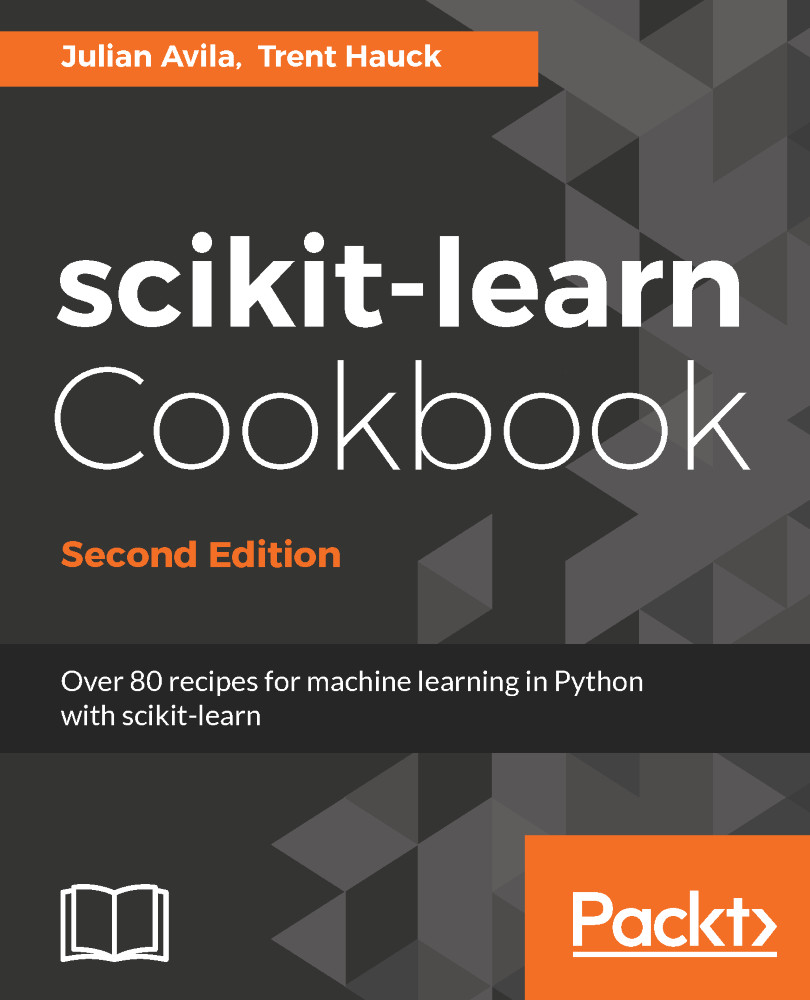
Python is quickly becoming the go-to language for analysts and data scientists due to its simplicity and flexibility, and within the Python data space, scikit-learn is the unequivocal choice for machine learning. This book includes walk throughs and solutions to the common as well as the not-so-common problems in machine learning, and how scikit-learn can be leveraged to perform various machine learning tasks effectively. The second edition begins with taking you through recipes on evaluating the statistical properties of data and generates synthetic data for machine learning modelling. As you progress through the chapters, you will comes across recipes that will teach you to implement techniques like data pre-processing, linear regression, logistic regression, K-NN, Naïve Bayes, classification, decision trees, Ensembles and much more. Furthermore, you’ll learn to optimize your models with multi-class classification, cross validation, model evaluation and dive deeper in to implementing deep learning with scikit-learn. Along with covering the enhanced features on model section, API and new features like classifiers, regressors and estimators the book also contains recipes on evaluating and fine-tuning the performance of your model. By the end of this book, you will have explored plethora of features offered by scikit-learn for Python to solve any machine learning problem you come across.
Table of Contents (13 chapters)
close
close

Introduction

In this chapter, we will reduce the number of features or inputs into the machine learning models. This is a very important operation because sometimes datasets have a lot of input columns, and reducing the number of columns creates simpler models that take less computing power to predict.

The main model used in this section is principal component analysis (PCA). You do not have to know how many features you can reduce the dataset to, thanks to PCA's explained variance. A similar model in performance is truncated singular value decomposition (truncated SVD). It is always best to first choose a linear model that allows you to know how many columns you can reduce the set to, such as PCA or truncated SVD.

Later in the chapter, check out the modern method of t-distributed stochastic neighbor embedding (t-SNE), which makes features easier to visualize in lower dimensions...

CONTINUE READING
83
Tech Concepts
36
Programming languages
73
Tech Tools
Icon Unlimited access to the largest independent learning library in tech of over 8,000 expert-authored tech books and videos.
Icon Innovative learning tools, including AI book assistants, code context explainers, and text-to-speech.
Icon 50+ new titles added per month and exclusive early access to books as they are being written.
scikit-learn Cookbook , Second Edition
notes
bookmark Notes and Bookmarks search Search in title playlist Add to playlist download Download options font-size Font size

Change the font size

margin-width Margin width

Change margin width

day-mode Day/Sepia/Night Modes

Change background colour

Close icon Search
Country selected

Close icon Your notes and bookmarks

Confirmation

Modal Close icon
claim successful

Buy this book with your credits?

Modal Close icon
Are you sure you want to buy this book with one of your credits?
Close
YES, BUY

Submit Your Feedback

Modal Close icon
Modal Close icon
Modal Close icon