Sign In Start Free Trial
Account

Add to playlist

Create a Playlist

Modal Close icon
You need to login to use this feature.
  • Book Overview & Buying Mastering Machine Learning with R
  • Table Of Contents Toc
Mastering Machine Learning with R

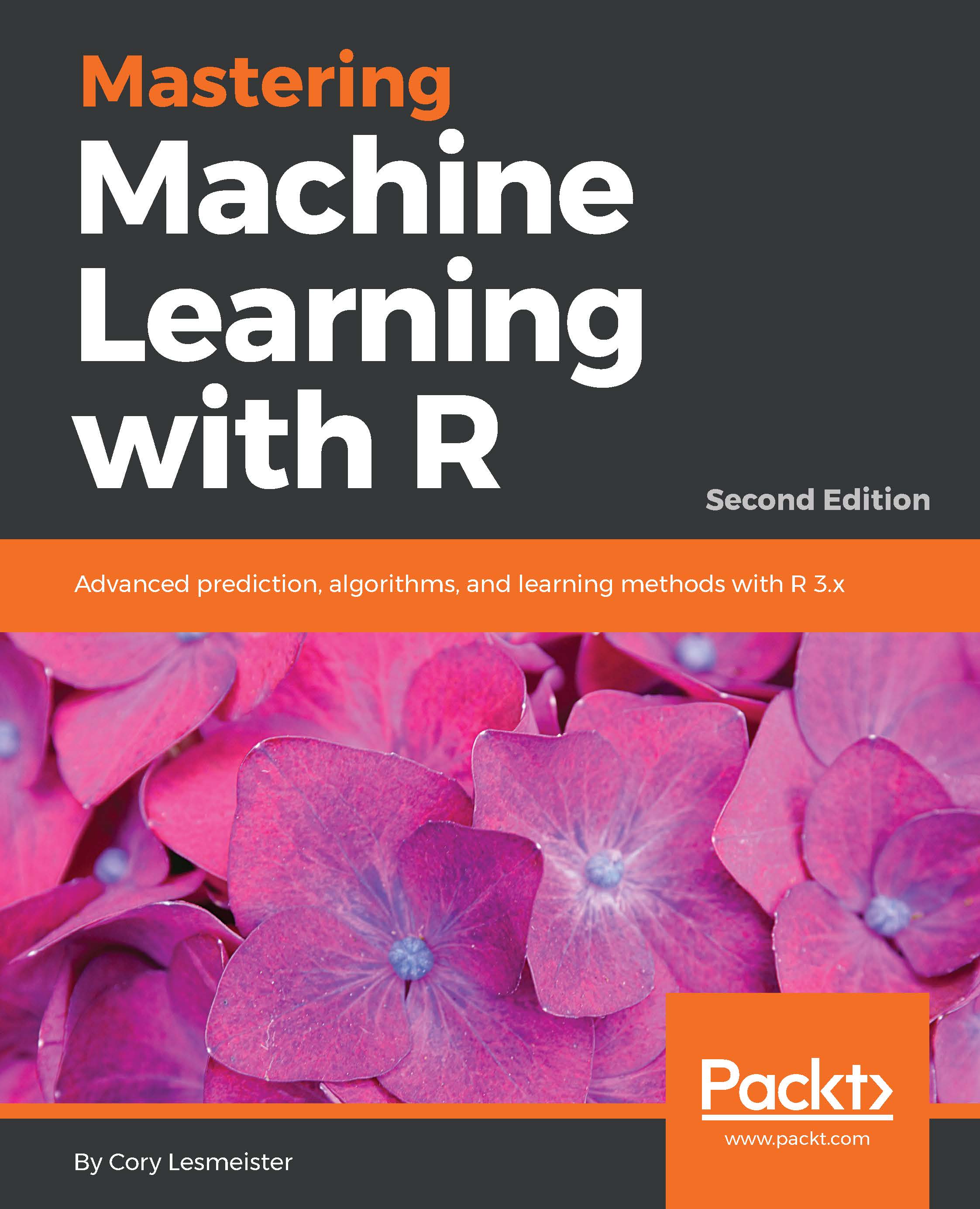
Mastering Machine Learning with R - Second Edition

By : Cory Lesmeister, Doug Ortiz , Vikram Dhillon, Miroslav Kopecky
2.8 (4)
close
close
Mastering Machine Learning with R

Mastering Machine Learning with R

2.8 (4)
By: Cory Lesmeister, Doug Ortiz , Vikram Dhillon, Miroslav Kopecky

Overview of this book

This book will teach you advanced techniques in machine learning with the latest code in R 3.3.2. You will delve into statistical learning theory and supervised learning; design efficient algorithms; learn about creating Recommendation Engines; use multi-class classification and deep learning; and more. You will explore, in depth, topics such as data mining, classification, clustering, regression, predictive modeling, anomaly detection, boosted trees with XGBOOST, and more. More than just knowing the outcome, you’ll understand how these concepts work and what they do. With a slow learning curve on topics such as neural networks, you will explore deep learning, and more. By the end of this book, you will be able to perform machine learning with R in the cloud using AWS in various scenarios with different datasets.
Table of Contents (17 chapters)
close
close
16
Sources

Modeling and evaluation


With the data prepared, we will begin the modeling process. For comparison purposes, we will create a model using best subsets regression like the previous two chapters and then utilize the regularization techniques.

Best subsets

The following code is, for the most part, a rehash of what we developed in Chapter 2, Linear Regression - The Blocking and Tackling of Machine Learning. We will create the best subset object using the regsubsets() command and specify the train portion of data. The variables that are selected will then be used in a model on the test set, which we will evaluate with a mean squared error calculation.

The model that we are building is written out as lpsa ~ . with the tilde and period stating that we want to use all the remaining variables in our data frame, with the exception of the response:

> subfit <- regsubsets(lpsa ~ ., data = train)

With the model built, you can produce the best subset with two lines of code. The first one turns the summary...

CONTINUE READING
83
Tech Concepts
36
Programming languages
73
Tech Tools
Icon Unlimited access to the largest independent learning library in tech of over 8,000 expert-authored tech books and videos.
Icon Innovative learning tools, including AI book assistants, code context explainers, and text-to-speech.
Icon 50+ new titles added per month and exclusive early access to books as they are being written.
Mastering Machine Learning with R
notes
bookmark Notes and Bookmarks search Search in title playlist Add to playlist download Download options font-size Font size

Change the font size

margin-width Margin width

Change margin width

day-mode Day/Sepia/Night Modes

Change background colour

Close icon Search
Country selected

Close icon Your notes and bookmarks

Confirmation

Modal Close icon
claim successful

Buy this book with your credits?

Modal Close icon
Are you sure you want to buy this book with one of your credits?
Close
YES, BUY

Submit Your Feedback

Modal Close icon
Modal Close icon
Modal Close icon