Sign In Start Free Trial
Account

Add to playlist

Create a Playlist

Modal Close icon
You need to login to use this feature.
  • Book Overview & Buying Feature Engineering Made Easy
  • Table Of Contents Toc
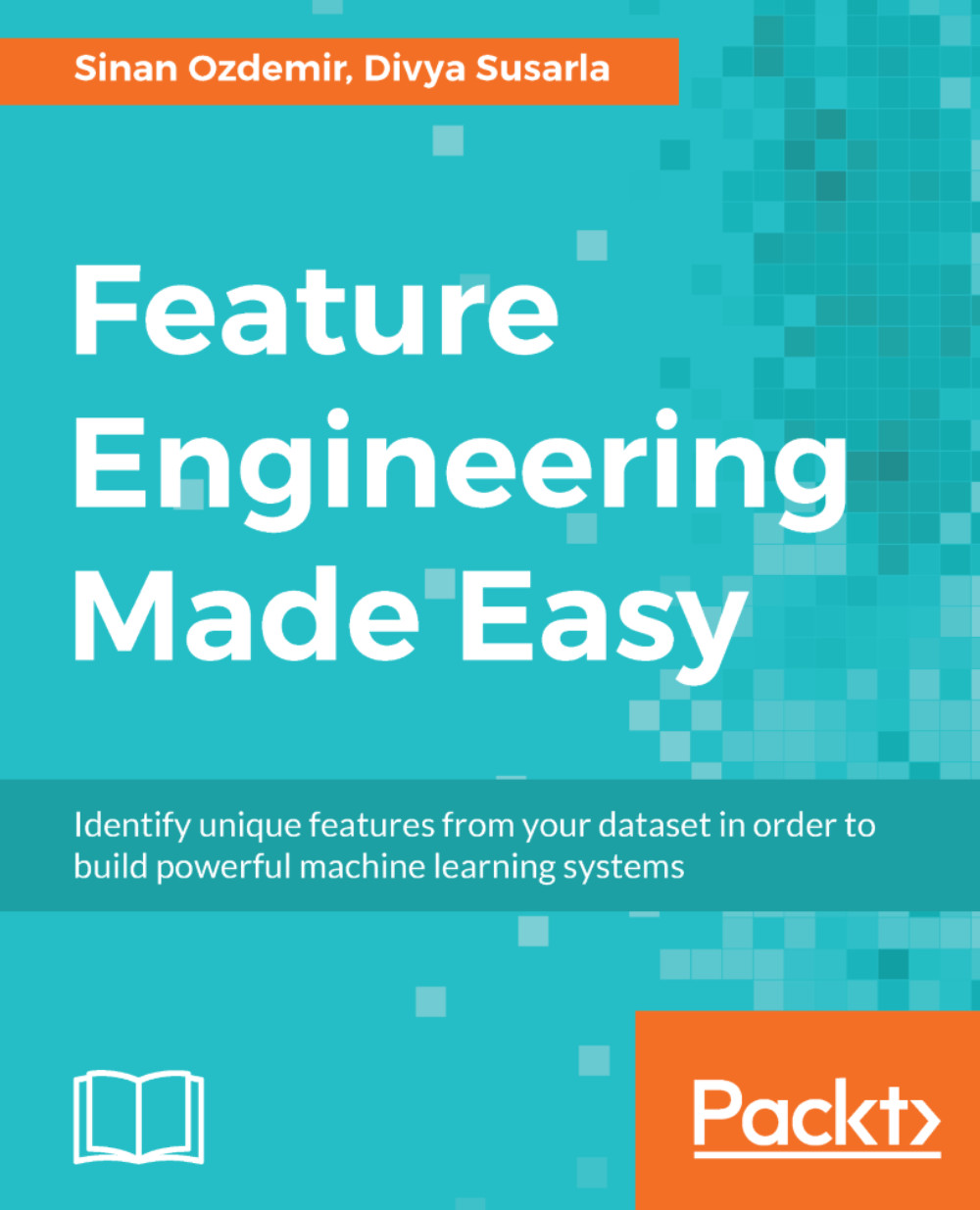
Feature Engineering Made Easy

Feature Engineering Made Easy

By : Sinan Ozdemir, Divya Susarla, Michael Smith
4.4 (11)
close
close
Feature Engineering Made Easy

Feature Engineering Made Easy

4.4 (11)
By: Sinan Ozdemir, Divya Susarla, Michael Smith

Overview of this book

Feature engineering is the most important step in creating powerful machine learning systems. This book will take you through the entire feature-engineering journey to make your machine learning much more systematic and effective. You will start with understanding your data—often the success of your ML models depends on how you leverage different feature types, such as continuous, categorical, and more, You will learn when to include a feature, when to omit it, and why, all by understanding error analysis and the acceptability of your models. You will learn to convert a problem statement into useful new features. You will learn to deliver features driven by business needs as well as mathematical insights. You'll also learn how to use machine learning on your machines, automatically learning amazing features for your data. By the end of the book, you will become proficient in Feature Selection, Feature Learning, and Feature Optimization.
Table of Contents (10 chapters)
close
close

Using RBMs in a machine learning pipeline


Of course, we want to see how the RBM performs in our machine learning pipelines to not just visualize the workings of the model, but to see concrete results of the feature learning. To do this, we will create and run three pipelines:

  • A logistic regression model by itself running on the raw pixel strengths
  • A logistic regression running on extracted PCA components
  • A logistic regression running on extracted RBM components

Each of these pipelines will be grid-searched across a number of components (for PCA and RBM) and the C parameter for logistic regression. Let's start with our simplest pipeline. We will run the raw pixel values through a logistic regression to see if the linear model is enough to separate out the digits.

Using a linear model on raw pixel values

To begin, we will run the raw pixel values through a logistic regression model in order to obtain something of a baseline model. We want to see if utilizing PCA or RBM components will allow the...

CONTINUE READING
83
Tech Concepts
36
Programming languages
73
Tech Tools
Icon Unlimited access to the largest independent learning library in tech of over 8,000 expert-authored tech books and videos.
Icon Innovative learning tools, including AI book assistants, code context explainers, and text-to-speech.
Icon 50+ new titles added per month and exclusive early access to books as they are being written.
Feature Engineering Made Easy
notes
bookmark Notes and Bookmarks search Search in title playlist Add to playlist download Download options font-size Font size

Change the font size

margin-width Margin width

Change margin width

day-mode Day/Sepia/Night Modes

Change background colour

Close icon Search
Country selected

Close icon Your notes and bookmarks

Confirmation

Modal Close icon
claim successful

Buy this book with your credits?

Modal Close icon
Are you sure you want to buy this book with one of your credits?
Close
YES, BUY

Submit Your Feedback

Modal Close icon
Modal Close icon
Modal Close icon