Sign In Start Free Trial
Account

Add to playlist

Create a Playlist

Modal Close icon
You need to login to use this feature.
  • Book Overview & Buying Learning PostgreSQL 10
  • Table Of Contents Toc
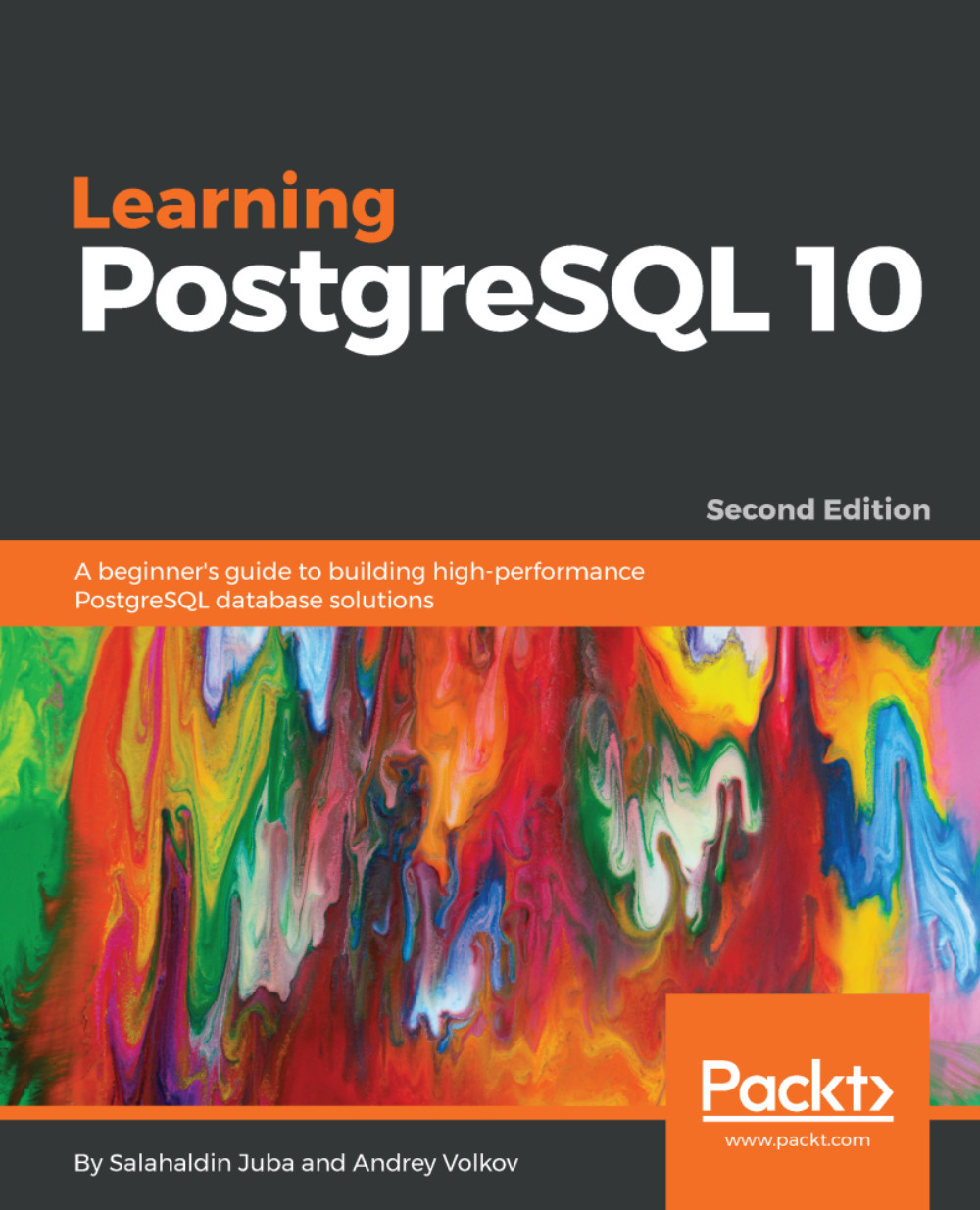
Learning PostgreSQL 10

Learning PostgreSQL 10 - Second Edition

By : Salahaldin Juba, Andrey Volkov, Sheldon Strauch, Isabel Maria Duarte Rosa
2.3 (6)
close
close
Learning PostgreSQL 10

Learning PostgreSQL 10

2.3 (6)
By: Salahaldin Juba, Andrey Volkov, Sheldon Strauch, Isabel Maria Duarte Rosa

Overview of this book

PostgreSQL is one of the most popular open source databases in the world, supporting the most advanced features included in SQL standards. This book will familiarize you with the latest features released in PostgreSQL 10. We’ll start with a thorough introduction to PostgreSQL and the new features introduced in PostgreSQL 10. We’ll cover the Data Definition Language (DDL) with an emphasis on PostgreSQL, and the common DDL commands supported by ANSI SQL. You’ll learn to create tables, define integrity constraints, build indexes, and set up views and other schema objects. Moving on, we’ll cover the concepts of Data Manipulation Language (DML) and PostgreSQL server-side programming capabilities using PL/pgSQL. We’ll also explore the NoSQL capabilities of PostgreSQL and connect to your PostgreSQL database to manipulate data objects. By the end of this book, you’ll have a thorough understanding of the basics of PostgreSQL 10 and will have the necessary skills to build efficient database solutions.
Table of Contents (17 chapters)
close
close

Indexes


An index is a physical database object that is defined on a table column or a list of columns. In PostgreSQL, there are many types of indexes and several ways to use them. Indexes can be used, in general, to do the following:

  • Optimize performance: an index allows the efficient retrieval of a small number of rows from the table. Whether or not a number of rows is considered small is determined by the total number of rows in the table and execution planner settings.
  • Validate constraints: An index can be used to validate the constraints on several rows. For example, the UNIQUE check constraint creates a unique index on the column behind the scenes. 

The following example shows how to use GIST to forbid overlapping between date ranges. For more information, have a look at https://www.postgresql.org/docs/current/static/rangetypes.html

CREATE TABLE no_date_overlap (
    date_range daterange,
    EXCLUDE USING GIST (date_range WITH &&)
);

To test date range overlapping:

car_portal=# INSERT...
CONTINUE READING
83
Tech Concepts
36
Programming languages
73
Tech Tools
Icon Unlimited access to the largest independent learning library in tech of over 8,000 expert-authored tech books and videos.
Icon Innovative learning tools, including AI book assistants, code context explainers, and text-to-speech.
Icon 50+ new titles added per month and exclusive early access to books as they are being written.
Learning PostgreSQL 10
notes
bookmark Notes and Bookmarks search Search in title playlist Add to playlist font-size Font size

Change the font size

margin-width Margin width

Change margin width

day-mode Day/Sepia/Night Modes

Change background colour

Close icon Search
Country selected

Close icon Your notes and bookmarks

Confirmation

Modal Close icon
claim successful

Buy this book with your credits?

Modal Close icon
Are you sure you want to buy this book with one of your credits?
Close
YES, BUY

Submit Your Feedback

Modal Close icon
Modal Close icon
Modal Close icon