


Feedback from our readers is always welcome. Let us know what you think about this book-what you liked or disliked. Reader feedback is important for us as it helps us develop titles that you will really get the most out of. To send us general feedback, simply email [email protected], and mention the book's title in the subject of your message. If there is a topic that you have expertise in and you are interested in either writing or contributing to a book, see our author guide at www.packtpub.com/authors.
-
Book Overview & Buying
-
Table Of Contents

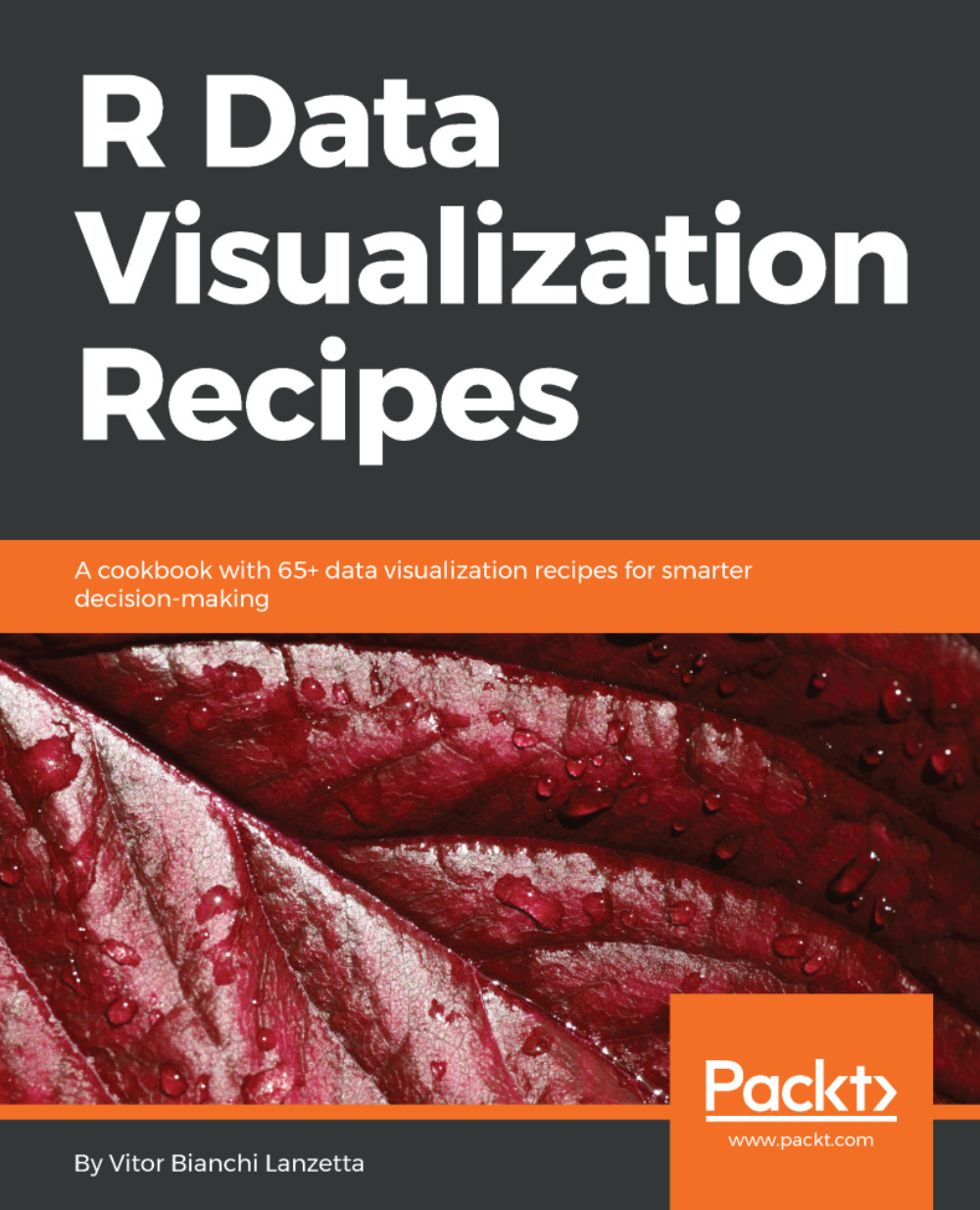
R Data Visualization Recipes
By :


R Data Visualization Recipes
By:
Overview of this book
R is an open source language for data analysis and graphics that allows users to load various packages for effective and better data interpretation. Its popularity has soared in recent years because of its powerful capabilities when it comes to turning different kinds of data into intuitive visualization solutions.
This book is an update to our earlier R data visualization cookbook with 100 percent fresh content and covering all the cutting edge R data visualization tools. This book is packed with practical recipes, designed to provide you with all the guidance needed to get to grips with data visualization using R. It starts off with the basics of ggplot2, ggvis, and plotly visualization packages, along with an introduction to creating maps and customizing them, before progressively taking you through various ggplot2 extensions, such as ggforce, ggrepel, and gganimate. Using real-world datasets, you will analyze and visualize your data as histograms, bar graphs, and scatterplots, and customize your plots with various themes and coloring options. The book also covers advanced visualization aspects such as creating interactive dashboards using Shiny
By the end of the book, you will be equipped with key techniques to create impressive data visualizations with professional efficiency and precision.
Table of Contents (13 chapters)
Preface

 Free Chapter
Installation and Introduction

Plotting Two Continuous Variables
Plotting a Discrete Predictor and a Continuous Response
Plotting One Variable
Making Other Bivariate Plots
Creating Maps
Faceting
Designing Three-Dimensional Plots
Using Theming Packages
Designing More Specialized Plots
Making Interactive Plots


