
Sign In Start Free Trial
Account

Add to playlist

Create a Playlist

Modal Close icon
You need to login to use this feature.
  • Book Overview & Buying Deep Learning with PyTorch
  • Table Of Contents Toc
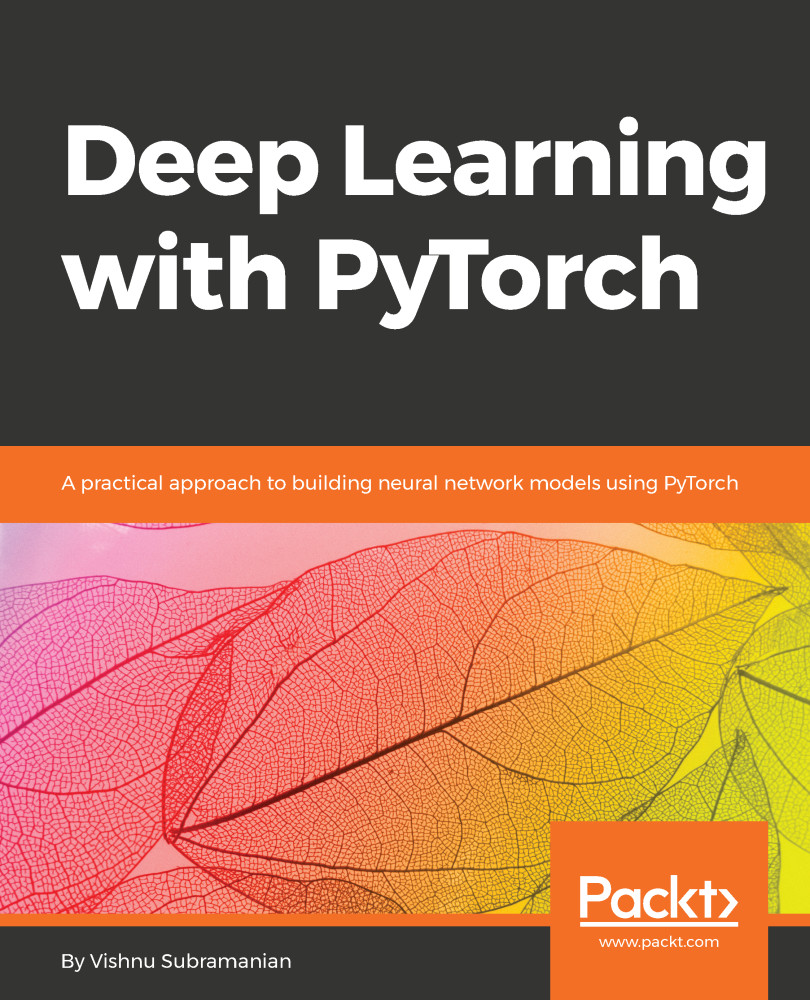
Deep Learning with PyTorch

Deep Learning with PyTorch

By : Vishnu Subramanian
3.4 (13)
close
close
Deep Learning with PyTorch

Deep Learning with PyTorch

3.4 (13)
By: Vishnu Subramanian

Overview of this book

Deep learning powers the most intelligent systems in the world, such as Google Voice, Siri, and Alexa. Advancements in powerful hardware, such as GPUs, software frameworks such as PyTorch, Keras, TensorFlow, and CNTK along with the availability of big data have made it easier to implement solutions to problems in the areas of text, vision, and advanced analytics. This book will get you up and running with one of the most cutting-edge deep learning libraries—PyTorch. PyTorch is grabbing the attention of deep learning researchers and data science professionals due to its accessibility, efficiency and being more native to Python way of development. You'll start off by installing PyTorch, then quickly move on to learn various fundamental blocks that power modern deep learning. You will also learn how to use CNN, RNN, LSTM and other networks to solve real-world problems. This book explains the concepts of various state-of-the-art deep learning architectures, such as ResNet, DenseNet, Inception, and Seq2Seq, without diving deep into the math behind them. You will also learn about GPU computing during the course of the book. You will see how to train a model with PyTorch and dive into complex neural networks such as generative networks for producing text and images. By the end of the book, you'll be able to implement deep learning applications in PyTorch with ease.
Table of Contents (11 chapters)
close
close

Summary

In this chapter, we covered some of the common and best practices that are used in solving machine learning or deep learning problems. We covered various important steps such as creating problem statements, choosing the algorithm, beating the baseline score, increasing the capacity of the model until it overfits the dataset, applying regularization techniques that can prevent overfitting, increasing the generalization capacity, tuning different parameters of the model or algorithms, and exploring different learning strategies that can be used to train deep learning models optimally and faster.

In the next chapter, we will cover different components that are responsible for building state-of-the-art Convolutional Neural Networks (CNNs). We will also cover transfer learning, which helps us to train image classifiers when little data is available. We will also cover techniques...

CONTINUE READING
83
Tech Concepts
36
Programming languages
73
Tech Tools
Icon Unlimited access to the largest independent learning library in tech of over 8,000 expert-authored tech books and videos.
Icon Innovative learning tools, including AI book assistants, code context explainers, and text-to-speech.
Icon 50+ new titles added per month and exclusive early access to books as they are being written.
Deep Learning with PyTorch
notes
bookmark Notes and Bookmarks search Search in title playlist Add to playlist download Download options font-size Font size

Change the font size

margin-width Margin width

Change margin width

day-mode Day/Sepia/Night Modes

Change background colour

Close icon Search
Country selected

Close icon Your notes and bookmarks

Confirmation

Modal Close icon
claim successful

Buy this book with your credits?

Modal Close icon
Are you sure you want to buy this book with one of your credits?
Close
YES, BUY

Submit Your Feedback

Modal Close icon
Modal Close icon
Modal Close icon