


Humans have an inherent ability to transfer knowledge across tasks. What we acquire as knowledge while learning about one task, we utilize in the same way to solve related tasks. The more related the tasks, the easier it is for us to transfer, or cross-utilize, knowledge. Machine learning and the deep learning algorithms, discussed so far, have been traditionally designed to work in isolation. These algorithms are trained to solve specific tasks. The models have to be rebuilt from scratch once the feature-space distribution changes. Transfer learning is the idea of overcoming the isolated learning paradigm and utilizing knowledge acquired for one task to solve related ones. In this chapter, we will introduce the concept of transfer learning and concentrate on aspects of the context of deep learning. This...
-
Book Overview & Buying
-
Table Of Contents

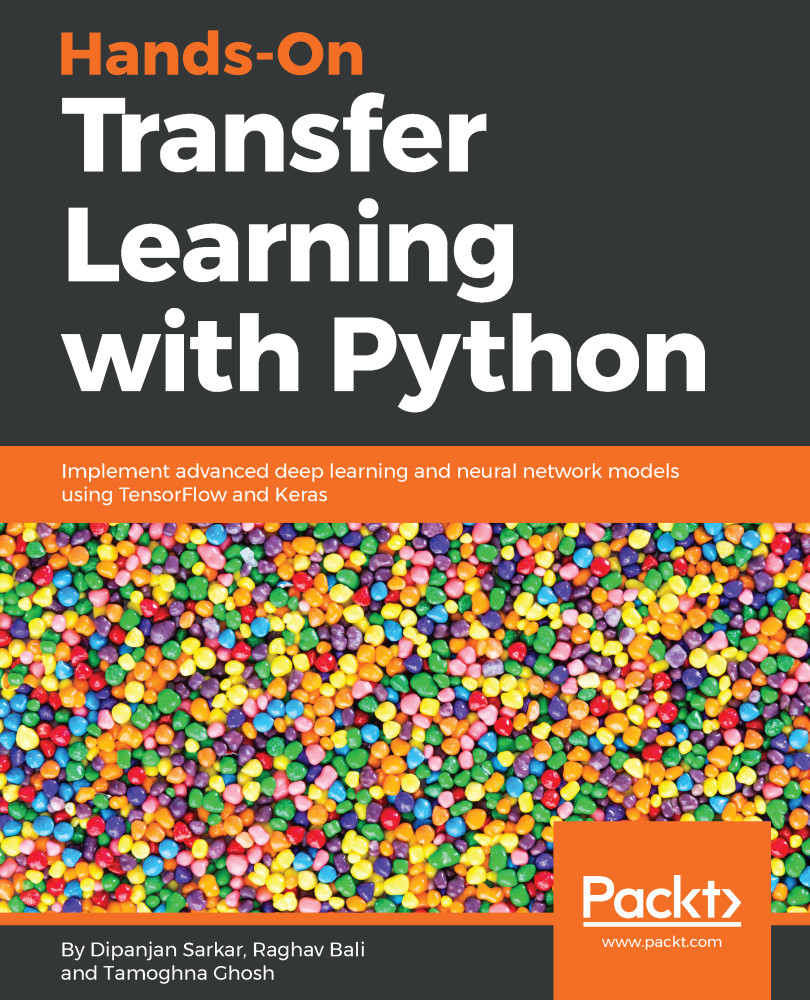
Hands-On Transfer Learning with Python
By :


Hands-On Transfer Learning with Python
By:
Overview of this book
Transfer learning is a machine learning (ML) technique where knowledge gained during training a set of problems can be used to solve other similar problems.
The purpose of this book is two-fold; firstly, we focus on detailed coverage of deep learning (DL) and transfer learning, comparing and contrasting the two with easy-to-follow concepts and examples. The second area of focus is real-world examples and research problems using TensorFlow, Keras, and the Python ecosystem with hands-on examples.
The book starts with the key essential concepts of ML and DL, followed by depiction and coverage of important DL architectures such as convolutional neural networks (CNNs), deep neural networks (DNNs), recurrent neural networks (RNNs), long short-term memory (LSTM), and capsule networks. Our focus then shifts to transfer learning concepts, such as model freezing, fine-tuning, pre-trained models including VGG, inception, ResNet, and how these systems perform better than DL models with practical examples. In the concluding chapters, we will focus on a multitude of real-world case studies and problems associated with areas such as computer vision, audio analysis and natural language processing (NLP).
By the end of this book, you will be able to implement both DL and transfer learning principles in your own systems.
Table of Contents (14 chapters)
Preface

 Free Chapter
Machine Learning Fundamentals
Deep Learning Essentials
Understanding Deep Learning Architectures
Transfer Learning Fundamentals

Unleashing the Power of Transfer Learning
Image Recognition and Classification
Text Document Categorization
Audio Event Identification and Classification
DeepDream
Style Transfer
Automated Image Caption Generator
Image Colorization
Other Books You May Enjoy


